Table of contents
Table of contents
Enterprise value meaning: Enterprise value is a financial reporting metric that considers both company equity and debt. This value would be the price to purchase the entire company, including all debt owed.
Understanding enterprise value is crucial to understanding the competitive landscape and potential acquisitions. For example, a critical factor in Google’s acquisition of YouTube in 2006 was understanding YouTube’s enterprise value, considering current numbers and future revenue.
Enhancing profitability is important in a growing mid-size business, and knowing how to leverage EV calculations is a part of that. Here, we'll explain what enterprise value is, explore use cases, and run through a real-world example.
Understanding enterprise value
Essentially, EV in finance is a company's total value, considering both equity accounts and debt. An EV can tell you:
- How much a company will cost to acquire, or how much your company will cost to be bought.
- Business valuation information for mergers.
- How your company is valued against competitors.
- If your company’s stocks are undervalued or overvalued.
To calculate a company’s EV, you’ll need four key pieces of information, some of which can be found on your balance sheet: market capitalization, total debt, cash, and cash equivalents.
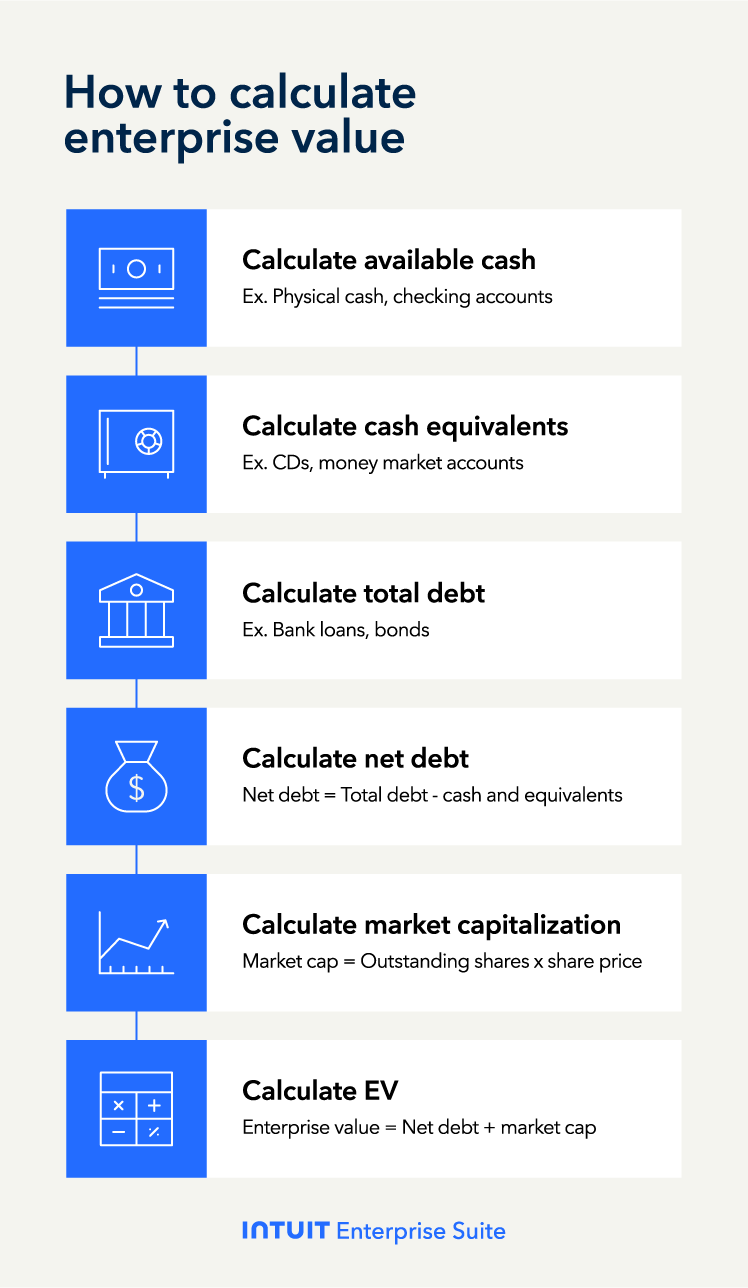
How to calculate enterprise value
Let’s tie all of this together with a real-world example to understand how to calculate enterprise value:
Let’s assume your company has the following information:
- Cash on hand: $7 million
- Cash equivalents: $2 million
- Total debt: $13 million
From here, we can start the total enterprise value equation by calculating your net debt:
Net debt = Total debt - cash on hand - cash equivalents
Net debt = $13 million - $7 million - $2 million
Net debt = $4 million
Now, to calculate your market capitalization:
- Outstanding shares: 5,000
- Share price: $100
Market capitalization = Outstanding shares x share price
Market capitalization = 5,000 x $100
Market capitalization = $500,000
Finally, let’s put it all together to calculate your enterprise value or the cost it would be to essentially purchase your business:
EV = Market capitalization + net debt
EV = $500,000 + $4 million
EV = $4.5 million
Therefore, your total enterprise value is $4.5 million.
Intuit Enterprise Suite customers are saying
"We’ve now been moved over to the Intuit Enterprise Suite. It has immediately solved the issues we’ve had as it relates to multi-entity. We were looking at something like Netsuite when all we need is consolidated financials and intercompany transfers via journal entries. Those needs are getting addressed now which is exciting for us."
- Matt Van Der Molen, CMO, Four Points RV Resorts
Enterprise value use cases
You’ve learned what enterprise value is and how to calculate it for your business. But what can you do with this information, and how can the EV formula benefit your company?
Financial ratios
Enterprise value is key to understanding your company’s overall financial well-being. A few ratios use EV and other financial values to determine total financial health.
Some of those ratios include:
- The EV/EBITDA ratio compares a business's EV to its earnings before interest, taxes, depreciation, and amortization (EBITDA) value.
- EV/Sales ratio depicts a company’s enterprise value against its total revenue.
- EV/FEC, which compares the EV to a company’s free cash flow.
 A business must consider all aspects of its finances to produce a full-scope financial health report.
Valuation methods
When valuing your company, it is vital to consider your enterprise value, as well as equity and debt, to get a holistic financial picture.
EV, along with the discounted cash flow (or DCF) analysis, is crucial to determining a business’s value. Here, your EV is considered a terminal value or the estimated future value of your cash flows beyond the projection period. These values can help determine your company’s intrinsic value or underlying worth.
With leveraged buyouts (LBOs), EV displays the amount of debt that would be taken on in the event of a buyout and helps assess the deal's financial feasibility.
Mergers and acquisitions
Enterprise value is a crucial financial figure when considering mergers and acquisitions. It helps provide a company's complete financial picture and determines the acquisition pricing, which is nice to have when considering such strategic moves.
Overall, having EV information can help business owners make informed decisions about mergers and acquisitions, particularly if they will make a decent financial investment.
Enterprise value can help determine how much debt financing is needed to acquire another business. In general, a higher EV could suggest that more debt financing will be necessary.
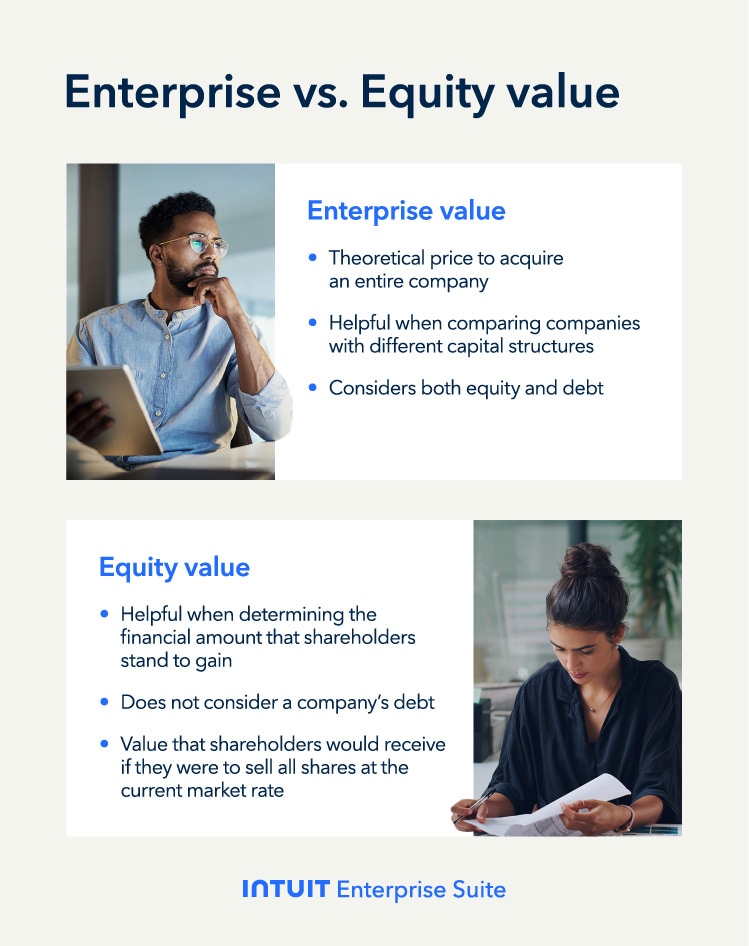
Enterprise value vs. equity value
While enterprise value and equity value are both used to determine a company’s business valuation, there are some differences between the two.
Enterprise value considers a business's market capitalization and net debt, taking into account both equity and debt.
Equity value is the result of taking the number of outstanding shares by the current market price per share. This is also known as market capitalization or market cap.
Be sure to calculate the equity value (or market capitalization) before calculating the enterprise value.
Another key distinction to make is between EV and the price-to-earnings (P/E) ratio. The P/E ratio focuses on the relationship between price and earnings by dividing the price per share by earnings per share. In comparison, EV provides a broader view of a company's overall value by considering both assets and debt.
Limitations of enterprise value
While understanding what enterprise value is and how it can give you a good overview of your company’s financial health, there are some limitations:
- Assumptions: Your enterprise value assumes that the given market will accurately value your future prospects.
- Qualitative information: While EV takes financial information into consideration, it doesn’t account for any qualitative factors like trends or competitive advantages.
- Short-term changes: Since the market cap is a major contributing factor, your EV can drastically change due to short-term market changes.
- Capital structure: Since debt plays a significant role, the EV value could be lower than expected, even if your business structure is thriving.
- Not for everyone: While EV is a great way to gauge your business's performance, it might not be a perfect indicator of financials for every industry, especially those with intangible assets like copyrights and other intellectual property (IP).
Thankfully, with the help of powerful financial tools, you can rest assured that these limitations will be minimal.

Boost profitability and enhance productivity
By keeping everything in one place, you can calculate your enterprise value and other vital financial numbers quickly and efficiently to raise your business equity. Utilize an all-in-one enterprise solution to access and leverage your company’s financial reporting easily.
Intuit Enterprise Suite customers are saying
"[Intuit Enterprise Suite has been] a solution for the thing that we needed right away, which is a consolidation of information, the ability to look across our organization, and get that data in a format so we could move quickly."
- Ed Sutton, Owner & CFO, MDR Realty LLC

What is enterprise value FAQ
Check out upcoming events and learn more about Intuit Enterprise Suite.

Customer stories

Case study
Business growth guide: Proven strategies to scale your business

Case study
How FEFA Financial scaled up with Intuit Enterprise Suite (No ERP migration needed)

Case study
Case study: Fire & Ice transforms multi-entity challenges with Intuit Enterprise
October 25, 2024

Case study
Four Points RV Resorts review: Why they chose Intuit Enterprise Suite over NetSuite
October 25, 2024

Case study
Humble House Foods case study: How they improved visibility & simplicity using Intuit Enterprise Suite
September 24, 2025
More on acquisitions & mergers

Funding ownership
Venture capital funding: What is VC funding, how to choose investors & negotiate equity
January 27, 2025

Funding ownership
Horizontal integration: Definition, pros & cons, vertical vs. horizontal integration comparison
October 23, 2025

Acquisition mergers