Table of contents
Table of contents
When I first started my business, managing finances felt like trying to juggle flaming torches. There were always a few too many in the air, and I was terrified one would fall and burn everything down. I was bootstrapping, trying to manage every dollar, and though I had some wins along the way, I quickly realized that as a business grows, so do the complexities of managing it.
Scaling a business isn’t just about adding more revenue— it’s about making sure your financial house is in order. That's why these three bold moves can make all the difference for CFOs and business leaders aiming to reach that next level of revenue— whether you're at $3 million, $30 million, or beyond.
1. Streamline financial operations for scalable growth
When you’re first starting out, financial management is pretty straightforward. You’re just keeping an eye on a few accounts, tracking expenses, and making sure your books are balanced. But as your business starts to grow, things get complicated, and fast. Suddenly, you might be dealing with multiple revenue streams, entities, and expenses from every corner of the business, and you need to manage profitability at scale.
I’ve been there. As my own businesses grew, I learned (the hard way) that processes that worked when I was pulling in six figures can start to crack under the weight of millions in revenue. To keep everything under control, you have to streamline your financial operations. This means centralizing your finances so that everything— cash flow, accounts, budgeting — can be managed in one place. Otherwise, you're just creating chaos as you grow.
One of the best ways you can simplify and centralize financial operations is with tools like Intuit’s Enterprise Suite. It’s designed for scalability, offering customizable reporting and automation tools that make managing complex financial structures much simpler. You get greater control over expenses, budgeting, and reporting so you can focus on what really matters: growing your business.

2. Automate to reduce overhead and enhance productivity
Automating parts of your business is one of the biggest power moves going. One of the first revelations I had as a business owner was realizing how much time and money we waste on repetitive tasks. Now those tasks can be automated. When I say my business practically runs itself, I’m not kidding. I set up systems and processes that automate routine tasks like payroll and invoicing, which saves a ton of time and cuts down on overhead. The beauty of automation is that it frees up your team to focus on more strategic initiatives rather than getting bogged down in daily operations.
This is a game-changer. Automating tasks like invoicing and payroll means that your financial operations are efficient and error-free, and your team can dedicate more energy to scaling the business.
Intuit Enterprise Suite comes with advanced automation features that handle all the heavy lifting when it comes to payroll, invoicing, and paying bills. Whether you’re managing multiple locations or just trying to reduce the manual data entry that eats up hours, Intuit Enterprise Suite takes care of it for you. This way, CFOs can shift their focus from operational headaches to the big-picture strategies that drive growth.
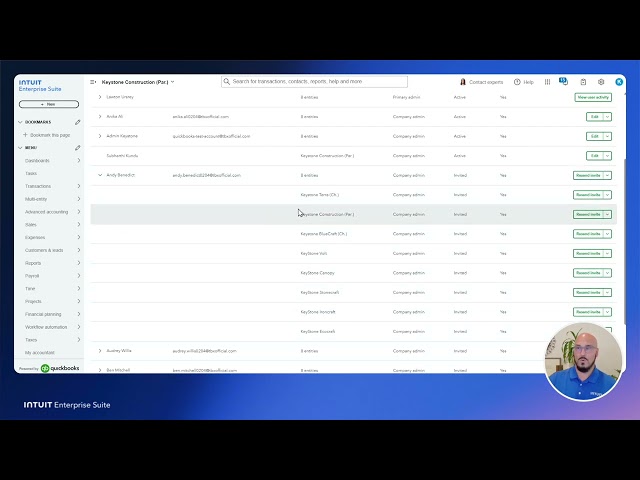
One of the first revelations I had as a business owner was realizing how much time and money we waste on repetitive tasks. Now those tasks can be automated. When I say my business practically runs itself, I’m not kidding.
3. Improve cash flow management for sustainable growth
Cash flow is like oxygen for a business. You don’t really think about it when you have plenty, but when it’s running out, it’s all you can focus on. As businesses scale, managing cash flow becomes more critical and more challenging. Growth can be a double-edged sword. It’s exciting to bring in more revenue, but if your expenses start to outpace what’s coming in, you can quickly find yourself in trouble. I’ve seen businesses fail because they didn’t get a handle on cash flow, even when they were making good money.
Ensuring businesses are set up for sustainable growth by keeping cash flow healthy and predictable is one of the cornerstones of success. This means having a clear understanding of where money is being spent, how it's coming in, and how to forecast future needs. If you can’t manage your cash flow, all the growth in the world won’t matter because you won’t have the capital to keep things moving forward.
Intuit Enterprise Suite offers a way to track and manage cash flow with real-time insights and advanced reporting features. You can generate cash flow forecasts, track inflows and outflows, and get a detailed breakdown of where money is being spent. This level of visibility lets you make informed decisions, ensuring that cash flow stays healthy and that the business is prepared for sustainable, long-term growth.
Why these moves matter now
In business, bold moves get results. Business leaders everywhere are evaluating how well their companies are set up for the next year. These three moves, streamlining financial operations, automating processes, and improving cash flow management aren't just good ideas— they’re essential steps for scaling up without the wheels coming off. As your business grows, so do the demands on your financial systems. If you don’t make the bold moves now, you’re setting yourself up for problems down the road.
Wishing you success and sustainability.
-Mike

Disclaimers:
[1] Money movement services are provided by Intuit Payments Inc., licensed as a Money Transmitter by the New York State Department of Financial Services.
Check out upcoming events and learn more about Intuit Enterprise Suite.

Customer stories

Case study
Case study: Fire & Ice transforms multi-entity challenges with Intuit Enterprise
October 25, 2024

Case study
How FEFA Financial scaled up with Intuit Enterprise Suite (No ERP migration needed)

Case study
Four Points RV Resorts review: Why they chose Intuit Enterprise Suite over NetSuite
October 25, 2024

Construction
Migrating to Intuit Enterprise Suite took 2 hours (with zero disruption) for this aspiring $50M revenue business
April 25, 2025

Case study
Humble House Foods case study: How they improved visibility & simplicity using Intuit Enterprise Suite
September 24, 2025
More Ask the Expert

Ask the expert
Hector Garcia CPA at QuickBooks: How to spot trends & use them to scale
February 5, 2025

Thought leadership
David Meltzer: Daily habits & formula for entrepreneurial growth
December 18, 2024

Ask the expert
Intuit Enterprise Suite feedback: How IES fixed an age-old problem: “Why does my business have so many software applications?”
October 29, 2024