Table of contents
Table of contents
As artificial intelligence (AI) becomes more accessible, the construction industry is increasingly leveraging it to streamline operations. By integrating AI into their core technologies, construction companies are transforming traditional workflows and uncovering new growth opportunities.
In the sections below, you’ll see how AI is helping construction leaders boost productivity, improve cost control, and make smarter, faster project decisions. With that foundation, let’s look at where AI is already delivering measurable impact.

What is the purpose of AI in construction?
AI is a technology designed to mimic human intelligence and combine it with the raw computing power of a machine. In the context of construction, AI can be invaluable throughout project lifecycles. For example:
- In preconstruction, it can streamline design development, improve risk analysis, and organize scheduling strategies
- During construction, it can monitor progress, detect safety risks, and anticipate material shortfalls or equipment failure
- In postconstruction, it can continue to provide value by predicting maintenance needs and optimizing energy usage
Project complexity and stakeholder disagreements have historically hindered AI adoption in the construction industry. However, various pressures, such as rising costs, supply chain issues, and labor shortages, are now pushing firms to evolve.
At the same time, the widespread adoption of generative AI among consumers and across industries is helping shift construction firm attitudes toward the technology.

The global AI in construction market was valued at $3 billion in 2023 and is expected to expand at a compound annual growth rate of 30% through 2030 and reach a value of $17 billion.
5 common applications of AI in construction
There are many potential applications for AI in construction. Understanding them can help you identify your firm's most valuable use cases. To that end, let’s explore five of the most common:
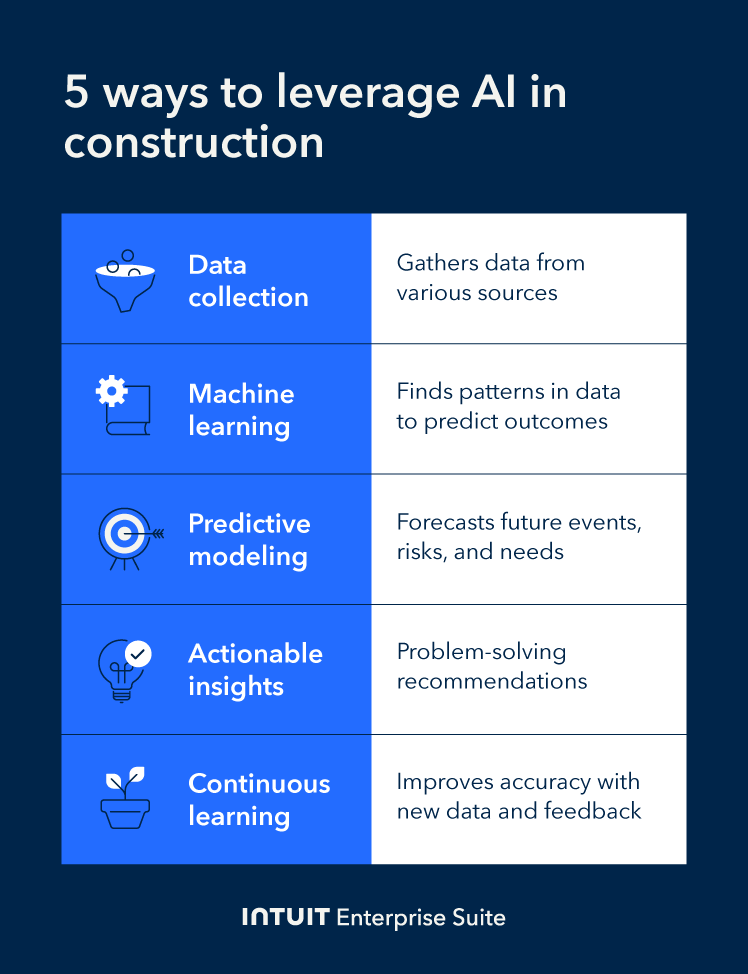
1. Data collection and integration
A critical first step when using AI in construction is to build a robust foundation of construction industry data. After all, the technology needs large volumes of high-quality data to work well.
Fortunately, modern construction ecosystems tend to include many different data sources, such as:
- Internet of Things (IoT) devices
- Sensors on manufacturing equipment
- Drones with high-definition cameras
- Project management software
- Historical project data
- Financial and procurement systems
AI excels at gathering data from these disparate sources and integrating it into a holistic view of a construction project.
Some solutions can even interface with Building Information Modeling (BIM) technology, which creates digital representations of construction projects in up to five dimensions—including cost and time.
2. Machine learning and pattern recognition
After collecting and integrating data from across your construction ecosystem, AI can process the information using machine learning.
That typically involves identifying complex patterns, correlations, and anomalies that human analysts might miss, then using those insights to predict outcomes or make recommendations.
Notably, two different types of machine learning algorithms are responsible for each step:
- Unsupervised learning: Uses unlabeled data to find patterns and relationships between data points without explicit guidance
- Supervised learning: Uses labeled data to train an AI model to predict outcomes and classify information
Despite these differences, all machine learning algorithms become increasingly efficient, accurate, and insightful as you expose them to more data. In other words, they only get smarter over time.
3. Predictive modeling and forecasting
Once an AI-powered business management platform has identified meaningful patterns and relationships in your data through machine learning, it can use those insights to build accurate predictive models.
These models can forecast future events and outcomes relevant to your construction projects. For example, that often includes predicting:
- What equipment may be nearing failure
- Where safety incidents are likely to occur
- When you might experience project delays
- How much material do you need to complete a project
- When you’re at risk of going over budget
4. Actionable insights and recommendations
Fortunately, AI doesn’t stop at making predictions. It can also provide actionable insights, including specific recommendations for avoiding or overcoming expected issues.
For example, that might include:
- Reassigning workers to improve productivity
- Adjusting the schedule to avoid a weather delay
- Flagging a high-risk area for additional safety checks
These types of recommendations can significantly enhance the decision-making process, helping construction teams reach well-informed conclusions and implement intelligent strategies faster.
That said, the technology isn’t infallible, so it’s still necessary for project managers to validate AI construction suggestions before committing.
5. Continuous learning and improvement
One of the most powerful applications of AI in construction stems from the technology’s ability to learn and improve as it processes new project information and user feedback.
Over time, this iterative process refines the accuracy of your AI’s predictive models, resulting in increasingly valuable insights and recommendations. Every job becomes an opportunity to learn new lessons: what worked, what didn’t, and what you could do better next time.
AI systems automatically incorporate these ideas into their analytical processes and apply them to future projects, allowing construction teams to build on past experiences continuously.

Key benefits of artificial intelligence in construction
Previously, we discussed common uses for AI in construction to help you identify those most relevant to your business. Next, let’s explore their benefits in more detail so you can narrow your list down further.
Enhanced planning and design
With its ability to rapidly analyze large volumes of historical data, AI makes preconstruction processes like project planning and building design much faster and more precise.
For example, AI tools can automatically:
- Detail current resources and estimate future project costs
- Evaluate multiple schedule scenarios and identify the most efficient
- Optimize design iterations for affordability, energy efficiency, or structural strength
AI-powered 3D modeling tools can even analyze comprehensive mechanical, electrical, and plumbing (MEP) plans, then suggest work sequences that increase efficiency and minimize delays.
Improved safety
Many construction tasks put workers in unavoidably dangerous situations. However, AI can be a powerful tool for predicting safety risks and avoiding accidents that could result in injury.
For example, AI can monitor equipment health, schedule maintenance to prevent failure, and identify hazardous conditions or unsafe practices—like a lack of personal protective equipment (PPE)—in real time.
Cost reduction
By analyzing large amounts of historical data, AI can estimate project costs faster and more accurately than traditional budgeting methods. This can go a long way toward minimizing wasted materials.
In addition, AI can monitor resource usage, contract labor rates, and material costs in real time, helping you identify potential cost overruns early, so you can prevent them from disrupting project profitability.

Increased productivity
AI can automate many time-consuming tasks, significantly increasing your overall productivity. For example, you can let AI systems handle materials selection, quote requests, and scheduling, freeing project managers to focus on more valuable work.
You can also generate productivity gains with AI by optimizing various processes, such as resource allocation, preventive maintenance, and the guidance of semi-autonomous robotic equipment.
Quality control
AI systems have various capabilities that can help maintain quality throughout the project lifecycle. For example, some of their potential contributions to quality control include:
- Analyzing designs and flagging conflicts to prevent costly rework
- Helping robots perform precise construction tasks like bricklaying
- Monitoring job sites through sensors and drone cameras to ensure work meets standards and matches blueprints
Predictive maintenance
AI systems can use historical information and real-time data from embedded sensors—such as those in cranes, bulldozers, and excavators—to predict maintenance needs with remarkable accuracy.
This allows project managers to schedule repairs proactively, reducing the risk of equipment failure and minimizing downtime.
Energy efficiency and sustainability
AI can be surprisingly helpful in making construction projects more energy efficient, reducing their environmental impacts, and enhancing regulatory compliance efforts.
For example, some AI’s greatest potential contributions to a project’s sustainability include:
- Analyzing data to help optimize HVAC systems
- Modeling energy needs for prospective building designs
- Suggesting concrete mixes that produce lower carbon emissions
- Enabling the use of sustainable materials through more accurate cost predictions
85% of construction professionals report that some or all of their activity is in sustainable construction projects as of 2024.
Project management optimization
Project management is all about predicting timelines, costs, and potential disruptions, making it one of the areas where AI truly shines. Thanks to machine learning, AI systems are much better at forecasting these things than human managers.
In addition, AI can automatically generate work schedules, identify bottlenecks, and adjust resource allocation in real time. When incorporated into centralized data platforms, it can significantly streamline collaborative workflows.
Advanced analytics
AI-based data analytics can be invaluable for construction firm owners and contractors alike. These systems can process vast amounts of data from across your construction ecosystem, including historical projects, BIMs, IoT devices, and on-site sensors or cameras.
As a result, they can identify patterns from which human analysts can extract insights that drive improvements in various areas. These often include scheduling, safety, quality control, and cost management.

AI use cases across the construction project lifecycle
AI can provide value throughout the project lifecycle. Understanding how it supports preconstruction, construction, and post-construction tasks can help you determine where to focus your adoption efforts. Let’s explore some of its specific use cases at each stage.

Preconstruction
AI is playing an increasingly central role in various preconstruction processes, such as design development, contractor selection, risk analysis, scheduling, and permitting.
For example, some specific uses include:
- Feasibility studies: AI systems can conduct granular feasibility studies, considering financial, market, and environmental factors to determine whether a project is viable.
- Materials analysis: AI-powered tools can optimize your material selection, automatically recommending the best options based on durability, sustainability, and cost.
- Cost prediction: AI image recognition software can review project blueprints and estimate total costs based on historical data and real-time market rates.
Construction
During the active building phase, AI can support various aspects of your construction operation. This can boost overall productivity, help manage risks, and improve eventual outcomes.
For instance, here are some of its potential contributions:
- Predictive analytics can help companies optimize the supply chain by anticipating disruptions and equipment maintenance needs
- Automated drones can monitor worksites for unsafe conditions and track project progress
- AI-powered central project platforms can coordinate work sequencing and streamline collaboration
Post-construction (maintenance)
Even after you’ve finished building, AI can still add value to a construction project. Its primary contribution is typically the scheduling of predictive maintenance for machinery and systems, extending their useful lives and minimizing downtime.
However, you can also use AI to monitor energy usage and optimize it for cost or carbon emission reduction. In addition, your AI algorithms will likely carry forward any lessons learned from the construction to future projects, continuously improving operational efficiency.
The future of artificial intelligence in construction
We’ve only begun to see the full potential of AI in construction. As the construction technology trends evolve, they will likely inevitably transform how the entire industry does business. Let’s take a closer look at what that might involve.
Augmented human expertise
You may be worried that AI construction software threatens traditional workers, but it’s primarily designed to support humans—not replace them. Even as AI’s capabilities expand, human judgment and experience will likely remain crucial in decision-making and oversight.
For example, as AI-powered robots become more common, they'll likely take over dangerous, physically demanding, and repetitive construction tasks, freeing humans to assume more complex roles.
In July 2025, EngineAI raised roughly $139.7 million to fund its development of viable humanoid robots.
Deeper integration with existing tools
Businesses are already finding new ways to integrate AI with other technologies, and that process can only accelerate. Eventually, AI features will likely be woven seamlessly into other existing tools, such as BIM solutions, drones, and robotics.
This can increase the capabilities of all construction technology examples and empower managers and workers to effectively leverage AI's power without extensive training.
Advanced visualization
As BIM solutions integrate more AI features into their systems, they’ll enable increasingly detailed visualizations. AI will likely automatically incorporate and update granular data in real time, such as material costs, job progress, or environmental conditions.
Digital models will likely also become more interactive and intelligent, benefitting every project lifecycle stage. For example, designers will likely be able to test out iterations more easily. Meanwhile, builders will likely be able to follow smarter work sequences, and managers may be able to predict maintenance needs with pinpoint accuracy.
Autonomous systems and robotics
Construction worksites are growing increasingly automated. Robots already handle many repetitive or hazardous tasks, such as bricklaying, excavation, and demolition.
AI will likely empower self-operating machines to take on more dynamic and complex tasks, especially those that are potentially dangerous to human workers. This will likely increase productivity and address labor shortages, and it will likely also help minimize accidents and injuries.
Data-driven insights for strategic decision-making
Remember, AI’s fundamental purpose is to mimic—and eventually surpass—human intelligence. As it becomes more advanced, its ability to analyze information, extract meaningful insights, and recommend smart strategic decisions could grow exponentially.
In addition to broader technological advancements, much of this progress will likely come from the lessons AI solutions learn automatically by studying historical data from completed projects.
Boost productivity and enhance profitability
AI in construction is helping firms increase productivity, improve safety, and reduce costs. It has applications across the project lifecycle, such as improving design development and predicting maintenance needs.
AI can also streamline your financial management, increasing productivity and saving time. For example, Intuit Enterprise Suite includes powerful AI agents that can automate accounting and finance processes. These capabilities help construction CFOs protect margins, manage risk, and gain real-time control over project finances.

Check out upcoming events and learn more about Intuit Enterprise Suite.

Customer stories

Case Study
How FEFA Financial is growing with Intuit Enterprise Suite—without migrating to an ERP

Case Study
How this mission-driven, employee-owned company created efficiencies with Intuit Enterprise Suite
October 25, 2024

Case Study
Why this camping business chose Intuit Enterprise Suite over NetSuite
October 25, 2024

Case Study
Migrating to Intuit Enterprise Suite took 2 hours (with zero disruption) for this aspiring $50M revenue business
April 25, 2025

Case Study
Humble House Foods case study: How they improved visibility & simplicity using Intuit Enterprise Suite
September 24, 2025
More on construction

Guide
2025 Construction technology trends report: What are the opportunities of AI in construction?

Construction
ERP for construction: Managing costs & keeping building projects profitable
September 18, 2024

Construction
3 common mistakes preventing profitable growth in your construction business
November 20, 2025

Construction
Risk management in construction: How to ensure construction compliance & mitigate project hazards
May 18, 2025