Table of contents
Table of contents
Working capital challenges can happen when you don’t have a current, accurate view of available cash after factoring in committed spend and uncleared payments. Cash position reporting gives you valuable information to help you protect company liquidity and put capital surplus to work early.
However, the QuickBooks Business Solutions Survey found that 45% of respondents cited inadequate reporting and analysis within their firms. For finance leaders, weak reporting undermines cash position reporting as a dependable tool for short-term decisions.
In this article, we'll define what cash position reporting is and explain how it differs from cash flow. We'll also show how to use cash position ratio (CPR) and current ratio to read risk, and outline how Intuit Enterprise Suite can support cash position reporting within your organization.

The purpose of cash position reporting
Cash position reporting is a precise, short-term view of an enterprise’s immediate liquidity and capital availability. Updated daily, it shows how much cash your organization has available right now and how much cash you’ve committed in the near term.
You can use cash position reporting to:
- Identify the company's ability to pay taxes, payroll, debts, and accounts payable on time, without requiring last-minute borrowing
- Reduce liquidity risks by spotting timing gaps early
- Manage working capital more effectively by deciding which payments to make, hold back on, or renegotiate
- Reveal available capital for growth strategies, like project investments
- Spot and investigate accounting discrepancies early by reconciling bank activity daily
The operational value of cash position reporting is that it offers a daily view of liquidity that reconciles with your bank activity. This gives accountants a number they can trust when timing vendor payments.
For example, an enterprise manufacturer has a large supplier run, payroll, and statutory payments to meet within the same week. Their cash position reports show that the amount left in the operating account will go below the minimum liquidity buffer because of the timing of expected inflows.
In this case, the treasury could choose the lowest-cost action to mitigate, like using the revolving credit facility for a few days or sweeping surplus cash from another group company.
What's the difference between cash position vs. cash flow?
A cash position report is a snapshot, showing where your cash balances are at a single point in time, and part of a finance team’s cash management reporting tool kit. You see what’s in your accounts today, what you’ve already committed to spending, and where you’ll land over the next few days as those receipts and payments settle.
On the other hand, cash flow statements track the movement of cash in and out of the company through operating, investing, and financing activities.
They highlight trends in business performance as well as meeting compliance and reporting needs.
Here’s a breakdown of the main differences between the two:
Cash positioning reporting tells you whether you can meet obligations as they fall due and what actions to take if payments don’t arrive on time. On the other hand, cash flow statements provide a longer view of how the business generates and uses capital.
Key metrics for cash position analysis
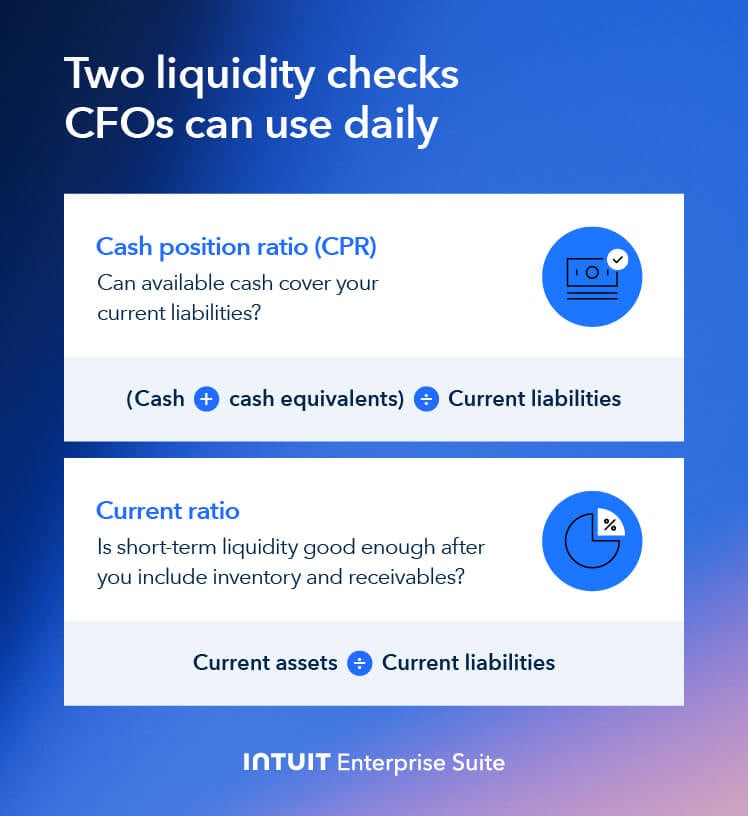
Once you have a daily cash position, the next step is analysis. The most useful metrics tie the cash you can access now to the current liabilities you need to settle.
With both, you can see what you can pay safely, what you might need to hold back, and whether you have more cash than you need for the current payment cycle.
Cash position ratio (CPR)
Cash position ratio (CPR) measures how well your cash and cash equivalents cover your current liabilities. Calculate it using this formula:
CPR = (Cash + cash equivalents) ÷ Current liabilities
When using CPR in decision-making, base it on cleared and available cash. Exclude unreconciled payments, cash that you’ve earmarked and anything that isn’t available for the next payment cycle.
The often cited ideal “target” figure for CPR is 2:1, but that benchmark won’t work for all businesses. Instead, set a CPR floor that reflects the cash the company needs to fund the next cycle. To do that, use this formula:
CPR floor = Cash floor ÷ Current liabilities
Run a CPR calculation every day and then compare the result to your CPR floor to get a quick check on headroom.
Let’s see how a contractor might use this method. A multi-entity construction firm has:
- Cash and equivalents: $90M
- Current liabilities: $80M
- Current CPR: 1.13x ($90M ÷ $80M)
- Cash floor (next 30 days with the buffer): $85M
- CPR floor: 1.06x ($85M ÷ $80M)
- Headroom above floor: $5M ($90M − $85M)
If CPR heads toward or goes below the floor, they should tighten payment releases or seek short-term funding like a revolving credit line. If it’s comfortably above, they have more cash than they need for the next cycle and can put it to work instead.
Current ratio
The current ratio is a broader measure of company liquidity:
Current ratio = Current assets ÷ Current liabilities
Lenders often use current ratios for broad liquidity checking. But, unlike CPR, it includes inventory and receivables, so it can look healthy even when cash is tight.
Here’s an example scenario involving a manufacturer:
- Current assets: $320M
- Current liabilities: $190M
- Current ratio: 1.68x ($320M ÷ $190M)
In this situation, the firm looks robust on paper. However, it may be that a large share of its current assets is work-in-progress, slow-moving inventory, or 60-day receivables.
CPR tells you if cash on hand covers what’s due, and current ratio assesses if the company is strong on paper. Typically, companies use both ratios together for a comprehensive analysis.

5 critical benefits of cash position reporting for CFOs
Accurate cash position reporting is more than regular and diligent balance checking. When you update your cash position report every day after reconciling your bank activity, it becomes a tool for strategic enterprise growth.
Below, discover the five main benefits:

1. Strengthened liquidity management
Daily visibility into your cash position helps CFOs stay ahead of what’s due rather than reacting when cash gets tight. You can see cash on hand, near-term spending commitments, and timing gaps that may otherwise only become clearly visible when you’re due to make payments.
This knowledge helps you avoid the ‘surprise scramble’ to find funding, eliminating the need for high-interest, short-term credit.
CFOs and treasurers rank cash and liquidity management as a top priority amid rising costs, rate uncertainty, and volatility, according to PwC’s Global Treasury Survey. That focus reflects the risk of not being paid on time while still having obligations to meet.
2. Strategic capital deployment
According to the EACT Treasury Survey, over 50% of treasury teams report that they have excess capital. Cash position reporting allows you to identify whether your company is operating at a surplus and by how much.
There are several ways to deploy that capital, but commonly lucrative ones include paying down debt early, building a seasonal buffer, or funding future projects.
If you want a simple way to judge whether those choices improved the core business, net operating profit after tax (NOPAT) is a useful measure. It shows profit from day-to-day activity after tax, excluding interest and other financing effects, so you can see the underlying performance.
3. Faster fraud and error detection
Many companies using cash position reporting reconcile daily. This means that finance teams can spot problems like bank errors, unauthorized activity, and duplicate payments faster. In many cases, you may still have time to reverse or correct them.
Cash position reporting can also help your teams spot certain instances of fraud faster, which can minimize financial losses. In fact, the Association of Certified Fraud Examiners reported that occupational fraud is a significant problem. The combined cost of 1,921 frauds from 138 countries totaled $3 billion.

Build an “exceptions” list for daily reconciliation runs. Focus on factors like new payees, duplicates, missing receipts, or unexpected fees as potentially suspicious transactions. Then, treat anything on the list as a priority to investigate and clear before you sign it off.
4. Improved credibility with stakeholders
Investors and lenders consider accurate, regularly updated cash reports a sign that the company has robust control over its liquidity and a marker of good governance.
Because you can share your consolidated cash position and headroom with supporting numbers, this kind of reporting simplifies covenant negotiations with relationship banks.
5. More accurate forecasting
Accurate forecasting is easier when finance teams work from reconciled daily cash positions rather than assumptions. You have a clear view of what happened today, as you can see what came in, what went out, and what changed because expected receipts or payments arrived earlier or later than planned.
This improves planning and budgeting because your forecasts reflect the real-time movement of cash and not the best-case timing. It also makes variance analysis easier because you can explain what changed and update the timing assumptions behind the forecast.
Sixty percent of treasury teams, responding to an AFP survey, indicated that cash or liquidity forecasting was among their “most challenging tasks.” PwC’s Global Treasury Survey, cited earlier, found that 76% cite poor data quality and 53% lack the right tools.
The solution here is to treat your reconciled daily cash position as a source of truth, then run a cash flow variance analysis based on what actually cleared.
How to implement cash position reporting with Intuit Enterprise Suite
To make strategic, informed financial decisions for your company, you need enterprise-level software with highly efficient, real-time cash position reporting. According to a Forrester TEI study, the centralized reporting capabilities of Intuit Enterprise Suite save companies a projected three-year present value of $139,940.
In practical terms, that involves:
- Offering consolidated reporting across all of your entities
- Automating your bank feeds and reconciliation so the cash position you see matches what’s actually cleared
- Providing visibility into what cash you have available, what you’ve committed, and what headroom still remains
All three capabilities are core parts of Intuit Enterprise Suite, allowing CFOs to run daily cash position reports that they can trust and act on.
Here’s how the platform delivers for finance teams:
Step 1: Unify reporting across all entities and subsidiaries
Finance leaders need a single source of truth to make fast, confident liquidity decisions. But, in EY’s DNA of the CFO survey, 80% of finance departments get their data from different parts of the business. Stitching together spreadsheets or manually checking intercompany balances is slow, error-prone, and difficult to scale.
Intuit Enterprise Suite provides the consolidated reporting and automated intercompany eliminations needed to manage multiple entities in one place. By unifying data that is typically siloed across disparate cash management tools or types of legacy ERPs, the suite gives finance leaders a real-time view of global liquidity.
This multidimensional accounting lets you roll up data and break it down by entity or region without having to rebuild reports from scratch. So intercompany activity doesn’t skew the consolidated view, and you get audit-ready figures that you and other leaders can trust.
To keep the group cash position report consistent and comprehensible, run it the same way every day. Pick a cut-off time, give one person ownership, and roll late entries into the following day’s report.
Step 2: Automate bank feeds and real-time reconciliation
A daily cash position only works if it stays tied to what has actually cleared. Depending on the method of payment, sales that show as received in your general ledger may distort your cash positions because the remittance has not arrived yet. Examples include credit card settlement windows and ACH payments.
Cash management solutions like Intuit Enterprise Suite reduce reliance on manual uploads by automating bank connectivity and daily reconciliation workflows.
It does this by connecting to company bank accounts through secure API-based bank feeds. With accounts mapped at setup, the system automates allocations from bank-feed activity, handling all debits and credits. This linked transaction data then flows back into your consolidated reports without the need for manual uploads.
From there, automation handles the heavy lifting. The platform incorporates and matches financial data so your finance team can focus on exceptions like missing items, duplicates, unexpected fees, and timing mismatches.
The aim is to ensure you base the cash figure you use for CPR, available cash, and payment timing on reconciled and cleared cash—not estimates.
Step 3: Seamless integration for strategic capital movement
Intuit Enterprise Suite connects the daily view to the forward view, so you can see what’s coming and act earlier. Forecast outputs feed directly into your financial planning and analysis (FP&A) models, or they can trigger treasury alerts and thresholds.
That means you see timing pressures when there are still options to manage them. Otherwise, balance and transaction visibility delays can compromise liquidity management, leading to lower investment returns and higher borrowing costs.
At this point, cash management shifts from reactive to proactive and should involve:
- Using cash forecasting to look ahead at the next payment cycle and spot timing risk early
- Setting alerts or thresholds to pause payment runs, speed up collections, or trigger short-term funding
- Moving faster on surplus cash by paying down debt, building a seasonal buffer, or funding planned work

When you schedule a demo, you agree to permit Intuit to use the information provided to contact you about Intuit Enterprise Suite and other related Intuit products and services. Your information will be processed as described in our Global Privacy Statement.
Boost productivity and enhance profitability
Cash position reporting helps you protect company liquidity and put genuine surplus cash to work without waiting for month-end. To maintain a consistent, integrated daily view across entities, choose a system that pulls the data together and keeps it current.
Explore how Intuit Enterprise Suite supports decision-grade cash reporting at scale.
Check out upcoming events and learn more about Intuit Enterprise Suite.

Customer stories

Case Study
How FEFA Financial is growing with Intuit Enterprise Suite—without migrating to an ERP

Case Study
How this mission-driven, employee-owned company created efficiencies with Intuit Enterprise Suite
October 25, 2024

Case Study
Why this camping business chose Intuit Enterprise Suite over NetSuite
October 25, 2024

Case Study
Migrating to Intuit Enterprise Suite took 2 hours (with zero disruption) for this aspiring $50M revenue business
April 25, 2025

Case Study
Humble House Foods case study: How they improved visibility & simplicity using Intuit Enterprise Suite
September 24, 2025