Table of contents
Table of contents
Key takeaways:
- Multi-entity complexity is accelerating because of M&A growth, decentralized spending, and expanding regulatory obligations.
- Every new entity puts finance teams under pressure with extra consolidation responsibilities.
- Current CFO financial strategy centers on creating the financial architecture required to absorb growth without losing visibility, control, or planning capacity.
Finance leaders are the first to feel the strain when a multi-entity organization grows faster than its financial structure can keep pace with. A strong CFO financial strategy addresses that directly, building the governance and reporting architecture that keeps the organization stable as it scales.
In Intuit's Enterprise Technology Benchmark report, 62% of leaders expect to outgrow their current technology within 12 months, rising to 73% among multi-entity businesses. CFO strategy is no longer just about reporting/planning; it's about designing financial architecture, controls, and data systems to scale.
The question is whether your financial strategy is set up to absorb that growth—or whether it's already falling behind.

3 structural drivers behind the 2026 surge in financial complexity
External market forces are fundamentally changing the profile of mid-market firms. The financial complexity they create leads to several problems, and the consequences stack up across every entity on the books.
Three structural factors that are converging in 2026 are:
1. The acceleration of M&A and inorganic growth
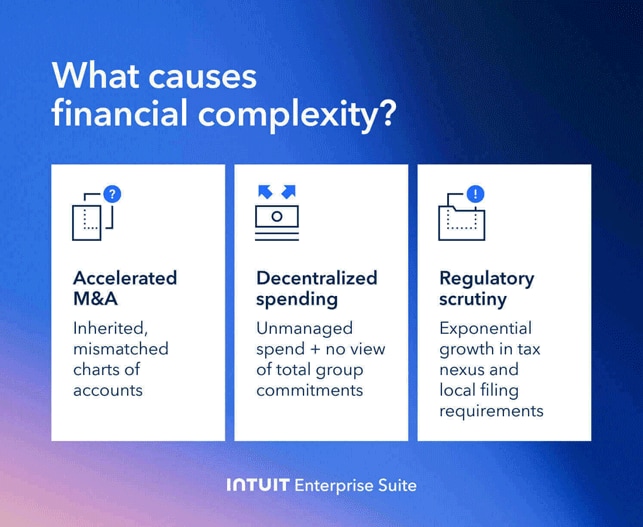
Every acquisition brings inherited charts of accounts, vendor lists, and payroll cycles that don't match the parent organization's structure. That debt is accumulating fast, with 80% of corporate dealmakers expecting to increase their deal volume in 2026, according to Deloitte.
The consequences are already showing up in the data. In Intuit's Enterprise Technology Benchmark, 80% of multi-entity firms report bottlenecks in managing intercompany transactions and billing, and 69% say they can't effectively manage growth without real-time visibility across entities.
Until each acquired entity runs on a shared chart of accounts, every close carries mapping risk from inherited structures that were never designed to consolidate.
The cost shows up in longer audits, avoidable restatements, and a consolidated view you receive too late to act on within the reporting period.
2. Decentralized operations and distributed spending
Modern firms have moved away from centralized purchasing to decentralized, employee-led spending across subsidiaries. Every subsidiary running its own procurement is spending you don't see until close.
According to Ardent Partners' CPO Rising study, the average enterprise has only 71% of its spend under management, leaving 29% outside procurement's managed view. That 29% is still spent by the organization, without knowing what was committed or to whom.
When subsidiaries run their own accounts payable workflow with local vendor lists and cost categories, parent-level finance has no reliable view of total group spend by category. The organization is negotiating contracts, reporting margins, and setting budgets from a cost base that doesn't reflect what each subsidiary committed to independently.
You cannot protect group margin or negotiate from strength on the spend data you have never seen at the group level.
 Tip
Tip
In Intuit's Enterprise Technology Benchmark, 76% of multi-entity businesses said their existing technology struggled to keep up when they added new entities. The spend visibility gap widens because the infrastructure was built for fewer purchasing sources than the organization now has.
3. Increasing regulatory and multi-jurisdictional scrutiny
As firms expand across state or national lines, the complexity of tax nexus and local financial reporting requirements grows with every new jurisdiction. Each new entity adds its own filing calendar, tax treatment, and reporting obligations.
In PwC's Global Compliance Survey, 85% of respondents said compliance requirements had become more complex in the last three years, and half said they operate across multiple jurisdictions.
A missed filing in one jurisdiction puts your group's regulatory standing at risk across every territory the business operates in. Lenders, counterparties, or auditors who see an open compliance issue won't proceed until it's resolved, and that hold-up is outside your control.
Why the finance office is the first to feel the strain (and why CFO financial strategy must shift)
Finance is the primary function responsible for normalizing data across every entity in the group. As the organization scales, the labor required to maintain this visibility scales exponentially, not linearly. This pressure forces a critical shift in CFO financial strategy: you must move from an "analysis-first" mindset to an "architecture-first" approach.
When data assembly consumes the team’s total capacity, the CFO’s role shifts from interpreting results to managing the mechanics of data production. Success at the enterprise level requires fixing the systems that produce data before those numbers can be used to drive strategy.
The reconciliation trap
The bottleneck is not analytical capability but the time consolidation takes before analysis can start. In Intuit's Enterprise Technology Benchmark, 64% of leaders say their month-end close takes too long, and 67% report data silos that hinder decision-making, with that figure rising to 75% among CFOs and CTOs.
Each entity adds another reconciliation cycle and another set of intercompany eliminations, but the team doing the work does not grow at the same rate. CFO strategic planning depends on a financial planning and analysis function that can produce current, reliable numbers without consuming all of its own capacity in the process.
The consolidated view you receive is less thoroughly reviewed each quarter, not because the team lacks capability, but because building it consumes time that should be devoted to verifying it.
The faster consolidation runs, the more of your team's time goes to verifying margins, testing assumptions, and catching errors before they reach the P&L.
Decision lag in a high-velocity market
The board expects you to reallocate capital, adjust forecasts, and greenlight or pause investment within the current reporting period. APQC's benchmarking data shows the median cycle time to complete monthly consolidated financial statements is 6 days.
In Intuit's Enterprise Technology Benchmark, 64% of leaders say their close already takes too long. Once your close stretches beyond that, the numbers reaching the board are already behind the business.
If the close is running long, you aren’t dealing with a slow team. You’re dealing with a structural data-consolidation problem that directly affects CFO strategic planning. Every extra day between period-end and usable numbers is a day the board is working from a position that no longer reflects the business's actual state.
Every day you take out of the close is a day the board makes capital and investment decisions on numbers that still reflect the business.

How to build a financial strategy designed for growth
Growth through acquisitions, decentralized operations, and multi-jurisdiction expansion is putting pressure on finance structures built for fewer entities and simpler reporting. For many firms, strategic financial planning now depends on whether the financial structure can keep pace with entity count and reporting complexity.
In 2026, CFO strategy is as much about establishing the governance and financial architecture of a growing organization as managing the books. That means operating as a financial strategist, setting the standards that determine how every entity reports, consolidates, and stays accountable as the organization scales.
Your financial architecture needs to deliver three things as entity count grows:
Here is what each strategy looks like in practice:
1. Design for single source of truth visibility
Without a unified platform, data from each subsidiary has to be manually mapped into the group view. In Intuit's Enterprise Technology Benchmark survey, 67% of businesses report persistent data silos, rising to 79% among multi-entity firms.
Real-time consolidation through a shared chart of accounts and a single ledger gives you the organization's cash position, consolidated P&L, and intercompany balances without waiting for each subsidiary to export, map, and reconcile.
Intuit Enterprise Suite's Consolidated View consolidates all entities into a single structure, so the organization's numbers are drawn from a single source rather than multiple systems with different account structures and reporting periods.
You go into the capital conversation with a group view that finance is built on one structure and can stand behind without qualification.
Tip
Consolidated visibility is only useful if you know what to look for. In Intuit's Enterprise Technology Benchmark survey, 80% of leaders say a single platform offers better long-term value. That value starts with distinguishing deployable cash from cash that's committed, restricted, or stuck in a jurisdiction with repatriation rules.
2. Automate the compliance floor
When intercompany eliminations and tax calculations are manual, the most experienced people on the finance team spend their time running process-heavy compliance work. The forecasts and scenarios the board needs to get built with whatever capacity is left.
Enterprise-level tools automate intercompany eliminations and tax calculations. In a Forrester TEI study commissioned for Intuit Enterprise Suite, accounting firms using automated intercompany journal entries projected a 60% to 95% reduction in time spent on those entries by Year 3. The three-year present value of that recovered capacity ranged from $253,000 to $462,000.
Intuit Enterprise Suite’s Intercompany Expense Allocations and Dynamic Allocations remove the manual steps that keep senior talent tied to compliance execution. This gives them time to complete real-time forecasts and scenarios you can use to test a capital decision before you commit to it.
3. Leverage AI to navigate multi-entity ambiguity
At 10 or more entities generating hundreds of thousands of transactions, manual review does not give you reliable coverage across the group. In Intuit's Enterprise Technology Benchmark, 82% of leaders say AI will be essential to achieving future growth goals, and 92% are already redesigning processes around it.
The question isn't whether AI belongs in multi-entity finance, but whether your current structure enables it to work across all entities at the transaction level.
In a modern finance workflow, AI functions as a continuous layer of internal control, shifting the team from manual data entry to exception-based management.
Rather than waiting for month-end to discover discrepancies, for example, AI agents within Intuit Enterprise Suite close the gap between transaction volume and review capacity:
- Accounting Agent: compares financial statements to account data across entities, identifies differences, and suggests how to resolve them
- Finance Agent: monitors financial performance across entities, identifies variances from forecast, and provides budget insights and scenario analysis
Because AI-assisted workflows highlight discrepancies and anomalies to finance as they occur across every entity, issues get resolved at entity level within the period. The numbers that reach you at close and at forecast have already been through that process, so you plan and report from a position your teams have already verified.
When to move to an enterprise-grade architecture + case studies
Succeeding as a strategic CFO in a multi-entity group means recognizing when the cost of maintaining a manual financial structure outweighs the cost of fixing it.

1. Multi-entity consolidation as a baseline
Every close that requires manual mapping of each entity's accounts into a consolidated view carries the risk of misclassification, and the cost doesn't stay in the spreadsheet. It shows up in rework, overtime, and audit adjustments that accumulate quietly until someone adds them up.
Western Companies, a multi-entity heavy equipment business, experienced this. A single manual consolidation error resulted in an incorrect trial balance and $12,000 in additional auditor fees. Slow audited financials also threatened lender reporting and their access to capital as the rental fleet expanded.
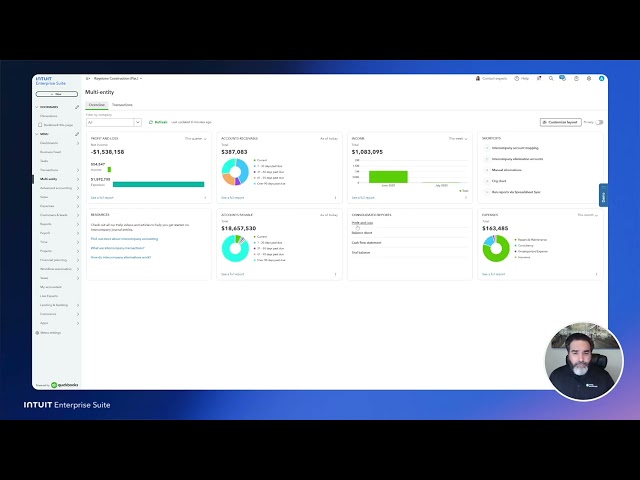
After moving to Intuit Enterprise Suite, the team saved 25 hours a month on consolidation and spreadsheet reconciliation, and audited financial reviews were completed 90% faster.
Western Companies brought consolidated reporting and intercompany eliminations directly into Intuit Enterprise Suite, replacing a third-party plug-in that cost $1,800 a month. Before the move, the team had been manually mapping 200+ general ledger accounts into spreadsheets.
2. The need for enterprise-ready controls
When a $10M+ business has minimal oversight over accounts payable and procurement, it has no consistent view of what's being approved, by whom, and under what rules.
Rhodes Companies, a family office managing nine entities, was running each entity on its own books with no built-in consolidation. Intercompany entries and balance sheet reconciliation could take half a day, and nearly all vendors were still being paid by paper check.
After moving to Intuit Enterprise Suite, owners and business leaders could review payments through approval workflows with more control. Month-end close dropped from 10 days to five, and executives can now pull consolidated reports in about five minutes.
Intuit Enterprise Suite's workflow automation enforces system-level approval rules with up to five parallel sign-off paths. Dimensions on Workflow Automation apply approval, reminder, and task conditions using dimensions that match your organization's structure. Workflow audit trails give finance a complete record of who approved what and under which rules across entities.
Tip
Weak controls usually show up first in exceptions, not routine transactions. Watch for overrides, post-close reclasses, and approval paths that change by entity or by person.
3. When data assembly delays every forecast
When you spend more time assembling numbers than analyzing them, your organization has hit its complexity ceiling. Every month that starts that way is a month where the finance function is behind before the real work even begins.

Cornerstone Development Company grew from one entity to five, and leadership estimated that 20+ hours a month were spent on manual data integration. Forecasting was delayed because finance had to manually pull data together. After moving to Intuit Enterprise Suite, the company cut month-end close time by 50% and gained real-time cash flow oversight.
Intuit Enterprise Suite's KPIs & Dashboards give you a consolidated view of project margins and cash position across the organization without waiting for each entity to report. The Advanced Reporting function lets finance model scenarios on current numbers, so the analysis you take to the board is built on where the organization is right now.

When you schedule a demo, you agree to permit Intuit to use the information provided to contact you about Intuit Enterprise Suite and other related Intuit products and services. Your information will be processed as described in our Global Privacy Statement.
Improve multi-entity control and visibility
When multi-entity complexity is taking more of finance's time than planning, control, and board decisions can afford, the financial structure has to change. The reward, as our case studies demonstrate, is organization-level numbers derived from a single structure, governance verified across every entity, and scenario analysis built on current data.
Intuit Enterprise Suite provides an AI-native environment with the multi-entity controls, real-time reporting, and workflow automation necessary for a scaling group. By compressing the time from month-end close to validated insights, the suite provides the board with the trusted numbers required for confident capital and investment decisions.
Connect with an Intuit Enterprise Suite specialist to review your requirements and get a demo today.
Check out upcoming events and learn more about Intuit Enterprise Suite.

Customer stories

Case study
How FEFA Financial scaled up with Intuit Enterprise Suite (No ERP migration needed)

Case study
Case study: Fire & Ice transforms multi-entity challenges with Intuit Enterprise
October 25, 2024

Case study
Four Points RV Resorts review: Why they chose Intuit Enterprise Suite over NetSuite
October 25, 2024

Construction
Migrating to Intuit Enterprise Suite took 2 hours (with zero disruption) for this aspiring $50M revenue business
April 25, 2025

Case study
Humble House Foods case study: How they improved visibility & simplicity using Intuit Enterprise Suite
September 24, 2025
More product updates

Product update
What’s new in Intuit Enterprise Suite spring 2025
April 1, 2025

Product update
Intuit Enterprise Suite 2025 update: AI agents & automation enhancements
July 22, 2025

Product update
What’s new in Intuit Enterprise Suite November 2025: The AI-native ERP that adapts with your business
November 14, 2025