Table of contents
Table of contents
Key takeaways
- Multi-entity challenges grow with every entity you add, and the risks are not always visible.
- Additional complexity means slower closes, wider compliance exposure, and a group financial view that is harder to trust.
- This can lead to close delays, lender and auditor questions you cannot answer quickly, and weaker capital allocation decisions.
- Firms address these issues by unifying financial data across entities to ensure the group view is current, consistent, and trustworthy.
When financial data is spread across multiple entities and departments, the group view you base decisions on is already out of date by the time it reaches the board. Most firms arrive at this point not through failure but through success, as they expand through acquisitions, new subsidiaries, and joint ventures.
Many growth strategies don’t account for the financial infrastructure needed to consolidate across those entities. After each addition, finance must close more entities, reconcile greater volumes of intercompany activity, and rebuild the group view on the same timeline, with the same team. A Forrester TEI study projected 74% savings over three years from efficiencies in intercompany transactions alone when firms move to a platform built for multi-entity operations
This article covers how multi-entity financial complexity begins, the specific pressure points that create enterprise risk, and sets out a framework for overcoming these challenges.

Understanding where multi-entity financial complexity begins
Multi-entity financial complexity increases with each entity or subsidiary you add to the group. Single-entity accounting systems strain when consolidation work spans multiple currencies, jurisdictions, and reporting standards.
The FP&A Trends Survey found 60% of organizations are constrained by manual processes and inconsistent data, and only 2% consider their finance teams fully optimized.
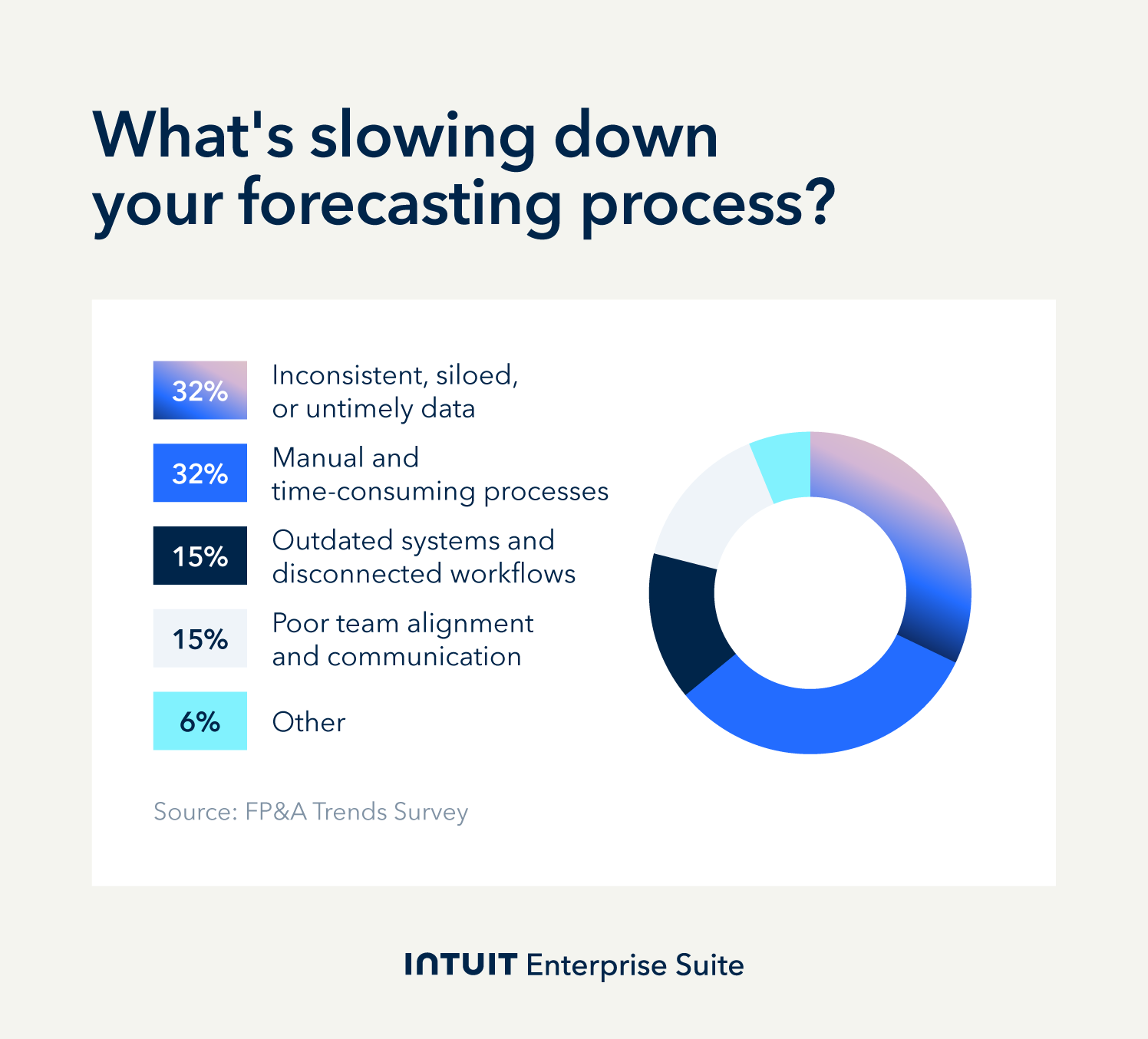
Reasons why traditional accounting workflows break at the multi-entity scale include:
- Spreadsheet dependency: Group closes fall behind as different entities reconcile balances in separate workbooks, and the final version may not reflect the latest close
- Duplicate reconciliations: Finance spends the final week of the month reconciling the same intercompany balances in three files, and the group pack still goes out with caveats
- Inconsistent data structures: Group finance starts each month remapping trial balances instead of reviewing margin, cash, and variance by entity
- Currency and jurisdictional mismatches: Entities apply translation adjustments at different points in the close, so group margin changes between the draft and final board pack without an audit trail
Risks stay buried in entity-level detail until the group close, the board pack, or an audit forces them into view.
With a multi-entity accounting infrastructure, you can see which entity, department, or transaction introduced the risk and correct it before consolidation starts.

A small entity-level error becomes a group problem when it lands in EBITDA, working capital, or covenant reporting. That is why the size of the error matters less than where it occurs. In multi-entity finance, the most damaging mistakes are the ones that hit the wrong line in the consolidated result.
Common multi-entity challenges finance leaders encounter as organizations scale
As you add entities, the processes that worked at a smaller scale start failing in ways that don't show up until the group close, the audit, or a board question that's hard to answer without caveats.
Six significant challenges you face as your organization scales are:
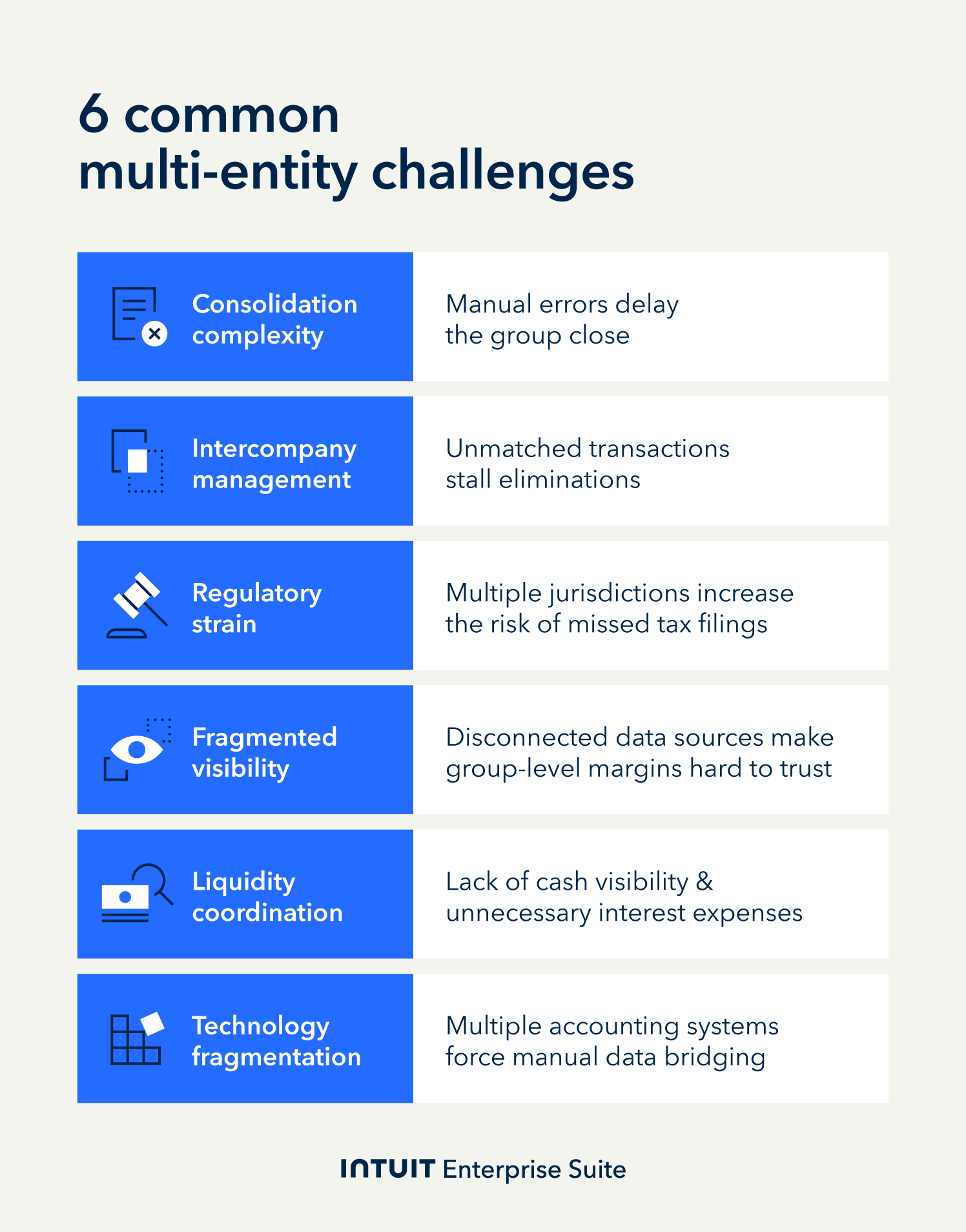
Financial consolidation complexity
Consolidation is where most multi-entity close delays originate. When entities operate across different currencies, jurisdictions, and reporting conventions, pulling numbers into a single group view is the hardest step in the financial reporting cycle.
Specific points of failure include:
The group close absorbs days of version checking, formula fixes, and reconciliation rework, and by the time you include the numbers in the board pack, they’re already out of date.
Intercompany transaction management
Intercompany transactions such as loans, transfers, cost allocations, and shared-service charges create reconciliation complexity that grows with each entity you add. Every transaction must be recorded on both sides, matched, and eliminated before you can rely on the consolidated financials.
APQC’s current benchmarking shows a median 50% of journal entry line items are intercompany, which helps explain why small mismatches can spread so quickly into close delays and elimination work.
Manual intercompany elimination introduces points of error that slow the close process, including:
- Matching delays: Entity teams record the same transaction at different times or in different amounts, so group finance spends days chasing confirmations before elimination can begin
- Errors buried until period-end: A misclassified allocation or an unmatched loan sits undetected for weeks, then appears during consolidation when correction is most expensive
- Unresolved disputes: When entities disagree on an intercompany charge, the dispute stalls the elimination process and adds days to the close while finance tracks down approvals and documentation
By the time intercompany issues appear, you are resolving them under close or audit pressure, and one unresolved balance can hold up the group sign-off.
Compliance and regulatory strain
Each jurisdiction you operate in introduces tax nexus obligations, transfer pricing documentation requirements, and statutory reporting deadlines. As you add more entities, compliance exposure multiplies, and a missed filing in one jurisdiction can trigger penalties that affect the entire group.
PwC's Global Compliance Survey found that 85% of respondents said compliance requirements had become more complex over the previous three years, and half said their remit covered laws and regulations across multiple jurisdictions.
The issue is that each entity’s obligations look manageable on their own, but across the group, they create more opportunities for missed filings, late submissions, or reporting gaps.
A missed filing in one jurisdiction triggers remediation work, wider audit scrutiny, and questions you now have to answer about how well the group is being controlled.
Fragmented financial visibility
Your entity’s books are accurate, but group numbers are still hard to trust. When entities don’t feed into a single consolidated view, finance compiles group numbers from disconnected inputs.
That gets harder when each entity introduces its own inconsistencies, such as different revenue dimension structures, late submissions that delay the group timeline, or recognition methods that don't align with the group standard. AFP’s FP&A Benchmarking Survey found that 60% reported challenges with reliable, accessible data, while spreadsheets are still widely used to prepare finance data, bypass core systems, or run alongside them.
Fragmented reporting means your answers to board questions on performance, cash, and margin come with caveats, because the group view is incomplete or inconsistent.
Cash management and liquidity coordination
Cash visibility becomes increasingly difficult when balances are spread across multiple entities, banks, and currencies. The Deloitte Global Treasury Survey, found that 58% ranked visibility into global operations, cash, and financial risk exposures as their top challenge.
The practical consequence is that some entities hold idle cash while others draw on credit. Often, the entity drawing on credit is also the one with billing delays or disputed receivables that slow collections. Without consolidated cash visibility, you cannot see those connections or decide where cash needs to move or whether borrowing is actually needed.
You end up borrowing in one entity while surplus cash sits idle in another, paying interest on liquidity the group already has.
Technology fragmentation
Growing businesses often end up with different accounting systems across entities. Over time, finance ends up managing three, five, or ten disconnected systems, each with its own data model, chart of accounts, and reconciliation requirements.
At the multi-entity scale, technology fragmentation creates three problems that worsen with every additional entity.
- Data integrity: When the same transaction is recorded differently across systems, group finance cannot confirm which version is correct without going back to source documents
- Reconciliation time: Every month, finance manually bridges data between platforms before consolidation can begin, adding days to the close and repeating the same exercise every period
- Consolidated reporting: Producing a single group view requires manual intervention at every step, from extracting entity data to mapping accounts to eliminating intercompany activity
AFP’s FP&A Benchmarking Survey found that 61% reported challenges with data reliability and 60% with data accessibility, while more than half use at least eight categories and 10 types of reporting tools on a quarterly basis.
Each platform you add puts another manual bridge between source data and the group numbers, and the cost of reconciling and proving those numbers grows with every entity.

Why unmanaged multi-entity complexity creates enterprise risk
Left unaddressed, multi-entity complexity turns into board, lender, and investor risk. That risk grows when finance works on disconnected systems and relies on manual consolidation.
Three areas of exposure are:
Reporting risk
Consolidation delays and fragmented data make it difficult to produce accurate, timely board and investor reports. Reporting errors, like a misclassified intercompany transaction or an incorrectly applied revenue recognition policy, accumulate at consolidation and are difficult to unwind after the fact.
When reporting is late or inaccurate, the consequences reach beyond the finance department. Board confidence weakens, investor questions get harder to answer, and you have to explain group numbers that the finance setup is not equipped to produce reliably.
Example: A multi-entity professional services firm closes each subsidiary on a different timetable and relies on manual account mapping and currency adjustments. As a result, group close is often a week or more late, meaning the board pack is already out-of-date when it goes out. The reasons margin has slipped in two entities cannot be explained with current data, so the board is left asking for answers finance cannot yet give.
Audit and compliance exposure
Unreconciled intercompany balances, missed compliance deadlines, and inconsistent chart of accounts structures are frequent sources of audit findings in multi-entity businesses, although each is manageable.
In combination, and at scale, these gaps create material exposure that increases with every entity added for firms still relying on manual processes. Plus, audit findings are expensive to remediate and damage relationships with lenders, investors, and regulators.
What starts off as an unreconciled balance or a gap in documentation can quickly escalate into audit scrutiny across a wider set of entities, costing you time and money and delaying vital processes like lender covenant reviews.
Example: At year end, the auditor reviewing a construction firm operating across several entities in multiple states finds a significant unreconciled intercompany balance and a statutory filing submitted weeks late. Finance is pulled into reconstructing approvals, support, and entity-level documentation that should have been captured as the transactions happened.
Strategic decision risk
When you make capital allocation, M&A, or headcount decisions on fragmented or outdated data, you are operating with incomplete information. Multi-entity complexity without the right systems creates a delay between what is happening in the business and what you know.
So, although the course of action you recommend appears sound, it may not hold up if margins, cash assumptions, or entity performance no longer reflect reality. Firms that manage multi-entity complexity well make faster, more confident decisions that they can stand behind when the board asks.
Example: A multi-entity manufacturing group is evaluating an acquisition. The analysis uses consolidated margins from the most recent quarterly close, but those margins reflect intercompany allocations that have not been updated since the previous fiscal year. Once recalculated, the actual group margin is materially lower, enough to weaken the acquisition case and change the recommendation going to the board.
The finance leader’s framework for solving multi-entity challenges
The lack of a unified financial infrastructure across entities leads to duplicated work, inconsistent controls, and repeated reconciliation efforts. The benefits of ERP software designed for multi-entity operations start with removing those structural weaknesses at the source.
These four key ERP platform capabilities address those weaknesses at source:
Centralized chart of accounts
A standardized chart of accounts across all entities is the foundation of reliable consolidation and reporting. Without it, inconsistent account structures across entities become the root cause of most manual reconciliation work at close.
Centralizing the chart of accounts is where to start when multi-entity complexity begins to introduce risk. APQC’s current benchmarking shows a median 76.9% of accounts are standard across reporting business units, which highlights how much reliable group reporting depends on account consistency.
A custom ERP built for multi-entity operations makes that standardization possible without the implementation burden of a traditional enterprise platform. Intuit Enterprise Suite provides a Consolidated View across multiple companies, with consolidated reports, intercompany tools, and account management capabilities that help finance work from one group view.
That means every new entity reports on the same structure from day one, the group view holds together as the business gets more complex, and you don't lose the first days of every close waiting for your team to realign accounts that would otherwise match.
Automated intercompany eliminations
Automated intercompany eliminations remove the manual reconciliation that causes close delays and introduces errors by matching transactions across entities as they are recorded rather than waiting until period-end to find breaks, mismatches, or missing entries.
EY's International Tax and Transfer Pricing Survey found that 75% said ineffective use of technology was a top challenge and 67% said the same about poor data quality.
Intuit Enterprise Suite automates intercompany accounting and keeps books in sync across entities in real time. Your balances already match when consolidation begins, and you don't lose the opening days of close to entries that should have been reconciled months ago.
Real-time consolidated dashboards
Real-time dashboards replace the manual assembly of entity-level reports with a continuously updated enterprise view. Instead of collecting spreadsheets from each entity at month-end, you have a live consolidated picture that updates as transactions are recorded.
Role-based dashboard access allows:
- Entity controllers to see their own performance metrics and can drill into entity-level detail
- You to see the consolidated group view with the ability to drill down into any entity
- The board to see the summary metrics required for governance decisions
Intuit Enterprise Suite delivers this through KPIs and Dashboards with real-time visibility across every entity. The Accounting Agent and Finance Agent highlight trends and risks that manual review would miss, giving you the foundation for business forecasting that reflects what is happening across the group right now.
Real-time visibility lets you investigate variances while the period is still open, so you understand what changed and why before period close.

Role-based controls and audit trails
Audit readiness depends on how financial data is governed throughout the year. Role-based access controls determine who can create, approve, and modify transactions in each entity, while audit trails track every journal entry, approval, and change across the group.
Without this infrastructure, finance spends the first weeks of every audit reconstructing documentation that should have been captured as it happened. Intuit Enterprise Suite is audit-ready by design, tracking every transaction, approval, and journal entry with role-based controls and audit-ready governance built into the platform.
Every transaction, approval, and change is already documented so the trail is ready to hand to the auditor on their arrival, rather than burdening your team with rebuilding it.

Firms adapting to market shifts through acquisition or geographic expansion often inherit different accounting systems, reporting standards, and compliance obligations with each deal. How quickly you integrate each new entity’s financials into the group is directly linked to regaining group visibility and control.
How AI surfaces multi-entity risk before it compounds
AI identifies anomalies in intercompany transactions before they become reconciliation problems by catching mismatches, unusual amounts, and classification inconsistencies as they are posted.
Machine learning improves consolidation accuracy over time by learning from historical close data and surfacing patterns that manual review would miss, such as recurring classification errors in specific entities or allocation mismatches that only appear at the group level.
AI-assisted compliance monitoring tracks regulatory deadlines and highlights exposure across jurisdictions, reducing the manual oversight required to stay current.
In Intuit Enterprise Suite, the:
- Accounting Agent reviews transactions as they come in, compares source records against the books, and highlights differences while they are still contained in one entity
- Finance Agent monitors performance across entities, points to unusual shifts in margin, cash, or spend, and helps finance drill from the parent view into the entity responsible for the change
The earlier visibility provided by AI allows finance to isolate the source of a problem and assess its effect on group reporting before it reaches the close.
Example: A multi-entity healthcare services group operates across more than a dozen entities. One entity misclassifies a significant intercompany service charge as an external expense. With AI monitoring transactions continuously, the classification inconsistency is identified within hours of posting, resolved before it affects the close timeline, and the consolidated financials go out on schedule.

When you schedule a demo, you agree to permit Intuit to use the information provided to contact you about Intuit Enterprise Suite and other related Intuit products and services. Your information will be processed as described in our Global Privacy Statement.
Boost productivity and drive enterprise performance
For many mid-market firms, the problem is not whether multi-entity control matters. It is whether the business can bear the cost, disruption, and implementation burden that usually accompany traditional ERP.
Intuit Enterprise Suite provides a high-velocity alternative for firms that require sophisticated multi-entity controls without implementation bloat. Book a call with our team to discuss your group structure, reporting needs, and what the Intuit Enterprise Suite would look like in practice.
Check out upcoming events and learn more about Intuit Enterprise Suite.
Customer stories

Case Study
How FEFA Financial is growing with Intuit Enterprise Suite—without migrating to an ERP

Case Study
How this mission-driven, employee-owned company created efficiencies with Intuit Enterprise Suite
October 25, 2024

Case Study
Why this camping business chose Intuit Enterprise Suite over NetSuite
October 25, 2024

Case Study
Migrating to Intuit Enterprise Suite took 2 hours (with zero disruption) for this aspiring $50M revenue business
April 25, 2025

Case Study
Humble House Foods case study: How they improved visibility & simplicity using Intuit Enterprise Suite
September 24, 2025