Table of contents
Table of contents
Summary
Intuit Enterprise Suite's Spring 2026 release consolidates enterprise-grade multi-entity close automation, dimensional financial reporting with real-time peer benchmarking, a purpose-built construction ERP, and a fully integrated HR and workforce suite onto one platform.
For finance leaders evaluating ERP options, it's a direct alternative to traditional mid-market ERPs, built on Intuit AI and the actual transaction data of millions of real businesses.
Modern finance leaders need one source of truth organized the way the business actually works, where every report, workflow, and AI capability gets sharper because of it.
Intuit Enterprise Suite is designed to be the command center for your business — a unified, intelligent and customized platform that brings everything into one place. Every entity, project, and team connected in a single view. It combines data and Intuit AI to close faster, report with confidence, and manage your workforce on the same platform as your financials to drive revenue growth.
The May 2026 release reflects a deliberate focus on depth, advancing the areas where finance teams feel the most friction as their businesses grow. The advancements to Intuit Enterprise Suite are focused on four key areas:
- Closing across entities without the end-of-period scramble.
- Getting a clear view of how the business is actually performing.
- Protecting construction margins with financial visibility that keeps pace with the work.
- Managing your people and your finances on one integrated platform.
Intuit Enterprise Suite has allowed us to close our fiscal year end at least 3 months faster than previous years. For a company of our size, having that data sorted and finalized by January is a massive win for our tax planning and strategy.
One place to close every entity
For finance teams managing multiple entities, closing the books is one of the most manual processes on the calendar. Now, Intuit Enterprise Suite delivers new and expanded capabilities for multi-entity businesses that help eliminate the manual processes of the financial close by bringing workflows directly into the platform.
Advanced multi-entity close for scaling businesses
Beyond automating individual transactions, this release introduces the architectural layer that enterprise multi-entity management requires.
- Automated intercompany accounting workflows: Keep consolidated reports accurate without the manual work that builds up at period close. Eliminations are generated automatically at the transaction level and journal entries upload directly from spreadsheets.
Note: This feature will launch in Intuit Enterprise Suite in June. See demo here.
- Multi-level entity hierarchy and consolidation establishes the parent-child structure that complex ownership arrangements depend on. It gives businesses the structural foundation for multi-level roll-ups and consolidated reporting without the risk of outgrowing the platform.
- Auto-categorize intercompany sales with AI: AI-powered categorization handles the high-volume, repetitive work of categorizing bills generated from intercompany sales by automatically suggesting and pre-populating categories based on historical patterns, with the team reviewing and approving before anything is finalized.
- Cross-company bill pay lets teams settle payables across any entity bank account from a single interface, with the system automatically generating the related intercompany journal entries in the appropriate entities for accurate records and simpler reconciliation.
The multi-entity command center gives teams a central location to set up and manage key workflows across the organization, surfacing recommended actions across intercompany transactions, a shared chart of accounts, and reporting. The multi-entity payroll hub extends this visibility to workforce costs, delivering a consolidated view of each entity's payroll status without switching between accounts.
Eliminations and intercompany transactions
Transaction-level eliminations are now generated at the point of recording, linked directly to the intercompany transaction that created them. Rather than eliminating entire account balances at period end and reconciling the differences, teams can shift eliminations to the source transaction, close faster, and produce consolidated reports that are accurate without the end-of-period reconciliation step.
For teams creating Intercompany Journal Entries (ICJEs) directly in the system, the platform now detects the transaction type and automatically generates the required balancing entries, removing the manual step of constructing both sides of the entry and reducing the risk of imbalance errors.
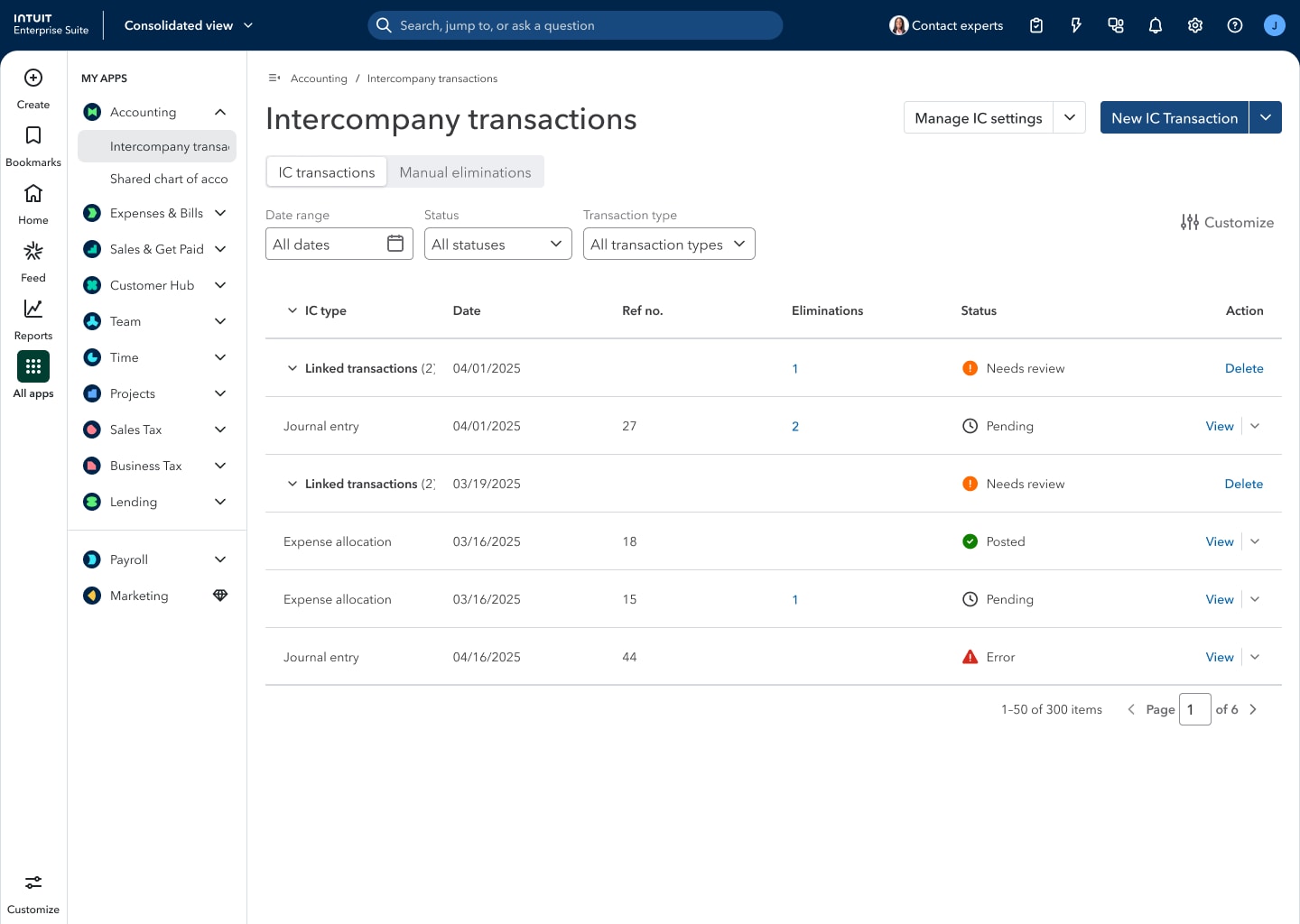
For teams that manage ICJEs in spreadsheets, CSV import lets you upload and draft multiple ICJEs at once, converting an existing workflow into a structured process without requiring teams to change how they operate. For recurring intercompany activity, the system identifies patterns in historical entries and surfaces predictable ICJEs as recommendations ahead of month-end. This converts what's typically a manual calendar item into a prompted, reviewable workflow.
Note: Cross-company bill pay and the mulit-entity command center are available in beta now; multi-level entity hierarchy is launching in beta in June. Reach out to your Customer Success Manager to learn more about signing up to access beta features.
What I love about Intuit Enterprise Suite is the intercompany transactions. Not only does our team get to save about 10 hours a week, but we were able to allocate that responsibility across multiple team members because it doesn't take as much accounting experience to complete.
Financial reporting and benchmarking for how your business actually operates
Meaningful financial reporting starts with consistently structured data. The Spring 2026 release of Intuit Enterprise Suite unlocks new reporting and benchmarking capabilities through structured data, and specifically through dimensions. For teams that have been working within the constraints of classes, this release opens up the structural change you’ve been waiting for. Dimensions are now the foundation for how data flows through Intuit Enterprise Suite. A migration workflow maps up to five years of historical class data to dimension values, with review steps at each stage, so year-over-year comparisons hold.
Built on top of that foundation are: reporting that answers multiple questions at once, calculated fields in multi-entity reports that eliminate the spreadsheet step, and peer benchmarking drawn from the actual transaction data of millions of real businesses, not survey estimates.
Together, dimensions, reporting, and peer benchmarking replace the manual assembly of financial performance with a picture that is structured from the start, reported natively, and measured against the outside world.
Note: Peer benchmarking is available in beta.
Dimensions
Dimensions are now fully integrated as the structural backbone of Intuit Enterprise Suite, extending beyond transactions to vendor, customer, and project records, inventory adjustments, and starting value transactions. Inventory activity can now be tracked and analyzed using the same dimensional structure as the rest of the business, so there are no gaps in how performance data flows through the system. Organizational context flows through the business consistently rather than being applied transaction by transaction.
For teams transitioning from classes, the migration is now automated. An agentic workflow maps up to five years of historical class data to dimension values, so year-over-year comparisons hold, and the context your team has built doesn't have to be rebuilt. Finance teams can reclassify dimensions as the business evolves without losing historical integrity.
Dimension defaults on vendor, customer, and project records eliminate manual tagging on every entry. Gaps in dimension data are flagged at entry, not reporting time. And for teams integrating with other systems, the dimensions API enables programmatic management of dimension data for developers and third-party applications.
Note: Dimension migration, dimension defaults, inventory dimension tagging, and the dimensions API are each available in beta.
Reporting
With dimensions flowing consistently through every transaction, the data becomes more manageable, and reporting capabilities expand to match.
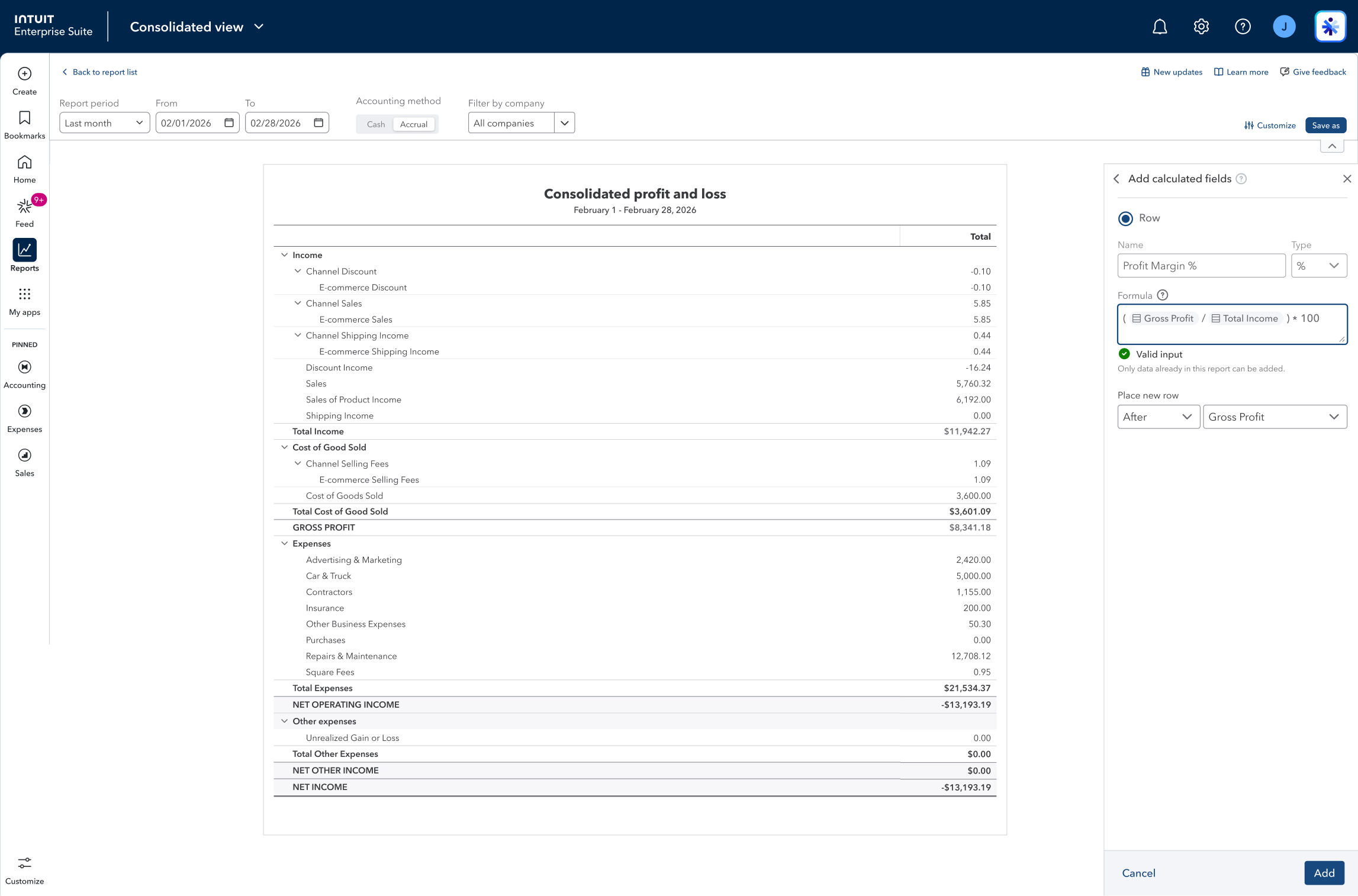
New management reports broaden what's available for analysis and presentation, with custom date ranges and landscape mode for individual report sections. Reports now support calculated fields as custom metrics directly, letting you use report rows as inputs for custom formulas without exporting to a spreadsheet first. In multi-entity reports, this removes one of the most persistent manual steps in consolidated financial analysis. Enhanced reporting with dimensions lets you group report columns and apply filters by dimension within financial and sales reports, giving you improved visibility into performance based on how your business is actually structured.
That’s the internal picture. Knowing how the business is structured and performing answers half the question, but still leaves open how that performance stands relative to peers. Peer benchmarking is the solution.
Peer benchmarking
Peer benchmarking draws on an anonymized dataset built from the actual financial transactions of millions of real businesses to show how your performance compares across industry, revenue band, and location. Most benchmarks are built on survey data, meaning they reflect what businesses report. These reflect what businesses are actually doing.
Note: Peer benchmarking is available in beta.
With Intuit Enterprise Suite, it allows us to drill down. Ownership can see a better snapshot of how the company in total is doing, providing the visibility needed to see truly profitable primary business lines versus R&D expenditures.
Expanded construction-specific capabilities and workflows
Construction businesses don’t usually lose margin at the bid stage. They lose it because the financial picture doesn't keep pace with the work. Costs shift over the course of a project, variances don't surface in real time, and by the time the financials are up to date, the window to protect the margin has already closed.
Intuit Enterprise Suite Construction Edition (open beta) is purpose-built for mid-market construction businesses. It’s the first industry-specific ERP from Intuit designed around how construction financials actually work. The Spring release deepens that foundation with real-time job cost visibility, AI-powered insights drawn from the business’s own transaction history, and financial reporting built specifically for construction sub-industries.
Note: Construction edition features are available in beta.
Financial visibility built for construction
Enhanced real-time Work In Progress (WIP) reporting shows where each job stands against contract value at any point in the project, including whether billing is ahead or behind cost. This way, teams have the financial picture they need to manage cash flow and monitor profitability before the period closes, not after.
Purpose-built reports arrive alongside WIP enhancements: construction KPI dashboards surface the metrics that matter most for project-based businesses, and a chart of accounts tailored for construction sub-industries means the books are structured for construction from the start, rather than adapted from a general-purpose framework.
For construction businesses bidding on federally funded projects, the certified payroll report generates Form WH-347 in compliance with federal regulations. Historically, this compliance step required separate tooling. Now, you can skip the extra work.

Cost accuracy from bid through execution
Protecting margin requires accuracy at the cost level, not just the reporting level.
- Flexible project costing lets teams move from basic costing at the estimate stage to a more detailed costing approach at execution without data loss or manual rework. As a project moves from bid to build, the costing structure evolves with it, so the level of detail the work requires is always available without starting over.
- Project Management AI-powered cost allocation recommendations recognize project names on bills and receipts and surface line-item allocation suggestions for review and approval in the flow of work. Critically, these recommendations are drawn from each customer's own transaction history, not a generic dataset, so suggestions reflect the actual cost patterns of your projects, not an industry average.
- Project Management AI cost and price insights flag where costs and pricing inputs are under pressure before variances reach the P&L, giving teams the signal they need to act while there's still margin to protect.
Together, these capabilities mean the financial picture keeps pace with the work, delivering earlier signals on where each job stands, more accurate cost data from bid through execution, and margin decisions made before the margin is gone.
One of the biggest roadblocks for a CFO in construction is visibility. You may not know whether a job is profitable until the project is already over. What Intuit Enterprise Suite brings to the table is the ability to quickly see budgets, actual versus budget, billings, and gross profit on a specific project.
Unified workforce and human capital management on the same platform
For most growing businesses, people management and financial management have historically lived on separate systems, with separate logins, separate records, and the need for manual reconciliation between them. With this release, that changes. Intuit Enterprise Suite now includes Intuit QuickBooks Workforce Elite, bringing the full HR lifecycle onto the same foundation as your financials. No separate login, no data reconciliation, no duplicate record management.
Intuit Enterprise Suite users with existing payroll and HR data can visit Team and select Overview for a guided onboarding experience.
Hiring and onboarding
Recruiting brings structure and consistency to your talent acquisition process with an integrated set of applicant tracking tools, so your team can hire with speed and confidence as you scale. Background checks via Checkr can be initiated directly from QuickBooks Workforce Elite, and employee information is pre-filled, with no need to switch tools or re-enter data to complete the onboarding workflow.** Onboarding gives HR teams a guided, unified experience for hiring, onboarding, and payroll setup to ensure new employees are ready to go on day one.
Managing your team
HR workflows improve consistency, visibility, and accountability across the business by standardizing and automating custom approval chains tailored to your organization. Centralized employee documents are stored and managed in one location, replacing external tools like Google Drive or Dropbox with a system that includes signature requests and a full audit trail for each document.
Performance management standardizes your review cycle to promote visibility and accountability, with structured tracking and feedback that drives employee growth and engagement. Time off policies are managed in one place, including common types and custom policies, each with accrual rules, maximum balances, and carryover settings. Offboarding completes the lifecycle, replacing fragmented exit workflows with a consistent, compliant process inside the same system where the employee's entire tenure has been managed.
Payroll
Payroll enhancements in this release make the process faster, more accurate, and easier to manage across the organization. Payroll runs can be broken into focused segments by filtering for base type, payment method, and work location. Column sorting and employee search reduce time spent navigating large payroll lists. Expedited IRS payroll tax amendments get IRS payroll tax corrections submitted in as little as seven days, with real-time visibility into amendment status throughout the process.**
For businesses managing payroll across multiple entities, the multi-entity payroll hub delivers a consolidated view of each entity's payroll status in one place. Teams can monitor the full picture without switching between accounts.
Financial operations
The financial operations layer becomes more automated alongside these workforce capabilities, removing the recurring manual steps that accumulate as organizations grow.
Approvers can act on invoices, estimates, bills, and purchase orders with direct approvals through email without signing in, with every decision automatically logged in the audit trail. Set up autopay for recurring bills with fixed, predictable amounts on a defined schedule, removing the manual step from expenses that don't change. Automated notifications trigger based on dimension conditions, so the right stakeholders are informed based on how the business is actually structured, not based on a generic notification rule. Resolution Center enhancements include consolidating support case management in one place, with full case history, the ability to delegate cases to team members, and the option to reopen cases within 30 days.
An improved migration experience for QuickBooks Desktop users
This release also improves the upgrade experience for teams moving from QuickBooks Desktop. A desktop migration tool built specifically for Intuit Enterprise Suite replaces the QuickBooks Online flow that Desktop migrations previously ran through. It is built for the requirements Intuit Enterprise Suite migrations involve, including multi-entity configurations and professional services coordination where needed. A migration readiness checklist with auto-completion surfaces and helps resolve common blockers before migration begins. Bank feed reconnection includes pull-date guidance to avoid duplicate transactions on arrival. Customers are supported throughout by an Implementation Consultant working closely with their Customer Success Manager to ensure a successful migration and onboarding experience.
With Intuit Enterprise Suite, we’ve saved 20 hours a week of manual labor. That efficiency allowed us to move away from external headcount, saving us over $100,000 annually.
Built for the complexity of how your business actually operates
The four areas this spring release addresses make Intuit Enterprise Suite the financial command center for CFOs: a connected platform where multi-entity close, financial reporting, construction operations, and workforce management run on the same unified platform. Intuit Enterprise Suite combines data and AI to deliver the visibility, efficiency, and confidence that modern finance leaders need to make faster, smarter decisions.
To get the full details, see the Intuit Enterprise Suite spring 2026 release notes.
Talk to sales today, or take a tour of Intuit Enterprise Suite with an interactive demo.

Disclaimers
This information is intended to outline our general product direction, but represents no obligation and should not be relied on in making a purchasing decision. Additional terms, conditions and fees may apply with certain features and functionality. Eligibility criteria may apply. Product offers, features, and functionality are subject to change without notice.
Conversational “chat” interface is currently available in beta for all eligible QuickBooks Online, QuickBooks Online Advanced, and Intuit Enterprise Suite customers.
Money movement services are provided by Intuit Payments Inc., licensed as a Money Transmitter by the New York State Department of Financial Services. Account subject to eligibility criteria, credit, and application approval. QuickBooks Payments and QuickBooks Bill Pay accounts are subject to eligibility criteria, credit, and approval prior to first payment. For details about our money transmission licenses, or for Texas customers with complaints about our service, please visit https://www.intuit.com/legal/licenses/payment-licenses/
*Real customers paid for their time. Customer Results may vary. Intuit does not guarantee that these results will apply to all customers.
**Features
Background checks: Checkr's terms and additional fees apply.
Expedited amendments are currently only available for California customers filing amendments for Form 941 and Form DE9.
Beta features are subject to change or discontinue at any time, and Intuit may introduce fees or other pricing requirements for such features in the future.
Check out upcoming events and learn more about Intuit Enterprise Suite.
Customer stories

Case study
How FEFA Financial scaled up with Intuit Enterprise Suite (No ERP migration needed)

Case study
Case study: Fire & Ice transforms multi-entity challenges with Intuit Enterprise
October 25, 2024

Case study
Four Points RV Resorts review: Why they chose Intuit Enterprise Suite over NetSuite
October 25, 2024

Construction
Migrating to Intuit Enterprise Suite took 2 hours (with zero disruption) for this aspiring $50M revenue business
April 25, 2025

Case study
Humble House Foods case study: How they improved visibility & simplicity using Intuit Enterprise Suite
September 24, 2025
More product updates

Product update
What’s new in Intuit Enterprise Suite spring 2025
April 1, 2025

Product update
Intuit Enterprise Suite 2025 update: AI agents & automation enhancements
July 22, 2025

Product update
What’s new in Intuit Enterprise Suite November 2025: The AI-native ERP that adapts with your business
November 14, 2025