Table of contents
Table of contents
Among multi-entity firms, 69% say they lack real-time visibility across entities, projects, and departments, according to Intuit’s Enterprise Technology Benchmark. A reliable field service management system connecting on-the-job activity to financial reporting gives you the full cost of every contract before close.
That strengthens revenue visibility, margin integrity, and working capital control, especially when field labor is split across entities and regional tax rules complicate reconciliation.
This article covers how field service management software closes that gap, what happens when field and financial data share a single record, and how to tell when your current setup is leaking margin between the job and the invoice.

What is the financial visibility gap in field service management?
In field service management, the financial visibility gap is the delay between a technician using labor or parts in the field and finance properly reflecting those costs in the general ledger. When that delay sits between the job and the books, you lose time protecting margin, collecting cash, and closing on numbers ready to use.
That gap only exists when field and finance run on disconnected systems. And when it does, revenue starts leaking before anyone in finance sees it.
Why does a disconnected field service management system cause revenue leakage?
The final invoice goes out with incomplete cost data. Billable labor, parts, and markups that the field used but didn't log against the work order don't appear on the bill. Over enough jobs, the margin you report is lower than the margin you earned.
The leakage spreads across the billing chain, the intercompany ledger, and the cash cycle, with each one compounding the others.

The forgotten billable trap
A lack of real-time inventory synchronization leads technicians to use parts without logging them against a work order.
The cost shows up later, but often through stock adjustments or broader parts spend rather than a direct charge against the job. Accurate parts tracking depends on that same record being right at the source.
You see the margin drop at month-end, but first you have to send the finance team back through stock adjustments and parts spend before. Once they have narrowed it down, you can challenge the managers on the jobs where the parts cost never made it onto the work order.
The inter-entity consolidation barrier
Manual labor transfers between subsidiaries obscure the global cash position and create "reconciliation debt" during month-end. Among multi-entity firms, 80% say managing intercompany transactions and billing is a significant bottleneck in financial operations, according to the Intuit Enterprise Technology Benchmark survey.
When one entity supplies labor to another, someone still has to move that cost into the right books before close. Until that cleanup is done, you don’t have a settled group cash position.
This means you’re making decisions on cash, covenant headroom, capital allocation, and short-term funding using intercompany balances that still need to be cleared.

Standardize how every entity records cross-company labor from the first entry. Without that, you go into close without a settled intercompany position to make decisions from.
The working capital blind spot
A 14-day billing delay artificially inflates an organization’s Days Sales Outstanding (DSO). In field services firms, that delay often comes from waiting on hours, parts, sign-off, or job notes before finance can issue the invoice. Credit Pulse estimates that missing the 24-hour invoice window can add five to eight days to DSO.
Delays in settlement can lead to liquidity issues, meaning you have to arrange short-term borrowing or push supplier payments back to cover cash the business earned weeks ago but still hasn’t brought in.

How does a unified financial architecture improve multi-entity governance?
A unified platform records every truck roll, parts draw, and labor entry against the same chart of accounts. System-enforced controls categorize, approve, and post each entry across every entity. Finance does not need to remap the data at close, so you review group performance from one set of numbers.
Standardizing the chart of accounts
With Intuit Enterprise Suite, a repair job is tracked identically across all 50 states, giving you a single view of restricted and unrestricted assets across every entity.
In Intuit’s Enterprise Technology Benchmark survey, 89% of multi-entity leaders said they need a single, unified view of financial and project performance. This is a lot harder when the same repair work produces different margins and cost pictures from one entity to the next.
Intuit Enterprise Suite records each job through a standardized enterprise accounting architecture, so labor, parts, revenue, and contract cost all post to one chart of accounts.
That common coding structure lets you review region, contract, and service-line margin from one basis and make pricing or spend calls without waiting for finance to reconcile the numbers at close. Every truck roll coded at source (operation) is a margin figure you can trust at the group level (finance).
Automating inter-entity labor eliminations
Intuit Enterprise Suite automates "arm’s-length" pricing, tax-nexus calculations, and intercompany eliminations when crews cross regional lines. After switching to Intuit Enterprise Suite Lallier Construction spent 90% less time on intercompany reconciliation for hundreds of invoices between four entities and five divisions each month with that same automation.
When crews, labor, or billable work are spread across two or more entities, each entry posts to the correct books as the work occurs, rather than being rebuilt at month-end. You go into close with cross-company labor already cleared between entities, giving you a settled basis for reviewing performance.
Make teams capture the home entity, borrowing entity, hours, rate, and work location at the point they book labor. If that detail is added later, your month-end close turns into a rebuild exercise.
Leveraging AI for anomaly detection
Intuit Intelligence identifies job-level cost overruns in real time, alerting you to contracts where costs are already running ahead of estimate while the job is still open. In Intuit’s Enterprise Technology Benchmark, 80% of leaders said AI delivers faster ROI than other technology investments, while 91% said human oversight is still essential. A practical way to use that is to set a threshold so only work orders with a variance above 10% need manual controller approval. That keeps the jobs that are still within tolerance out of the same review queue as the ones that are genuinely off plan. You spend controller time on the jobs that need intervention while the contract is still open, instead of reviewing every work order personally at close.
What are the indicators that an organization has outgrown its current field service tools?
You have outgrown your current field service tools when you cannot produce real-time margin reports, the close runs past 10 days, and finance is still using spreadsheets to reconcile intercompany labor.
For many firms, this is a pressing issue. In Intuit’s Enterprise Technology Benchmark survey, 62% of leaders said they expect to outgrow their current technology within 12 months if growth targets are met, while 64% said month-end close takes too much time.
1. When multi-entity complexity becomes a liability
Managing three or more legal entities without automated eliminations creates significant audit risk. Intuit’s Enterprise Technology Benchmark survey found that 76% of multi-entity businesses said their existing technology had struggled to keep up when they added new entities.
Each new entity adds another layer of intercompany balances, audit trails, and reporting checks that finance has to verify manually. Organizations pursuing vertical integration across service lines (for example, adding installation on top of maintenance), face the same multiplication.
You keep adding entities without letting the cost of proving the numbers keep pace with the business.
Case study: Western Companies was managing four entities with 200+ general ledger accounts mapped into spreadsheets. The team now closes from one system instead of four spreadsheets, saving 25 hours a month and cut audited financial review time by 90%.
Western Companies: Before and after Intuit Enterprise Suite
2. When you hit the data ceiling
You hit the data ceiling when finance spends more time reconciling field data than using it. In Intuit’s Enterprise Technology Benchmark, 67% of leaders said data silos were hindering decisions, rising to 75% among CFOs and CTOs.
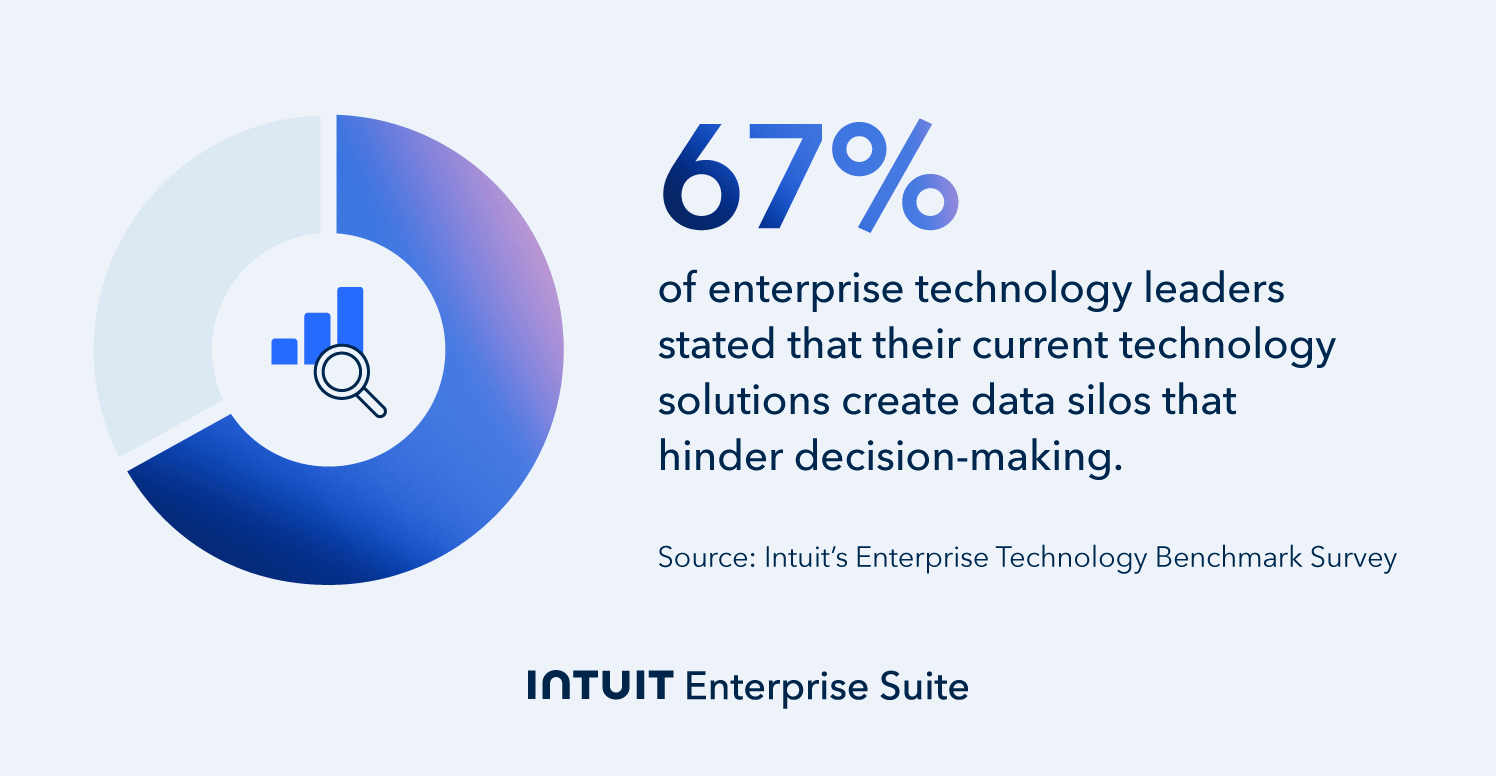
Every standalone dispatch tool, procurement management system, and manual handoff adds another round of checking before the numbers are usable.
By the time the field data is usable, the hours intended for forecast review, capital allocation, and board prep have already been spent getting the numbers into shape.
Case study: Cornerstone Development Company spent 20+ hours a month on manual data integration across five entities, and forecasting was delayed because finance still had to pull the numbers together by hand. After standardizing those entities on one platform, the business cut month-end close time by 50% and gained better project-level visibility and real-time cash flow oversight.
Example: A national HVAC firm with multiple branches was still pulling field hours, parts usage, and intercompany labor into spreadsheets before close. After centralizing those entities onto a single platform, the business cut month-end close time by 50% and gained better project-level visibility and real-time cash flow oversight.
Treat any spreadsheet that exists just to tie field data back to the ledger as a sign that the process has broken. Once your finance team is rebuilding that trail by hand, the toolset has already stopped scaling. Benchmark the reconciliation costs you each month and compare them with the cost of consolidating onto a single platform.
3. When revenue leakage exceeds the cost of a suite upgrade
"Minor" leaks, like unrecorded technician overtime or forgotten material markups, become a multi-million-dollar liability at enterprise scale. Analysts estimate that field service revenue leakage can reach 5% of annual revenue.
The transition from trust-based field entries to a system-enforced workflow pays for itself as soon as billables are captured at the source. By preventing labor and expenses from leaking out of the gap between project completion and invoicing, you ensure that every hour of work is reflected in the firm's revenue.
Example: A commercial maintenance firm running over 200 service contracts was losing roughly 4% of gross margin to unbilled field parts. Transitioning to a field service management system that automated the link between field consumption and the final invoice recovered that margin.

When you schedule a demo, you agree to permit Intuit to use the information provided to contact you about Intuit Enterprise Suite and other related Intuit products and services. Your information will be processed as described in our Global Privacy Statement.
Bridge the gap between field operations and financial control
Disconnected field and finance systems leave margin, cash, and close quality exposed. The right enterprise field service management platform gives you more accurate numbers, faster cash collection, and a better basis for pricing, planning, and growth.
See how Intuit Enterprise Suite closes these gaps across field and finance by booking a call with one of our consultants.
Check out upcoming events and learn more about Intuit Enterprise Suite.

Customer stories

Case study
Migrating to Intuit Enterprise Suite took 2 hours (with zero disruption) for this aspiring $50M revenue business
April 25, 2025

Case Study
How FEFA Financial is growing with Intuit Enterprise Suite—without migrating to an ERP

Case Study
How this mission-driven, employee-owned company created efficiencies with Intuit Enterprise Suite
October 25, 2024

Case Study
Why this camping business chose Intuit Enterprise Suite over NetSuite
October 25, 2024

Case Study
Humble House Foods case study: How they improved visibility & simplicity using Intuit Enterprise Suite
September 24, 2025