Table of contents
Table of contents
Key takeaways:
- Construction contracts are crucial for a business's financial health, helping to prevent disputes and ensure timely payments by clearly defining project scope and terms.
- Choosing the correct contract type—whether it's cost-plus, lump-sum, or a guaranteed maximum price—is essential for managing costs and risks on any construction project.
- Effective contract management requires following best practices, like using a centralized document system and a defined change order process, to keep projects on track and legally sound.
Cash flow volatility poses a significant challenge for construction businesses, directly impacting their ability to execute strategic growth plans. A recent survey from QuickBooks revealed that a significant majority of mid-market companies prioritize expansion—but without clear contracts, late payments and disputes can slow down or even halt this growth.
But what if you could mitigate financial risk and enhance fiscal predictability from the project's inception? By setting clear terms from the start, a well-defined contract can be the key to securing timely payments and ensuring your business stays on a path to steady expansion.
Today, we'll look at what a construction contract is, the different types of contracts, and how the right one can benefit your construction business.

What is a construction contract?
Construction contract documents detail all aspects of the project and guide you through each phase as you progress. They include the contract for construction work, detailed drawings, and specifications for the construction project. These documents serve as the roadmap, ensuring that both your team and the client understand the expectations.
Construction contract documents are important since they:
- Define the scope, cost, and schedule of your project
- Prevent misunderstandings by clearly outlining the roles and responsibilities of each party involved
- Ensure a smoother process, fewer disputes, and a clearer path to project completion
You should also explore construction job costing to improve profitability and learn how to manage your construction contracts using a centralized business solution.

Key construction contract terms to know
- Scope of work: A detailed description of the work to be completed, including tasks, responsibilities, and deliverables, ensuring all parties understand their obligations.
- Addenda: Updates or changes made to the original contract documents before the project starts, ensuring all parties are aware of any revisions to plans or specifications.
- Change order request (COR): Documents changes needed during the project, whether due to unforeseen issues or client requests, potentially affecting scope, cost, and timeline.
- Retainage: A percentage of the contract payment withheld until project completion, serving as a financial incentive to ensure work is finished to satisfaction.
- Field order: Addresses minor changes or on-site instructions that require quick implementation without significantly altering the project’s overall scope.
- Liquidated damages: A set amount of money that the contractor must pay if the project isn't finished by the agreed-upon deadline. This will compensate the client for delays.
Key construction contract types
Choosing the correct type of construction contract agreement can make all the difference. It involves understanding the various parts of a contract that define how you manage costs and allocate responsibilities.
Here, we explore the main contract types, highlighting their features, benefits, and potential drawbacks to help you make an informed decision for your project.
1. Cost-plus
A cost-plus contract covers the contractor’s actual project expenses plus a profit margin, which may be either a fixed sum or a percentage of the total costs. It provides flexibility for projects where the scope may change or unforeseen issues might arise.
This type of contract offers transparency and flexibility, making it easier to manage changes and unexpected conditions. However, the lack of a fixed total can lead to higher costs and less certainty about the final price. Proper construction inventory management is key to avoiding cost overruns.
Example: In a large-scale lab renovation where the exact scope of hazardous material removal is unknown, a cost-plus contract might allow for a safe and flexible budget without the contractor having to inflate their bid to account for unknown risks.
2. Design-build
In a design-build contract, one entity is responsible for both the design and construction of the project. This integrated approach can streamline communication and expedite the project timeline, as the design and construction phases overlap.
The design-build method simplifies project management by providing a single point of contact and often results in faster completion. That said, it may limit your control over the design process and can lead to higher initial costs due to the integrated approach.
A recent study by the Design-Build Institute of America, however, found that design-build projects are delivered 102% faster than traditional methods—so a higher price tag may be worth it.
3. Guaranteed maximum price
A guaranteed maximum price (GMP) contract limits the total project cost. The client agrees to pay the contractor up to this maximum amount, and any savings below this limit are typically shared between the client and contractor.
The GMP contract offers cost control with a fixed upper limit, encouraging the contractor to complete the project under budget. However, it might include a higher initial price to cover potential risks and can complicate the process of managing scope changes.
Example: A contractor might bid $20 million on a project with an estimated cost of $18.5 million to create a $1.5 million buffer for unexpected issues, which they then might share with the client if the project comes in under budget.
4. Incentive construction
Incentive construction contracts provide additional compensation to the contractor for achieving specific goals, such as completing the project ahead of schedule or under budget.
These contracts encourage high-performance and cost-effective solutions, which can potentially lead to significant savings. On the downside, disputes may arise over the achievement of goals, and the contract may result in higher initial costs due to the incentive structure.
Example: A contractor might earn a $5,000 bonus for every day they finish ahead of schedule, up to a maximum amount. This encourages the contractor to work more efficiently and innovatively, which can lead to significant savings for the client through reduced overhead and earlier project completion.
5. Integrated project delivery contract
Integrated project delivery (IPD) contracts involve all major project stakeholders—owner, architect, and contractor—in a single collaborative team. They aim to align interests and share risks and rewards among the participants.
IPD contracts foster collaboration and innovation, leading to more efficient processes and enhanced outcomes. However, setting up and managing an IPD contract can be complex, and disagreements among team members may pose challenges.
That said, according to research by Dodge Data & Analytics, projects using the Integrated Project Delivery (IPD) method are twice as likely to be completed under budget and three times more likely to be completed ahead of schedule compared to projects using traditional methods.
6. Lump-sum contract
A lump-sum, or fixed-price, contract involves the contractor completing the project for a predetermined total amount. It includes all costs related to labor, materials, and overhead.
With this contract, you gain cost certainty and simplified budgeting, as the total price is agreed upon upfront; however, it provides less flexibility for changes. Also, a fixed budget might lead a contractor to cut corners, potentially compromising the quality of the work.

Select a contract type that best suits your project's needs.
For flexibility, consider cost-plus or time-and-materials contracts.
For cost control, look at lump-sum or guaranteed maximum price contracts.
7. Time and materials contract
In a time-and-materials contract, the client pays for the actual time spent on the project and the cost of construction materials used. It’s a good choice for projects with uncertain or evolving requirements.
Though the time and materials contract provides flexibility and transparency, allowing you to adjust the project as needed, it can lead to uncertain final costs and potential inefficiencies.
Example: A contractor might submit a time log showing 1,000 hours of labor when a similar project typically takes 800 hours, resulting in a higher-than-expected bill for the client.
8. Unit price contract
A unit price contract sets the price based on the unit of work, such as square footage or linear feet. The final cost is determined by the actual quantities of work performed.
This contract type is ideal for projects with variable quantities, as it provides a transparent pricing structure; however, fluctuating quantities can lead to unpredictable final costs. Also, discrepancies in measurements can lead to disputes over payments.
Example: A road construction project where a contractor is hired to excavate and pave a new road. Instead of a single lump sum, the contract might specify a price per unit of work, like $50 per cubic yard of earth excavated and $100 per linear foot of asphalt laid. The contractor then excavates 2,000 cubic yards of soil and lays 500 linear feet of asphalt.
The final payment is calculated by multiplying the unit prices by the actual quantities completed: ($50 x 2,000) + ($100 x 500) = $100,000 + $50,000 = $150,000.

9 essential construction contract elements
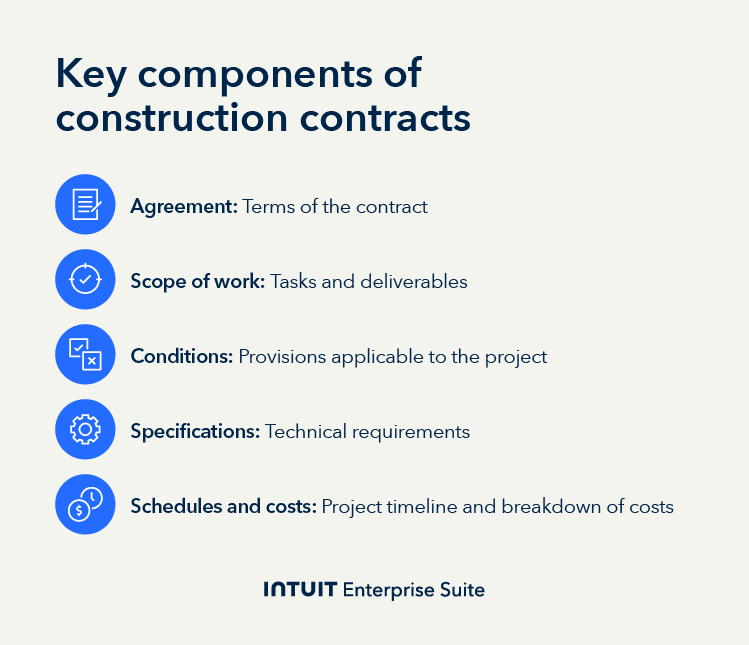
A well-crafted construction contract agreement details every aspect of the agreement, from scope and specifications to timelines and costs. Here are the nine essential elements of a construction contract to ensure you understand what should be included and what role each component plays in ensuring a smooth and successful construction process.
1. The agreement
The agreement outlines the fundamental terms and conditions of the contract, including the project scope, cost, and timelines. It serves as the foundational document that details the obligations and expectations of both parties involved in the construction project.
2. General conditions
General conditions are standard provisions applicable to most construction projects. They cover the basic rules and responsibilities, such as project management, safety requirements, and legal obligations, ensuring consistency and clarity throughout the project.
3. Special conditions
Special conditions address specific requirements unique to the project, helping you tailor the contract to your business’s needs, such as site constraints or specialized work. These also include additional details beyond the general conditions to accommodate the unique demands of specific projects.
4. Scope of work
The scope of work details the specific tasks and deliverables required for the project. It defines what is included in the project, outlining the work to be completed, any exclusions, and the standards for performance, ensuring all parties have a clear understanding of project expectations.

5. Construction drawings
Construction drawings are visual representations of the project, including floor plans, elevations, and sections. They provide a detailed guide for construction, outlining the project's design and serving as a reference for both contractors and clients.
6. Specifications
Specifications outline the technical requirements and standards for materials and workmanship. They detail the quality and performance criteria for construction elements, ensuring that materials and work meet the necessary standards and project requirements.
7. The schedule
The project schedule provides a clear timeline, highlighting key milestones, deadlines, and the sequence of work tasks. This structure supports effective time management and progress tracking throughout the project.
8. Schedule of values
The schedule of values breaks down the project costs into specific categories, such as labor, materials, and overhead. It provides a detailed account of the budget allocation and helps you manage expenses and track financial progress.
9. Bill of quantities
The bill of quantities is a detailed list of materials and labor required for the project. It includes quantities, descriptions, and unit prices, helping to accurately estimate project costs and required resources.
Use a custom ERP with automation capabilities to manage your construction contracts with ease.
Best practices for managing contracts in construction
Effective contract management is a critical discipline for the financial health of any construction business. Implementing a few key strategies can help reduce financial risk, prevent costly disputes, and protect your cash flow.
Create a clear document hierarchy
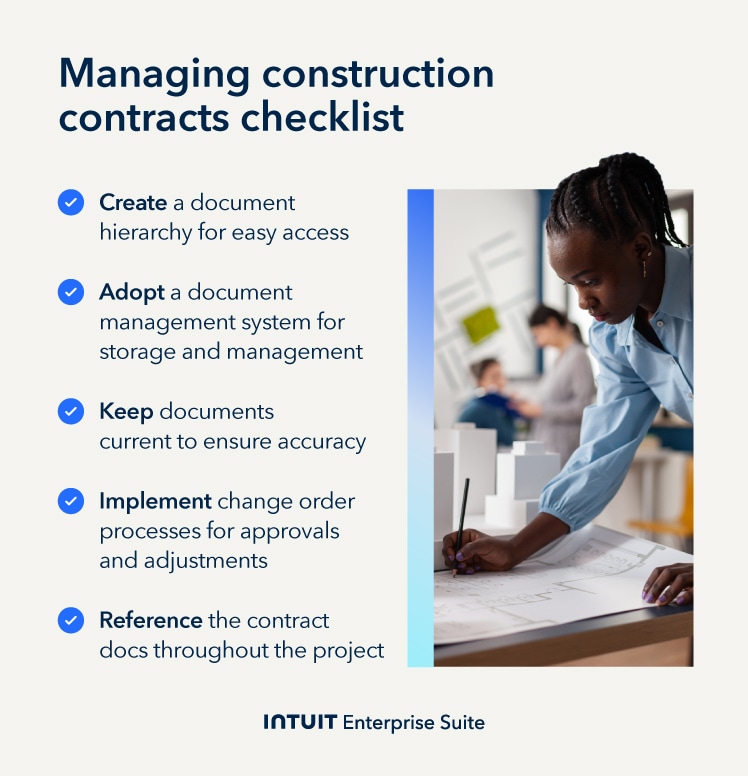
Organizing your construction documents in a clear hierarchy ensures all critical information is easy to access and reference. A well-structured system—from the master contract to sub-agreements and change orders—helps to prevent costly errors and reduce construction accounting mistakes. A systematic approach to construction project accounting is also essential for accurately tracking costs.
This systematic approach streamlines communication and provides an immediate source of truth, minimizing financial risk and protecting your bottom line.
Adopt a comprehensive document management system
Using a document management system simplifies the process of storing, managing, and sharing documents. Construction software tools allow you to track revisions, control access, and maintain a central location for all contract-related files, improving efficiency and reducing the risk of lost or outdated documents.
Keep documents current and comprehensive
Regularly updating your construction documents is essential for maintaining accuracy and preventing potential legal and financial disputes. Ensure all changes and additions are formally recorded and that all documents are complete.
Comprehensive and up-to-date records are fundamental to ensuring compliance, providing an audit trail, and protecting your company from liability.
Implement defined change order processes
Establishing a structured change order process is crucial for managing any modifications to the original contract. A clear procedure for submitting, reviewing, and approving changes ensures all parties understand the precise financial, scope, and timeline implications.
This proactive approach reduces the likelihood of costly disputes and helps prevent scope creep, which can quickly erode profit margins and disrupt project schedules.
After signing, reference the contract docs
Once the contract is signed, refer to the contract documents regularly throughout the construction process. Doing so ensures everyone follows the agreed-upon terms, avoiding miscommunication and ensuring the project adheres to its original scope and conditions.
Legal concerns that can impact construction contracts
Knowing what makes a contract legally sound—or not—is just as important as the work itself.
Here are some key legal principles that can affect your construction contracts and agreements:
The rule of construction
The rule of construction is a legal principle used to interpret the terms and clauses of a contract based on its original intent and meaning. This rule helps clarify any ambiguous language and ensures the document accurately reflects the agreement between all parties.
Despite the name, this principle applies to most types of legal contracts, not just construction contracts.
Invalid construction contracts
A construction contract can be deemed invalid or void for several reasons. It may be invalid if it lacks mutual consent between the parties or fails to meet specific legal requirements, such as including all necessary signatures or a clear scope of work. A contract can also be voided due to misrepresentation or fraud.
Factors that make a contract voidable include:
- Lack of mutual consent: Occurs when there's a misunderstanding or if one party was under duress—meaning they didn't give consent freely.
- Misrepresentation: Involves one party making a false statement of a material fact to coerce the other party into signing the contract.
- Failure to meet legal requirements: Contracts must meet certain legal formalities to be enforceable. For instance, a contract may be invalid if it lacks a clear scope of work, making it impossible to fulfill the agreement.
While voiding a contract is a less-than-ideal scenario in most cases, knowing what makes a contract valid or invalid can help you protect yourself and your business.
Navigate midsize and complex business challenges and opportunities
Running a growing construction business comes with its fair share of challenges, but also plenty of opportunities. Whether it’s managing contracts or keeping projects on track, having the right tools can make all the difference.
Ready to take control of your financial future? Learn how Intuit Enterprise Suite can help your growing construction business streamline workflows, improve cash flow, and scale with confidence.

Check out upcoming events and learn more about Intuit Enterprise Suite.

Customer stories

Case Study
How FEFA Financial is growing with Intuit Enterprise Suite—without migrating to an ERP

Case Study
How this mission-driven, employee-owned company created efficiencies with Intuit Enterprise Suite
October 25, 2024

Case Study
Why this camping business chose Intuit Enterprise Suite over NetSuite
October 25, 2024

Case Study
Migrating to Intuit Enterprise Suite took 2 hours (with zero disruption) for this aspiring $50M revenue business
April 25, 2025

Case Study
Humble House Foods case study: How they improved visibility & simplicity using Intuit Enterprise Suite
September 24, 2025
More on construction

Guide
2025 Construction technology trends report: What are the opportunities of AI in construction?

Construction
ERP for construction: Managing costs & keeping building projects profitable
September 18, 2024

Construction
3 common mistakes preventing profitable growth in your construction business
November 20, 2025

Construction
Risk management in construction: How to ensure construction compliance & mitigate project hazards
May 18, 2025