Table of contents
Table of contents
In many multi-entity firms, subsidiaries run their own close using their own dimensions, recognition rules, and reporting conventions. That means by the time you've standardized every file into a group view, the data will already be out of date.
An ERP is a software platform that pulls financial and operational data from every entity into one place, giving you a consolidated view of margins, cash, and project costs without manual reconciliation. This allows finance teams to identify issues earlier and make decisions during the period, not after the close. AI-native platforms go further, acting on that data automatically rather than waiting for the finance team to process it.
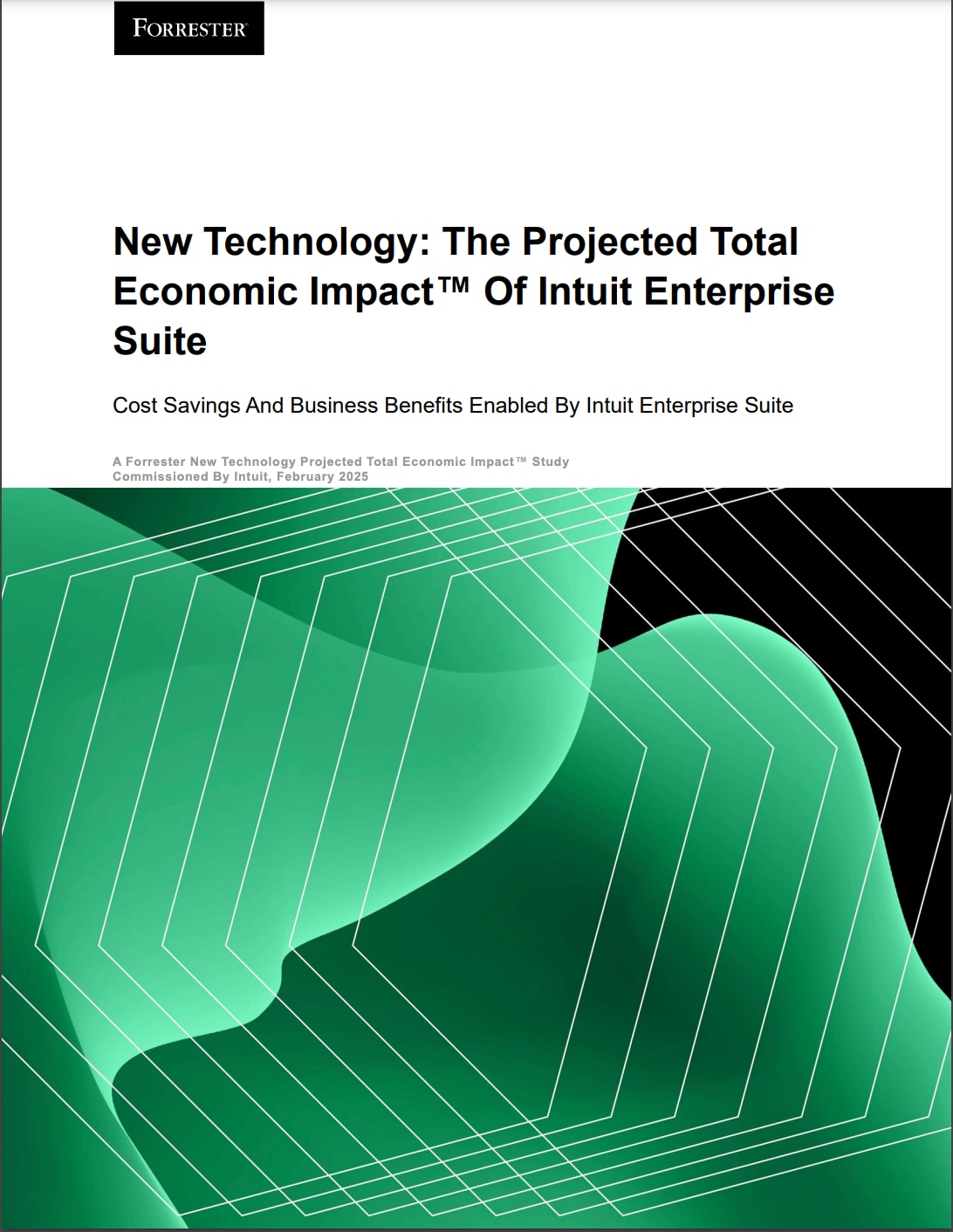
The returns justify the investment. A Forrester TEI study commissioned by Intuit projected a 299% ROI over three years for Intuit Enterprise Suite customers.
In this article, we cover the top 10 advantages of enterprise resource planning, the pitfalls to avoid when implementing a system, and how to decide whether an ERP is right for your business.

1. Operational efficiency
Finance teams in multi-entity firms routinely spend more time collecting and reconciling data than analyzing it. 81% of companies that have implemented an ERP have reported improved productivity, according to Panorama Consulting Group's ERP Report.
Embedded AI in ERP systems goes further by automating reconciliation, forecast updates, and collections follow-up directly within the workflow. For example, Intuit Enterprise Suite’s:
- Accounting Agent automates reconciliations and identifies anomalies across entity-level transaction data
- Project Management Agent retrieves cost and schedule data from active projects to keep forecasts current without manual updates
- Payments Agent analyzes customer payment behavior and automates invoice reminders to accelerate collections
This shift from manual processing to automated workflows means that the outputs that affect margins and cash, like forecasts and variance analysis, are based on live entity and group data, so strategic decisions reflect current performance rather than last month's close.
Example: A manufacturer operating across six entities relied on spreadsheets emailed from each subsidiary to build a group cash forecast. The problem was the numbers were a week old by that point. Since implementing an ERP with automated reconciliation, they can now spot drifting group margin and cash position in days rather than weeks, while there’s still time to make a course correction.

2. Scalability and flexibility
Switching to a new ERP during a period of growth is highly destabilizing for finance teams and the operations that rely on their reporting.
According to Panorama Consulting Group, 51% of companies experience operational disruption when going live with a new ERP. That disruption shows up as delayed reporting, frozen integrations, and months of running old and new systems side by side, doubling the workload for teams who are already stretched.
Modern ERPs absorb additional complexity as the business adds new entities, jurisdictions, or service lines, without requiring a rebuild. Their modular architecture also allows firms to add extra capabilities, such as multi-entity consolidation, project accounting, or payroll, as needed.
Cloud-based ERP systems also remove the infrastructure overhead that made scaling so expensive, and vendors manage software updates so new features and compliance changes arrive without scheduled downtime or IT projects.
When the board approves a new entity or acquisition, finance maps its chart of accounts, recognition rules, and reporting calendar onto the group's existing structure. This speeds up integration and maintains consolidated visibility from day one.
 A Forrester TEI study commissioned by Intuit projected $42,831 in technology cost savings over three years for Intuit Enterprise Suite customers, reducing the cost of scaling as the group adds entities and jurisdictions.
3. Decision-making
The data reaching a CFO's desk is often the most current in the business, but if it doesn’t forecast what comes next and explain what has already happened, leadership is more reactive than proactive. This becomes a data quality problem, which, according to Cherry Bekaert's CFO Survey, 49% of middle-market CFOs cite as a barrier to making critical financial decisions.
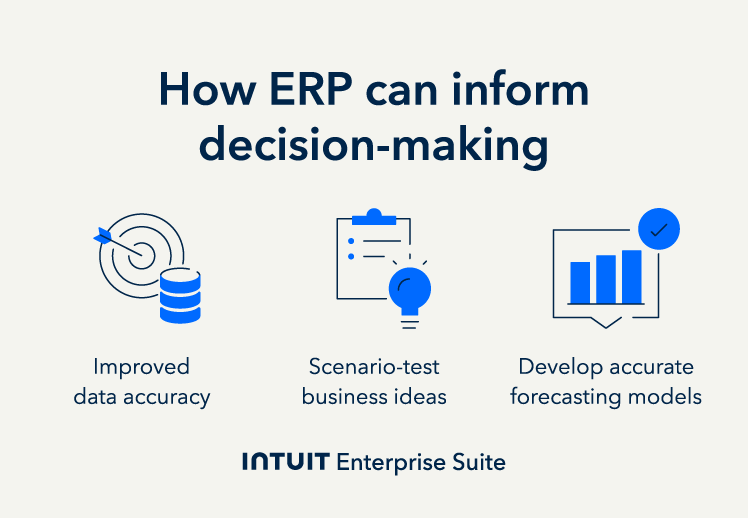
With live consolidated data in one place, enterprise planning shifts from a quarterly exercise to a continuous process. You can:
- Model scenarios across entities: Test the impact of pricing changes, staffing decisions, or capital allocation in areas like equipment investment and market expansion before committing to a course of action
- Forecast with AI: Intuit Enterprise Suite's AI Finance Agent uses up to five years of historical data to set benchmarks and update forecasts as real-time numbers come in, improving on manually maintained spreadsheet models
- Analyze performance by dimension: Break down margin, revenue, and cost by entity, project, region, or product line to identify which are delivering value and which are eroding it
Forecasting from live, consolidated data rather than static spreadsheets means the gap between recognizing a problem and acting on it gets shorter across all entities. This is the foundation of effective enterprise performance management across the group.
Example: A consulting firm with six entities on Intuit Enterprise Suite notices that utilization rates are strong, but project margins are declining in two subsidiaries. Using dimensional analysis in the platform, the CFO discovers they are pricing new work based on outdated rate cards. They revise the pricing model using the AI Finance Agent to confirm that the adjustment restores margins without affecting win rates across the group.
4. Customer service satisfaction
Many multi-entity firms know their overall churn rates but, without centralized client profitability reporting, can't distinguish between losing low-margin accounts and losing the ones that fund growth. ERPs close this gap by connecting client revenue, cost-to-serve, and retention data across entities, so you can identify which customers are driving margin and which are eroding it.
With that visibility, firms can allocate resources toward higher-margin accounts, identify and renegotiate low-margin or unprofitable contracts, and proactively address attrition that impacts revenue and customer lifetime value. 65% of businesses improved the customer experience after implementing an ERP, according to Panorama Consulting Group's survey.
When sales and account teams see which clients generate margin and which don’t, retention becomes a lever for improving profitability.
When multiple entities are involved in service delivery, costs from the same jobs end up in different books. An ERP rolls up the full picture so you can assess deal-level margin at the group level and not just in the entity that booked the revenue.
5. Cost savings
Cost savings are among the most measurable advantages of ERP software for multi-entity firms. First, there are the direct process savings the software delivers. The Forrester TEI study commissioned by Intuit projected $596,024 in total benefits over three years for Intuit Enterprise Suite customers.
Those figures only cover the direct process savings. For multi-entity firms, an ERP creates cost advantages across the business:
- Group-wide spend: Uncover when subsidiaries are buying the same goods or services from different vendors and negotiate a volume discount. Likewise, retire separate company software licenses and bring the group onto one contract at a lower per-seat cost.
- Resource visibility across the group: Allocate resources between entities when there’s idle capacity. For example, deploy in-house staff instead of hiring subcontractors when another entity's team has the capacity to absorb the work.
- Working capital optimization: Embedded cash management solution features let you move surplus cash from one entity to another to cover shortfalls or potential covenant breaches to reduce reliance on external credit.
- Anomaly detection for margin protection: Intuit Enterprise Suite's Accounting Agent automates bank reconciliation and monitors transaction data for coding inconsistencies, duplicate entries, and unusual variances, catching errors before they affect the accuracy of group reporting.
- Predictive cost management: Use forecasting tools to identify budget drift and resource misallocation in time to make a correction and protect margins and cash.
As the group grows and takes on new departments and entities, you create a shared cost structure that gets more efficient with every one, improving margins and freeing capital for reinvestment.


6. Compliance requirements
For multi-entity firms, the complexity of adhering to compliance requirements scales with every new entity and jurisdiction. It also adds cost when finance teams spend time preparing for audits and tracking regulatory changes across every region the group operates in.
72% of executives say the increasing complexity of compliance requirements over the last three years has negatively impacted profitability, according to PwC's Global Compliance Survey.
ERPs build compliance controls into daily workflows so you have the evidence ready for auditors as required. Features include:
- Role-based access controls: Enforce segregation of duties through the system, defining who can view, edit, and approve financial data at entity and group level
- Audit-ready reporting: Every transaction carries a complete audit trail, showing who created it, who approved it, and when, without the need to reconstruct it during audit season
- Automated tax rule updates: Platforms update tax rates, filing deadlines, and jurisdictional rules when regulations change, so you’re always applying current rules to entity-level returns
- Real-time compliance monitoring: Receive immediate notification on deviations from approved workflows, unusual transaction patterns, or missing approvals before they become an auditing issue
While ERPs don’t fully eliminate the risk of compliance failures, you can defend and evidence every transaction and approval when auditors come calling, protecting the group from penalties and reputational damage.
 Businesses must stay informed about changes in laws and regulations. Payroll errors can result in a $1,000 fine, and failing an ISO 9001 audit could lose you your certification. Fortunately,
ERP systems have built-in controls to help prevent compliance errors and can even provide regulatory change updates.
7. Collaboration and communication
In multi-entity firms, the same question produces different answers depending on which entity or department is reporting if they record transactions differently, use different tools, or follow different reporting conventions. This leads to multiple incoming spreadsheets and a scramble to normalize everything into one group view at the end of the period.
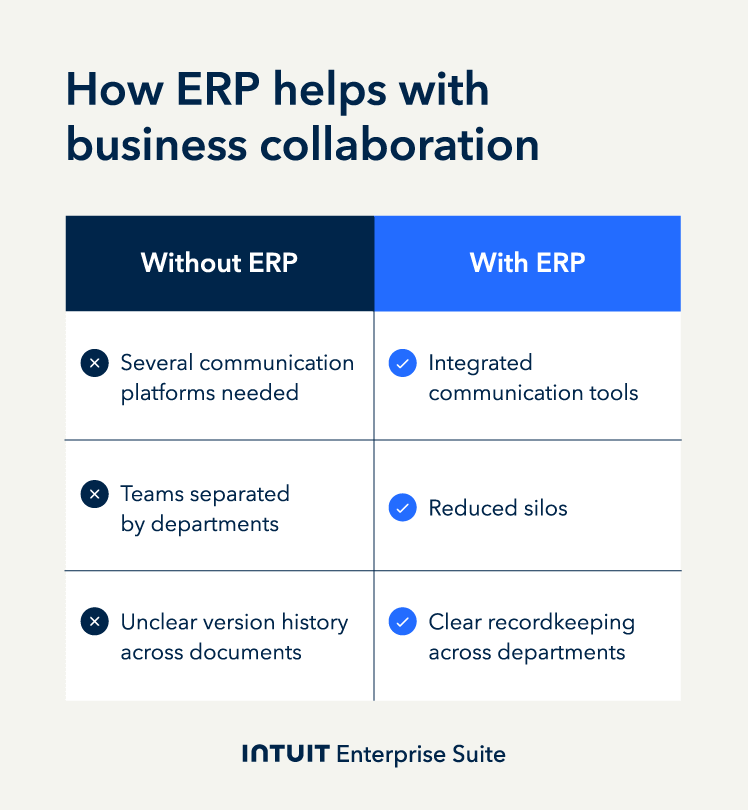
In a survey of 700 finance leaders by FinTech Strategy, 31% said reconciling accounts between entities was their biggest monthly pain point, followed by month-end close delays and audit preparation.
An ERP solves this by giving every function that touches financial data, from project managers to operations to subsidiary controllers, a single version of the numbers to work from. In practice, that means:
This shared process across the group means the numbers you receive have been validated using the system you put in place. At the board level, this means the conversation is about strategy and performance, not data quality.

8. Workforce productivity
Productivity gains are harder to achieve when every entity and department produces data in its own way. Finance inherits the consequences as they have to standardize every spreadsheet they receive before it's usable. This is one reason only 35% of FP&A professionals' time goes to high-value work, according to the FP&A Trends Survey.
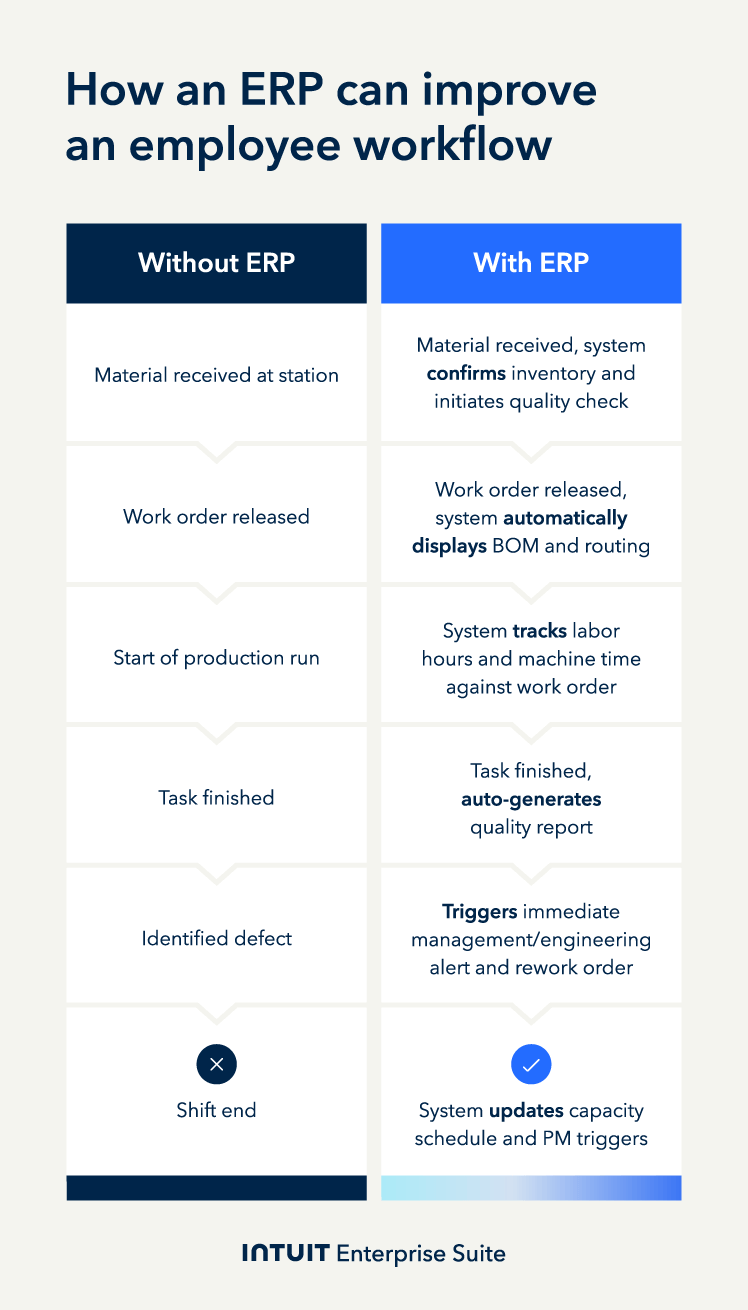
An ERP lets you reclaim that time and extend productivity gains across the business. ERP dashboards display information relevant to department heads and entity controllers.
AI agents accelerate these gains further. Intuit Enterprise Suite's Accounting Agent automates reconciliation across entities, and the Finance Agent updates forecasts as actuals post, reducing the manual work that sits between raw data and a decision. In practice, these productivity gains look like:
As productivity increases across the group, your role shifts from chasing data to spearheading performance improvement across every entity.

9. Supply chains
Every purchasing, inventory, and shipping decision has cash and margin consequences. In multi-entity firms, the consolidated impact often becomes clear after the close, by which point the cost of correcting it is higher.
An ERP that connects supply chain activity to financial data across the group gives you a continuous view of how operational decisions are affecting cash and margins. You see the impact as each transaction is posted, not after they've settled into the P&L.
Here is how an ERP mitigates risk across four areas:
- Working capital: ERPs record purchase orders, receipts, invoices, and payments across every separate entity, so you can see committed cash, the date it leaves, and which subsidiaries drain cash first
- Margin accuracy: ERPs can also capture freight, duty, and rebates as well as supplier pricing, giving you true gross margin by entity rather than a number distorted by how each one recorded costs
- Inventory risk: See group-wide aging and turnover data so you can act before a write-down or write-off hits P&L
- Group exposure: Intercompany stock movements and transfer pricing can be tracked across the group, so revenue, cost of sales, and profit stay in the right entity
With an AI-native ERP like Intuit Enterprise Suite, supply chain data feeds into financial reporting across the group. You manage both margin and cash on a continuous basis, instead of having to investigate and explain variances at period end. The platform's AI-driven accounting capabilities monitor transaction-level anomalies automatically, so catch supply chain coding errors before they distort the group P&L.
SelectHub’s analysis of 225 companies evaluating ERP software, accounting was the most critical function for 89% of respondents, with general ledger, accounts receivable, accounts payable, budgeting, and financial reporting rated as the most important accounting features.
10. Connected platform and multi-entity control
Each of the nine benefits in this article depends on operating on a common platform with shared data and shared rules. According to that same Forrester study, 59% of respondents experienced data fragmentation with their existing financial ecosystem before moving to Intuit Enterprise Suite.
The cost of fragmentation is real, not abstract. Leaving aside the licensing, integration, and maintenance costs of running multiple systems, every additional platform means another close process to coordinate, and another source of numbers that need reconciling before group reporting can begin.
Platform consolidation eliminates that overhead by giving every entity, function, and user one system to work from. In practice, this changes:
For any ERP business case to hold, the platform has to eliminate more overhead than it introduces. The Forrester study projected $42,831 in technology cost savings over three years from consolidating redundant systems onto Intuit Enterprise Suite.
But the bigger saving is your time. With a connected platform, you have the data to make and steer decisions at the group level and the confidence of the board to act on your recommendations.
What are the most common pitfalls of ERP implementation?
Traditional ERP implementation carries capital and disruption risk, even if you select the right system and configuration. The most common pitfall is underestimating what it takes to get the organization ready to switch away from the tools and processes that staff in each entity feel comfortable with.
To prevent low adoption rates, you need to show each team how the new system makes their specific role easier, not just improve the group's reporting.
Other risks that matter include:
- Data migration: Legacy data carries years of inconsistencies and duplicates which, left unresolved, impact the effectiveness of the new system
- Cost underestimation: Training, change management, and IT and support often exceed initial budgets you’ve planned
- Overestimation of benefits: The complexity of traditional ROI inhibits immediate returns but ROI improves over time, so phased targets tied to specific outcomes
- Insufficient planning: Phased rollouts through a structured ERP modernization program reduce risk by proving value in one area before expanding to the next
In contrast to the long run-in traditional ERP system implementation, 95% of Intuit Enterprise Suite customers report being set up in under 30 days. From there, the pace of return depends on how quickly each entity adopts it.
Gartner estimates that by 2027, as much as 75% of ERP initiatives will fail to meet their goals due to a lack of planning and strategy. This is why knowing what you need and choosing a flexible ERP solution is key.
Is an ERP the right move for your business?
ERPs become essential for mid-sized businesses managing multiple entities. To maintain control over the operating and financial complexity of running a group, your ERP needs to deliver on several fronts:
The right ERP pays for itself every time you make a decision based on data that’s live, accurate, and trusted by the board.

Take control of your multi-entity operation
Moving a multi-entity group onto a traditional ERP platform is a significant commitment in time, budget, and organizational change. The benefits are worth it, though, through faster closes, more accurate forecasting, and group-level financial control.
With Intuit Enterprise Suite, you get enterprise-grade multi-entity control and AI-native automation without the multi-year implementation or the cost of a legacy platform.
To find out more about Intuit Enterprise Suite, book a call with one of our consultants to walk through your requirements and get a tailored demo.
Check out upcoming events and learn more about Intuit Enterprise Suite.
Customer stories

Case study
How FEFA Financial scaled up with Intuit Enterprise Suite (No ERP migration needed)

Case study
Case study: Fire & Ice transforms multi-entity challenges with Intuit Enterprise
October 25, 2024

Case study
Four Points RV Resorts review: Why they chose Intuit Enterprise Suite over NetSuite
October 25, 2024

Construction
Migrating to Intuit Enterprise Suite took 2 hours (with zero disruption) for this aspiring $50M revenue business
April 25, 2025

Case study
Humble House Foods case study: How they improved visibility & simplicity using Intuit Enterprise Suite
September 24, 2025
More product updates

Product update
What’s new in Intuit Enterprise Suite spring 2025
April 1, 2025

Product update
Intuit Enterprise Suite 2025 update: AI agents & automation enhancements
July 22, 2025

Product update
What’s new in Intuit Enterprise Suite November 2025: The AI-native ERP that adapts with your business
November 14, 2025