Table of contents
Table of contents
Key takeaways
- ERPs become necessary for multi-entity businesses when their current accounting stack cannot close on time with reliable group numbers.
- They connect financial and operational data, so entity-level activity reaches the ledger without separate reconciliation work.
- ERPs give real-time visibility on consolidated performance, intercompany positions, and entity-level results.
- Choose an ERP that allows you to set accounting and governance baselines and absorb new entities without adding to headcount.
Enterprise Resource Planning (ERP) systems consolidate financial and operational data into a real-time single source of truth. When a purchase order is approved, a milestone triggers a billing event, or a supplier payment clears, the financial position updates in real time without requiring finance to post it to the ledger manually.
In multi-entity businesses, ERPs do this across every subsidiary, location, and service line. They eliminate intercompany transactions automatically so the consolidated view reflects external performance only.
According to Intuit’s Enterprise Technology Benchmark, 76% of multi-entity businesses say existing technology struggled to keep up when they added new entities. These are the issues that ERP systems solve. This article covers the five essential pillars of a modern multi-entity ERP and when it is the right time to move away from spreadsheet-based accounting.

The essential pillars of a modern multi-entity ERP evaluation
There are hundreds of ERP platforms available, but only a few are specifically designed for multi-entity organizations. Look for these five capabilities when evaluating and shortlisting potential vendors:
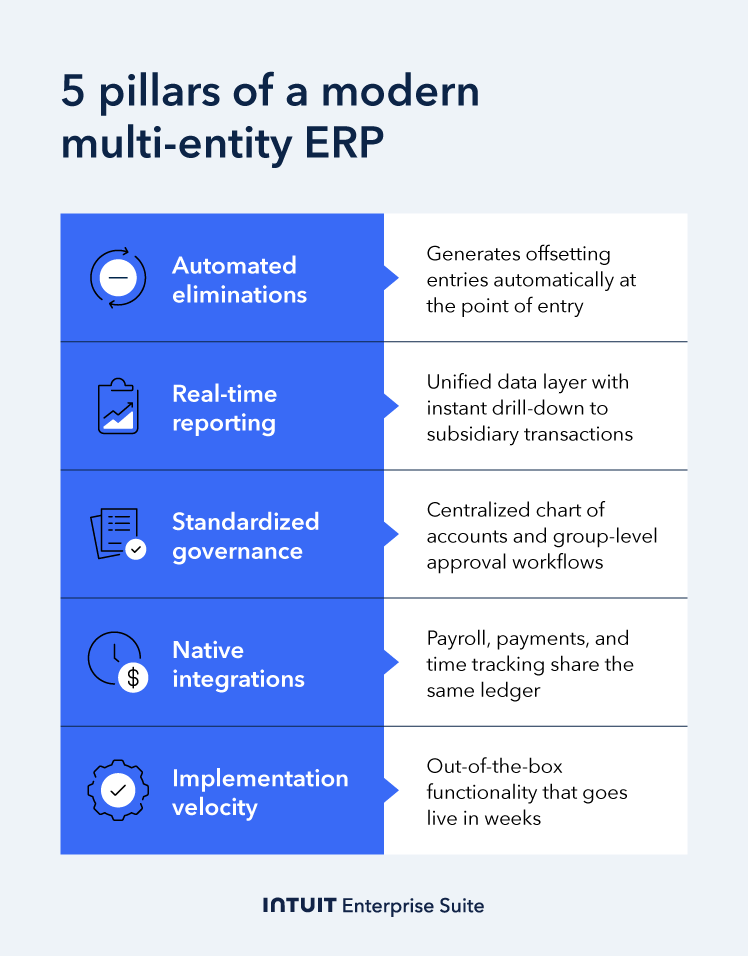
1. Automated intercompany eliminations
Intercompany reconciliation is the stage of the multi-entity close that mainstream accounting platforms and spreadsheet-based stacks struggle with. Finance teams are under pressure to manually match sales, expenses, and interest entries across entities within a given time.
It’s challenging, and likely one of the reasons 64% of leaders in Intuit’s Enterprise Technology Benchmark survey that month said the month-end close takes too much time.
Modern multi-entity cloud ERP solutions automatically generate offsetting eliminations whenever an intercompany transaction is posted, preventing double-counting. This means the consolidated statement no longer depends on a Controller catching every offset before the close deadline.
Point-of-entry eliminations let you sign off consolidated results before internal transfers become a close delay or board-reporting risk.

When assessing vendors, ask whether intercompany eliminations occur automatically on every transaction or as a batch adjustment at the end of the period. If it’s the latter, you still carry the same reconciliation risk into every close.
2. Real-time consolidated reporting
In most multi-entity operations, finance compiles consolidated numbers at a point in time and reviews them later. By the time you open the report, the underlying entity data has already changed. The Intuit Enterprise Technology Benchmark found that 69% of multi-entity businesses cannot effectively guide growth without real-time visibility into performance across entities, projects, and departments.
Ask potential ERP vendors to take the "10-second proof" test. Get them to show you that they can move from a consolidated balance sheet down to a specific transaction in a regional subsidiary instantly.
If the vendor needs a separate Business Intelligence (BI) tool to show you the transactions behind a consolidated number, the summary and the detail aren’t in the same unified system.
There are three major issues with this:
- Latency: The consolidated number and the transaction detail may update on different schedules, so it’s hard to tell if any discrepancy is an error or a sync gap
- Traceability: The ERP does not control the path from group number to source transaction, so you need to debug two systems if something does not reconcile
- Speed: If you answer "we need to pull it up in another tool” when someone in a board meeting asks "where did this come from," this can erode confidence in the figures.
For example, with Intuit Enterprise Suite, you get one consolidated view of multi-entity performance, with live access to shared data and drill-down from summary reports to transaction-level detail.
Real-time consolidated reporting gives you time to investigate entity-level variances, so you stop outdated numbers from reaching the board pack and being used as the basis for decision-making.
3. Standardized governance and internal control frameworks
A centralized chart of accounts ensures that every entity follows the same reporting rules, eliminating the need for manual data mapping. Despite this, only 48% of businesses describe their technology environment as highly integrated, according to Intuit’s Enterprise Technology Benchmark report.
Once this standardized reporting structure is in place, leadership can effectively govern data access across the portfolio. Intuit Enterprise Suite uses custom roles and granular permissions to let you define access privileges at both the group and individual entity levels, ensuring regional managers can view and act on financial data relevant to their specific operational responsibilities.
Plus, Parallel Approval in Workflow Automation sends each transaction to all required approvers at once, rather than one at a time, so approvals do not become a bottleneck at close.
Set your own controls across a single framework that governs approvals, access, and reporting across every entity to stay compliant with audit requirements, with no need to rebuild the process each time you add a subsidiary.
What’s the difference between ERP and MRP systems? ERP systems manage financial and operational data, while MRP systems manage production planning, including materials, scheduling, and shop-floor workflows.
4. Native integration of payroll, payments, and time tracking
Disconnecting core operational drivers like payroll execution, vendor disbursements, and field time tracking from the financial core obscures your true working capital position.
Relying on fragile third-party APIs to push this data into the general ledger creates synchronization gaps and manual reconciliation checkpoints where numbers easily diverge. This fragmented data layer forces finance teams to manage cash positions using stale ledger balances, turning liquidity oversight into a reactive exercise.
Consolidating these operational layers directly into the unified financial architecture eliminates this systemic friction. When the core ledger, payroll, payments, and time data reside in the same database, every transaction posts in real time without batch delays or manual transfers.
Business leads recognize this value, with 73% saying consolidating technology is the fastest path to profitability, according to the Intuit Enterprise Technology Benchmark report.
Intuit Enterprise Suite leverages this native integration to deliver same-day working capital clarity across your entire portfolio. The system automatically reflects real-time payroll liabilities and payment runs on the balance sheet, providing the group finance office with immediate visibility into the global cash position.
This live data feed allows you to precisely time disbursements, efficiently redirect surplus capital between entities, and optimize short-term funding without incurring unnecessary borrowing costs.
5. Implementation velocity
Many firms put off upgrading because of "implementation debt." Legacy ERP deployments typically mean months of lost productivity, high consulting fees, and a long runway before they can finally use their system.
Overspeccing is another major concern. The Intuit Enterprise Technology Benchmark found legacy ERP users estimate they leave 47% of available capabilities unused.
A suite that goes live in weeks, with relevant out-of-the-box multi-entity functionality, delivers a faster ROI than a platform that requires extensive initial configuration. When choosing a multi-entity ERP, calculate total cost of ownership for each system. Ask how long until go-live, how dependent you are on consultants after that, and how much of your finance team’s time they’ll need to get the platform ready.
The shorter the implementation time, the less team time you lose to the project and the lower the cost. You keep your best people on the work the migration was designed to improve.

How does implementation debt impact long-term financial scalability?
Implementation debt doesn’t stop at system launch. It is the ongoing cost of maintaining a system that needs consultant intervention to keep pace with new entities, changed reporting requirements, or updated workflows.
Custom scripting is what disrupts most organizations. Customizations built during the original implementation often break during routine system updates. This affects the system’s functionality and pulls the finance team away from work to diagnose and repair the system.
Modern ERP suites prioritize out-of-the-box multi-entity functionality to ensure the finance team can manage growth independently. They are flexible and faster to deploy, with 95% of Intuit Enterprise Suite customers live within 30 days.
Choose a platform that handles new entities, reporting changes, and workflow updates without needing a consultant to reconfigure it, and you don’t need to factor in implementation time to onboard each new acquisition.
Case study: HFMM Legacy Group, an outdoor services company managing eight entities, migrated to the Intuit Enterprise Suite in about 2 hours. The founder and CFO report that the firm saves 10 to 15 hours a week by eliminating manual consolidation across systems.
Why is AI a critical asset in the modern finance suite?
AI is most valuable when it solves specific, high-friction problems during the month and not at close. Catching issues like unmatched intercompany transactions or cost anomalies mid-month gives you more time to investigate and correct a missing offset or a miscoded expense. According to Intuit's Enterprise Technology Benchmark, 92% of leaders are redesigning their company processes around AI to maximize impacts like these.
Intuit Intelligence acts as a proactive governance monitor that identifies discrepancies in real time. It helps finance teams analyze performance patterns, review anomalies, and examine entity-level results before close.
Case study: Intuit Enterprise Suite’s AI identified a 50% variance in a prepaid asset account that had gone unnoticed in conventional review for Rhodes Companies, a family office managing 9 entities.
Mid-month detection of cost discrepancies and intercompany mismatches changes the Controller's job. Instead of assembling data and checking it line by line, they review identified exceptions and recommend next steps to take.
The same Enterprise Technology Benchmark found that 91% of leaders agree human oversight is still essential as AI becomes more helpful.

Earlier anomaly detection gives you time to correct miscoded expenses and missing offsets before close, so you approve the group result having already resolved the main variances.
During a vendor demo, ask to see an anomaly AI finds by comparing data across entities, not just within one. That could be an intercompany charge recorded by one entity but not by the counterpart. If the vendor can only demonstrate single-entity examples, the AI may not be reading across the group.
When is it time to move away from spreadsheets?
Reconciliation debt is often the trigger for a move to an ERP solution and away from spreadsheets. According to Intuit's Enterprise Technology Benchmark, 73% of multi-entity businesses expect to outgrow their technology within 12 months, and spreadsheet-driven consolidation is typically where the strain shows first.
Signs your current setup has reached its limit include:
- Intercompany reconciliation: Finance spends so long manually untangling intercompany transactions that decision-grade data doesn't reach you in time for the board.
- Mismatched balances: Entity A's receivable does not match Entity B's payable, because each entity recorded the same transaction differently. Manual reconciliation catches it during period-end but cannot fix the underlying fault.
- Close cycles lengths: Mismatches and manual reconciliation contribute to 15-day close cycles, which limit your ability to redirect capital toward higher-growth subsidiaries.
Spreadsheet-driven consolidation is a governance risk when finance spends more time reconciling data than analyzing it. At that point, you need to weigh the cost of staying against the cost of switching and present the total cost of both options to the board.
Case study: Four Points RV Resorts, which manages eight parks across multiple LLCs, reduced intercompany entries from more than 90 minutes to approximately 30 minutes after moving to Intuit Enterprise Suite’s unified platform. Consolidated reports that once took the best part of an hour to produce now take a few seconds.

When you schedule a demo, you agree to permit Intuit to use the information provided to contact you about Intuit Enterprise Suite and other related Intuit products and services. Your information will be processed as described in our Global Privacy Statement.
From evaluation to operating baseline
Intercompany accounting, access control, consolidation, and reporting speed are where most spreadsheet models and legacy ERP setups hit their limits. These constraints worsen as you add more entities to the group.
The right ERP system handles all four, even as you scale. The test when evaluating an ERP is whether it automates intercompany accounting, applies permissions and approvals across the group, and produces consolidated reports under the rules you set without months of implementation and a higher headcount.
Book a call with an Intuit Enterprise Suite consultant to share your current setup and determine whether our platform is a good fit.
Check out upcoming events and learn more about Intuit Enterprise Suite.
Customer stories

Case study
How FEFA Financial scaled up with Intuit Enterprise Suite (No ERP migration needed)

Case study
Case study: Fire & Ice transforms multi-entity challenges with Intuit Enterprise
October 25, 2024

Case study
Four Points RV Resorts review: Why they chose Intuit Enterprise Suite over NetSuite
October 25, 2024

Construction
Migrating to Intuit Enterprise Suite took 2 hours (with zero disruption) for this aspiring $50M revenue business
April 25, 2025

Case study
Humble House Foods case study: How they improved visibility & simplicity using Intuit Enterprise Suite
September 24, 2025
More product updates

Product update
What’s new in Intuit Enterprise Suite spring 2025
April 1, 2025

Product update
Intuit Enterprise Suite 2025 update: AI agents & automation enhancements
July 22, 2025

Product update
What’s new in Intuit Enterprise Suite November 2025: The AI-native ERP that adapts with your business
November 14, 2025