Table of contents
Table of contents
What is financial planning and analysis? Financial planning and analysis (FP&A) is the process businesses use to guide financial decision-making, manage budgets, forecast future performance, and analyze financial results to support overall business strategy.
Understanding your company's financial health is important for sustainable growth, but many businesses find their current tools lack deep financial insights.
In fact, 45% of executives cite inadequate reporting and analysis capabilities as a key challenge with their digital solutions, according to QuickBooks’ Business Solutions Survey. This highlights the critical need for effective financial planning and analysis (FP&A).
FP&A uses forward-looking insights and analysis, beyond historical accounting, to strategically allocate resources, drive profit, and shape the organization's financial future.
Learn the key aspects of financial planning and analysis, from its core processes and strategic benefits to the modern tools that help streamline these vital functions.
The financial planning and analysis process
The FP&A process is a continuous cycle designed to provide ongoing financial guidance and performance monitoring. It involves several key stages that work together to support strategic objectives.
1. Data collection and organization
This foundational step involves gathering relevant financial and operational data from various sources across the organization. Data collected must be accurate and complete as it’s vital for the reliability of all subsequent analyses.
Data points often include:
- Revenue figures
- Cost of goods sold (COGS)
- Operating expenses
- Sales metrics
- Marketing metrics
- Headcount and personnel costs
- Cash flow statements
Successfully managing this data collection process ensures a reliable foundation for the subsequent planning, forecasting, and analysis activities.
 Implement data validation rules and regular audits of your source systems to prevent errors—such as typos skewing profit forecasts or misclassifications leading to budget misallocations—from cascading through your financial plans and forecasts.
2. Financial planning and forecasting
Once data is gathered and organized, the next step is to develop financial plans and forecasts. This involves projecting future financial outcomes based on historical data, market trends, and strategic initiatives. It's about setting expectations and direction.
Common financial planning methods include:
- Driver-based planning: Uses key operational metrics (drivers) to predict financial outcomes (e.g., predicting sales revenue based on website traffic and conversion rates).
- Zero-based budgeting (ZBB): Requires justifying every expense from scratch for each new period rather than simply adjusting the previous period's budget.
- Rolling forecasts: Continuously updating the forecast over a set period (e.g., 12-18 months), adding a new period as the current one concludes.
- Scenario planning: Modeling different potential future situations (e.g., best-case, worst-case, likely-case) to understand potential impacts and prepare responses.
Ultimately, robust planning and forecasting enable more informed strategic decisions and lay the groundwork for effective resource allocation in the budgeting phase.
3. Budgeting
Budgeting translates strategic plans and forecasts into actionable financial targets for specific periods, typically a year. It allocates resources to different departments or initiatives and incorporates detailed budgets for jobs derived from job costing while setting spending limits.
The budget serves as a benchmark against which your business will measure actual performance. This process often involves collaboration between finance and department heads to ensure alignment and buy-in.
4. Monitoring and analysis
This ongoing stage involves tracking actual financial performance against the budget and forecasts. FP&A teams analyze variances (the differences between actual results and planned figures), investigate the root causes, and report findings to stakeholders. This provides critical feedback for operational adjustments and future planning cycles.
Common FP&A key performance indicators (KPIs) include:
- Gross profit margin
- Net profit margin
- Operating cash flow
- Revenue growth rate
- Customer acquisition cost (CAC)
- Customer lifetime value (CLTV)
- Budget vs. actual variance
- Days sales outstanding (DSO)
Successfully managing this data collection process ensures a reliable foundation for the subsequent planning, forecasting, and analysis activities.

Why FP&A is important
A well-executed financial planning and analysis function delivers significant strategic value., It moves finance from a purely historical reporting role to a forward-looking business partner.
It enables smarter, data-driven decisions
Sound business decisions require solid data, not just intuition. FP&A provides the analytical rigor needed to move beyond guesswork, offering leaders a clearer view of potential outcomes based on current performance and informed projections. Instead of waiting weeks or months for traditional reports,
Financial planning and analysis aims to provide a near real-time understanding of the company's financial health to help leaders better assess the opportunity cost of choosing one strategic option over another.
This includes deep insights into cash flow dynamics, what truly drives profitability, and the potential returns on investment opportunities. Armed with this knowledge, leadership can confidently create strategic plans that are both ambitious and achievable.
Don't just report the numbers. Focus on the 'so what?' Provide context and actionable recommendations based on your analysis to truly guide decision-making.
It actively improves financial performance
A key role of FP&A is actively driving better financial results. It's not just about tracking numbers; it's about using analysis to proactively enhance profitability and operational efficiency. Through careful examination of trends and metrics, FP&A teams can pinpoint promising new revenue streams or identify untapped market potential.
FP&A also helps de-risk major business decisions using techniques like scenario modeling. This allows you to simulate the potential financial impact of choices, such as launching a product, entering a new market, or making significant capital investments, before committing substantial resources.
Proactive financial assessment leads to:
- Better allocation of capital and resources
- Minimized financial risks on major initiatives
- Identification and vetting of growth opportunities
- Optimization of cost structures and operational spending
Strategic FP&A moves finance beyond simple scorekeeping to actively shaping better financial outcomes and driving sustainable growth.
 Anchor your financial plans and forecasts in key operational drivers, like website conversion rates or units produced per employee. This is critical for understanding why performance changes and identifying actionable levers to improve future results.
It fosters collaboration and strategic alignment
It's common for different departments, like Marketing or Operations, to focus heavily on their own specific goals. Which can sometimes lead to communication gaps or 'silos' between teams, slowing things down.
Without a way to easily share and align data, confusion and delays between teams can occur. FP&A helps bridge these gaps. The FP&A team uses clear financial language to connect the company's overall strategy to each department's targets.
FP&A gives every team involved a clearer, shared view of the big financial picture. Individuals can see how their work affects the company's bottom line, leading to better teamwork, communication, and smoother progress toward business goals.
Implement shared, cross-functional KPIs that link departmental activities (like marketing spend to sales results ) to ensure everyone is aligned and accountable to the same overall financial goals.
It helps maintain compliance and mitigate financial risk
Staying compliant financially means meeting your company's obligations like loan terms and supplier payments and following relevant regulations. Which can include financial reporting and providing accurate business data for tax purposes.
While your accounting team manages the precise historical record-keeping and official filings like tax returns, Financial planning and analysis’s role is to help anticipate and manage potential compliance risks before they turn into actual problems.
FP&A helps achieve this through several key activities:
- Forecasting cash flow: This ensures funds are projected to be available to meet critical debt payments and other obligations right on schedule.
- Monitoring loan covenants: FP&A tracks projected performance against specific financial requirements in loan agreements, helping to prevent costly violations.
- Analyzing regulatory impacts: The team assesses the potential financial consequences of new or changing regulations, giving the business vital lead time to adapt its plans.
- Supporting tax planning: FP&A provides essential data and scenario analysis that informs strategic tax planning, complementing the final filing work done by accounting.
Failing to stay ahead can lead to serious consequences, including steep fines from regulators, legal challenges, damage to your business's reputation, difficulty securing loans down the road, or even defaulting on current debt.
Use FP&A scenario analysis to model the financial impact of potentially breaching key terms in major customer or supplier contracts, uncovering hidden operational or cash flow risks before they become critical.
FP&A vs. accounting
While often housed within the same finance department and working closely together, FP&A and accounting serve distinct functions. Understanding the difference is key to appreciating their unique contributions.
Accounting
The accounting function is primarily concerned with accurately recording, classifying, and summarizing historical financial transactions.
Its main goal is to ensure financial reporting integrity and compliance with the established standards, such as Generally Accepted Accounting Principles (GAAP) or International Financial Reporting Standards (IFRS).
Accountants are responsible for maintaining the company's financial records and producing core financial statements like the balance sheet, income statement, and cash flow statement.
These statements provide a clear picture of the company's financial position and performance in the past. Think of accounting as building a reliable historical foundation; its outputs are crucial data sources for FP&A.
Financial planning and analysis (FP&A)
Financial planning and analysis (FP&A), on the other hand, takes the historical data provided by accounting (along with operational data from other business areas) and uses it to look forward. The focus is on planning for the future, forecasting financial outcomes, analyzing performance trends and variances, and providing strategic insights to guide business decisions.
The main goal of FP&A is to support strategic decision-making, help optimize resource allocation, and drive future business performance. It acts as a strategic partner, interpreting financial data to help shape the company's direction.
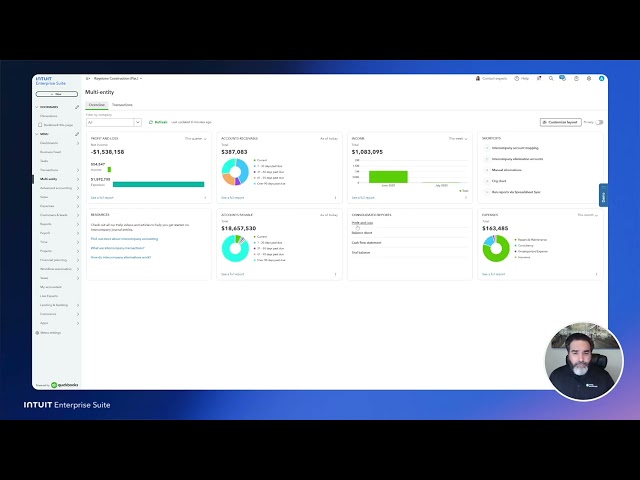
How Intuit Enterprise Suite can simplify FP&A
Effective financial planning and analysis thrives on accurate data and efficient processes. Intuit Enterprise Suite is designed to replace manual methods and provide the tools necessary to streamline FP&A functions within your business.
Here’s how specific features can help:
Centralize data with multi-entity management
For businesses with complex structures, managing finances across different entities, locations, or subsidiaries presents a major FP&A challenge.
Intuit Enterprise Suite allows you to manage users and all these business segments from a single sign-in. It facilitates intercompany transactions with automatic eliminations and generates consolidated reports, ensuring you have a unified and accurate view of the entire business's financial health – a critical foundation for reliable planning and analysis.
Streamline processes with automation
Manual data entry and repetitive tasks consume valuable time and increase the risk of errors in FP&A.
This isn't just an inconvenience. According to QuickBooks’ Business Solutions Survey, 91% of owners and executives say manual data wrangling has undermined their businesses’ productivity.

Hours spent copying data between systems or manually reconciling figures are hours not spent on strategic analysis and forecasting, directly impacting efficiency and potentially delaying critical business insights.
Intuit Enterprise Suite tackles this by allowing your team to:
- Use AI to automatically record and match bills and payments
- Create pre-filled bills efficiently via bulk uploads or email forwarding
- Implement customizable, built-in approval workflows for invoices and bills
- Assign specific roles and permissions to control who can access your books, enhancing security
This automation frees up your finance team for more strategic analysis rather than getting bogged down in routine tasks.
Gain deeper insights with advanced reporting and AI
Moving beyond standard reporting is essential for strategic FP&A. Basic reports often show what happened but lack the depth to fully explain why or predict what's next.
Harnessing advanced technologies like artificial intelligence (AI) is becoming crucial for unlocking deeper understanding and competitive advantage.
In fact, according to the Business Solutions Survey, 89% of owners and executives agree that AI is key for business success in today’s economic climate.
With Intuit Enterprise Suite, your business can:
- Utilize multi-dimensional reporting, allowing analysis across up to 20 different dimensions for granular detail
- Create custom, investor-ready reports tailored to specific stakeholder needs
- Categorize data comprehensively by line item within reports
- Leverage AI-powered recommendations that analyze connected workflows and data dynamically, supporting more confident decisions on resourcing, budgets, and project viability
- Benefit from integrated data from connected areas like Payroll and Payments, which provides a more holistic view for cash flow projections and labor cost planning
These features work together to transform raw financial data into actionable intelligence for better decision-making.
The effectiveness of AI and ML in FP&A heavily relies on high-quality, clean, and comprehensive data. Ensure your data governance practices are strong before investing heavily in these advanced technologies.
Enhance planning, forecasting, and budgeting
This suite provides tools specifically designed for the core forward-looking tasks of FP&A. You can track your budgets, manage your inventory, and monitor cash flow more effectively with real-time insights, comparing actual performance against plans.
Intuit Enterprise Suite assists with planning for the future using AI-generated forecasts based on your integrated data. Additionally, features like automated revenue recognition help ensure compliance while providing accurate revenue data, which is crucial for reliable financial projections and planning.

Boost productivity and enhance profitability
Financial planning and analysis serve as a strategic compass, guiding businesses beyond historical reporting toward proactive decision-making and future growth. Implementing strong FP&A processes provides the crucial visibility and control needed to navigate today's complex economic landscape.
Ready to elevate your company's financial strategy and unlock deeper insights from your data?
Discover how Intuit Enterprise Suite can help you automate workflows, improve forecasting accuracy, and empower your team for better performance.
Financial planning and analysis FAQ
What does financial planning and analysis do?
FP&A professionals guide business strategy by budgeting, forecasting, analyzing financial performance against plans, reporting key insights, and supporting data-driven decision-making across the organization.
How much does FP&A cost?
The cost to establish an FP&A function varies significantly based on your company's size, complexity, and specific needs. The primary investments are typically for skilled personnel (FP&A analysts/managers) and necessary technology, which could range from advanced spreadsheet techniques and existing ERP features to specialized FP&A software platforms.
What software is used for FP&A?
FP&A teams commonly use a mix of tools, including spreadsheets (like Excel), modules within their ERP systems (such as Intuit Enterprise Suite), dedicated FP&A/CPM software for more advanced planning and forecasting, and often Business Intelligence (BI) tools for reporting and visualization.
Check out upcoming events and learn more about Intuit Enterprise Suite.

Customer stories

Case Study
How FEFA Financial is growing with Intuit Enterprise Suite—without migrating to an ERP

Case Study
How this mission-driven, employee-owned company created efficiencies with Intuit Enterprise Suite
October 25, 2024

Case Study
Why this camping business chose Intuit Enterprise Suite over NetSuite
October 25, 2024

Case Study
Migrating to Intuit Enterprise Suite took 2 hours (with zero disruption) for this aspiring $50M revenue business
April 25, 2025

Case Study
Humble House Foods case study: How they improved visibility & simplicity using Intuit Enterprise Suite
September 24, 2025