Table of contents
Table of contents
Financial teams at growing multi-entity manufacturing firms face operational challenges that traditional processes can’t solve. Manually tracking intercompany transactions is time-consuming and error-prone. This allocation of high-value talent to low-value tasks eats into your margins and is insufficient to catch spending leakage before it impacts your bottom line.
ERP solutions like Intuit Enterprise Suite elevate manufacturing finance. With automated accounting across entities, CFOs and finance teams can reallocate their time and attention while realizing $127,000 in cost savings on intercompany transactions.
This article will discuss how multi-entity operations affect finance in manufacturing and where strain occurs under traditional systems. Learn how advanced AI-powered platforms provide the centralized, unified visibility and control you need to scale with confidence.

What causes multi-plant complexity?
Multi-plant complexity is the natural result of growing manufacturers expanding from a single site to multiple locations. Overseeing two or more factories creates logistical complications and planning difficulties that simply weren’t a consideration at the original site.
As growth continues and your entity count rises, trying to maintain manual oversight eventually becomes a losing battle. That’s when factory owners turn to AI-native ERPs like Intuit Enterprise Suite to automate operations and consolidate their business workflows into a single source of truth.
Adding to the new and complicated dynamic are external market factors that manufacturers can respond to or even anticipate, but never fully control.
Here are the top three market trends affecting multi-entity manufacturing in 2026:
1. The acceleration of portfolio reshaping and reshoring
Manufacturers are increasingly bringing operations back to domestic soil and using “bolt-on” acquisitions of smaller companies to provide more services or facilitate vertical integration. Both can come with previously unaffiliated debts and legacy technology that must be reconciled and modernized.
In fact, 90% of organizations are burdened by the need to update legacy systems, which can spike expenses and bog down productivity.
Handling newly acquired entities and their disparate parts creates a fog that slows down consolidated reporting and obscures real-time performance.
2. Decentralized operations and distributed plant spending
According to research from Supply Chain Media and BCI Global, 48% of surveyed manufacturers in Europe and North America decentralized operations between 2020 and 2023. Another 31% aimed to do so by 2026. While decentralization and distributed plant-led spending increase operational agility, they also have downsides.
This lack of central control severely complicates reconciliation. With each plant working by its own rules, out-of-pattern spending becomes virtually impossible for financial teams overseeing multiple entities to track. Legitimate purchases, albeit unusual, look identical to anomalies when viewed by off-site teams.
3. Increasing regulatory and multi-jurisdictional scrutiny
As firms expand across state lines or reshore operations in new jurisdictions, they face increased scrutiny, both in legal reporting and in the court of public opinion. In the US, trust in big businesses has dropped, with only 36% of Americans believing companies act responsibly.
Navigating new tax considerations and reporting requirements is hard enough on its own. When combined with the fact that even a small error in compliance, accuracy, and transparency can further erode public trust, the pressure can be immense.
You must ensure every subsidiary remains audit-ready in a more aggressive regulatory environment while simultaneously meeting manufacturing financial KPIs.
Why is finance the first to feel the strain?
Financial departments are the first to feel strained after new acquisitions and growth, given their central role within the company. While other departments like Marketing, HR, Sales, and Procurement operate in linked (but ultimately distinct spheres), everything must pass through the financial department eventually.
Your company’s financial department is the ultimate clearing house for all manufacturing activity. It acts as an intermediary for all other departments, tracking all internal expenses and incoming payments. When businesses try to scale, finance faces the greatest administrative burden and is at the greatest risk of failure.
The reconciliation trap
Manual consolidation is a linear process that does not easily scale: One accountant can only do so much work before they are at capacity. Aggravating this efficiency problem is the fact that teams spend 80% of their time on manual data compilation and entry, and only 20% analyzing it. This ultimately results in longer close times.
During multi-entity acquisition or expansion, this linear process is insufficient to meet the demands of exponential growth. Adding a single new entity to your company adds dozens of departments for your financial team to oversee.
Rather than depend on manual workflows and overwhelm their finance teams, growing manufacturing companies use automated systems. AI-powered accounting solutions automatically compile and reconcile financial data, significantly reducing month-end workflows.
 Conveyor supplier PULSEROLLER used Intuit Enterprise Suite to support their financial teams and automate workflows were on track to scale multi-entity sales by
88% over five years.
Conveyor supplier PULSEROLLER used Intuit Enterprise Suite to support their financial teams and automate workflows were on track to scale multi-entity sales by
88% over five years.
Decision lag in a high-velocity market
Successful growth decisions are fueled by real-time financial visibility. When overseeing multi-entry business structures, that clarity can be hard to come by. In fact, research from Intuit QuickBooks Business Solutions Survey found that 45% of leaders felt they had inadequate reporting and analysis capabilities.
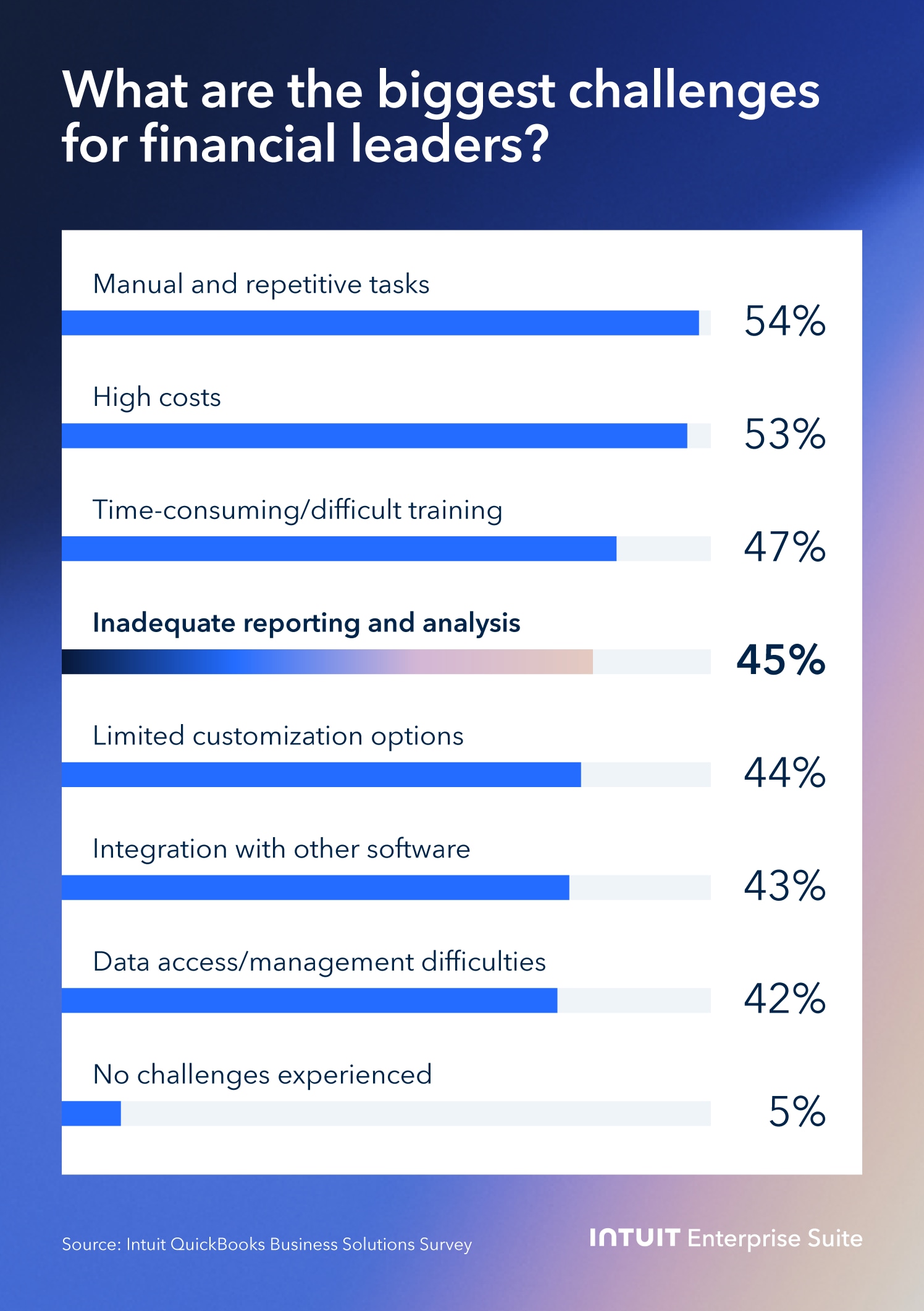
Board members expect their CFOs to make decisions confidently in a fast-paced market, and that can’t happen with reporting inefficiencies. If your month-end close takes longer than seven days, you aren't dealing with a slow team. You are dealing with operational friction and data silos.
With the right strategy and tools in place, it’s possible to build a streamlined, automated business structure that powers growth rather than hinders it.

How to build a manufacturing financial structure designed for growth
The role of CFOs in 2026 is not to manage the books. They should be building an architecture of growth. Here are the top three things to implement to create a cross-entity, scalable financial system:
1. Design for single-source-of-truth visibility
With multiple entities spread across regions or states, you need accurate insight into each factory and the overall company performance. Switching to a unified system like Intuit Enterprise Suite eliminates the need for manual data mapping between subsidiaries and breaks down silos.
Having performance and cash flow data continuously uploaded to a single hub reduces decision lag by automating previously time-consuming data compilation. This real-time consolidation allows you to see the company’s overall cash position and factory-level margins at any time.
For example, Cornerstone Development Company used Intuit Enterprise Suite not only to consolidate its construction entities but also to incorporate subsidiaries in distinct industries. The five-entity operation spans construction, environmental compliance consulting, and utility electrical engineering.
Intuit Enterprise Suite brought them all together seamlessly for comprehensive insight and centralized control. This eliminated prohibitively expensive manual processes and enabled Cornerstone to go from flying blind to achieving unprecedented financial clarity.
2. Automate the compliance floor
Manual financial processes are a time sink that inhibits growth at scale. With multi-entity operations, the sheer complexity invites human error and takes valuable hours away from true strategizing and financial oversight.
Enterprise-level tools and advanced accounting software automate intercompany eliminations and inventory valuation across entities. This improves accuracy for both internal insight and external compliance reporting. Rather than chasing unrecorded intercompany transfers, CFOs and senior accounting talent can reallocate to a high-value strategy.
By using Intuit Enterprise Suite, Lallier Construction, based in Colorado, reduced intercompany month-end reconciliation by 90% during peak season. This rapid consolidation provided Lallier with the insight and time savings needed to triple its revenue over the next three years.
3. Leverage AI to navigate multi-plant ambiguity
In most multi-entity manufacturing operations, the transaction volume is too high for human accountants alone to reliably oversee. When each plant has different and variable spending patterns, even well-written software can’t account for every change. The solution is AI-powered oversight.
Intuit Intelligence leverages agentic AI to help you surface valuable insights across thousands of transactions without manual review. Unlike static being limited by algorithms, AI adapts and learns, flagging anomalies and out-of-pattern spending even among highly variable datasets.
Integrating AI into your operations ensures peak subsidiary performance and eliminates issues before they affect the parent company’s bottom line. Manufacturing companies can also use this AI-powered solution to automatically document intercompany transfers, creating a clear audit trail in real time.
When to move to an enterprise-grade architecture
CFOs may become so accustomed to their operations that they fail to recognize inefficiencies. Here are the top three signs that tell you it’s time to switch from manual processes to an enterprise-level architecture:

When you need multi-entity consolidation
The more complicated your financial workflows, the greater the opportunity for error. Despite excellent financial teams, growth can overwhelm them fast.
If your accountants are managing as few as three legal entities or multiple plants with varying cost structures, the cost of manual errors likely already exceeds the cost of a platform upgrade.
Users gain an extra cost incentive by switching to multi-entity accounting software. According to a Forrester TEI study, you can expect to see as much as a 299% return on their investment when using Intuit Enterprise Suite. So not only does manufacturing ERP software eliminate the cost of human error, but it also provides a stronger foundation for growth.
When you need enterprise-ready controls
Manual processes and trust-based controls may work for in-person teams operating out of a single location. As companies decentralize, however, processes need to be standardized and automated with system-enforced governance, such as ERPs and MRPs.
This ensures that every entity continues to operate with the best interests of the parent company in mind. Slower, manual processes that operate with stale data become a significant competitive liability when a company moves into the enterprise landscape.
This liability was felt by PULSEROLLER and its director of finance, Brandon Webster. With multiple entities and a legacy system, the financial team had to manage individual Chart of Accounts (COA) structures. This obscured the business's overall performance, impeded quick, centralized decision-making, and created a costly reliance on CPAs.
By consolidating their systems into Intuit Enterprise Suite, Webster was able to obtain a clear, “50,000-foot view” of the company’s performance and reduce CPA expenses by 15%. With centralized insight and control, PULSEROLLER is set to scale to over $100 million in revenue over the next five years.
Intuit Enterprise Suite eliminates the overhead of fragmented tech stacks, resulting in estimated cost savings of over $42,000 over three years.
When you need real-time visibility
Once you’re spending more time hunting down and compiling data across subsidiaries than using it to support strategic planning, your company has hit its complexity ceiling. At this point, the business cannot realistically expand. Attempting to would further divide your financial team’s time, hurrying processes and inviting mistakes.
Switching to an ERP solution for manufacturing, such as Intuit Enterprise Suite, provides the architecture needed for strategic, informed growth. Our AI-powered software automatically compiles data from all entities into a single, real-time view. This enables you to proactively adjust project margins and reallocate their time from data hunting to critical analysis and decision-making.
Such was the case for Western Companies. CFO Brady Martin realized that manual procedures were causing months-long audit delays. This impaired the company’s ability to provide lenders with the financial reports they needed to maintain their credit lines.
By switching to Intuit Enterprise Suite, Western Companies eliminated third-party services and auditor fees, immediately saving them $34,000 annually. The multi-entity consolidation software provided allowed Martin to complete audit review 90% faster, save 25 hours per month, and generate individual reports in mere minutes.

When you schedule a demo, you agree to permit Intuit to use the information provided to contact you about Intuit Enterprise Suite and other related Intuit products and services. Your information will be processed as described in our Global Privacy Statement.
Protect margin integrity and strengthen financial control
Bringing on new entities and acquisitions should increase margins, not erode them. An AI-native ERP, like Intuit Enterprise Suite, provides the multi-factory financial consolidation you need to properly oversee the health of your company.
Check out upcoming events and learn more about Intuit Enterprise Suite.

Customer stories

Case study
Case study: Fire & Ice transforms multi-entity challenges with Intuit Enterprise
October 25, 2024

Case study
How FEFA Financial scaled up with Intuit Enterprise Suite (No ERP migration needed)

Case study
Four Points RV Resorts review: Why they chose Intuit Enterprise Suite over NetSuite
October 25, 2024

Construction
Migrating to Intuit Enterprise Suite took 2 hours (with zero disruption) for this aspiring $50M revenue business
April 25, 2025

Case study
Humble House Foods case study: How they improved visibility & simplicity using Intuit Enterprise Suite
September 24, 2025
More on manufacting

Manufacturing
Material requirements planning: How to use MRP for smarter manufacturing
January 3, 2025

Manufacturing
Procurement lifecycle 101: How effective procurement management affects supplier relationships
April 23, 2025

Manufacturing
Vertical integration vs. Horizontal integration: Gain leverage by owning your supply chain
February 18, 2025