For accounting and tax professionals—especially those evaluating their next career move—all signs point toward 2026 as a moment of leverage. Hiring demand remains high across the US, with employers in many industries competing for experienced financial talent.
And that demand is no longer limited to just traditional accounting firms. For many professionals, that shift is opening up new types of roles, giving them the choice between high-demand local, in-person roles within their community, or flexible, remote-first opportunities like those available through Intuit Expert Careers.
This national snapshot, produced by Intuit using LinkedIn Talent Insights, pinpoints where hiring pressure is on the rise and where talent is concentrated. It also explores what, exactly, that means for professionals navigating their next career move and hiring professionals building out their teams.
To assess the accountant job outlook in 2026, our analysis zooms in on 2 closely related talent pipelines:
- Tax roles (including tax preparers, tax accountants, and tax managers)
- Bookkeeping and accounting roles (including bookkeepers, controllers, staff accountants, and senior accountants)
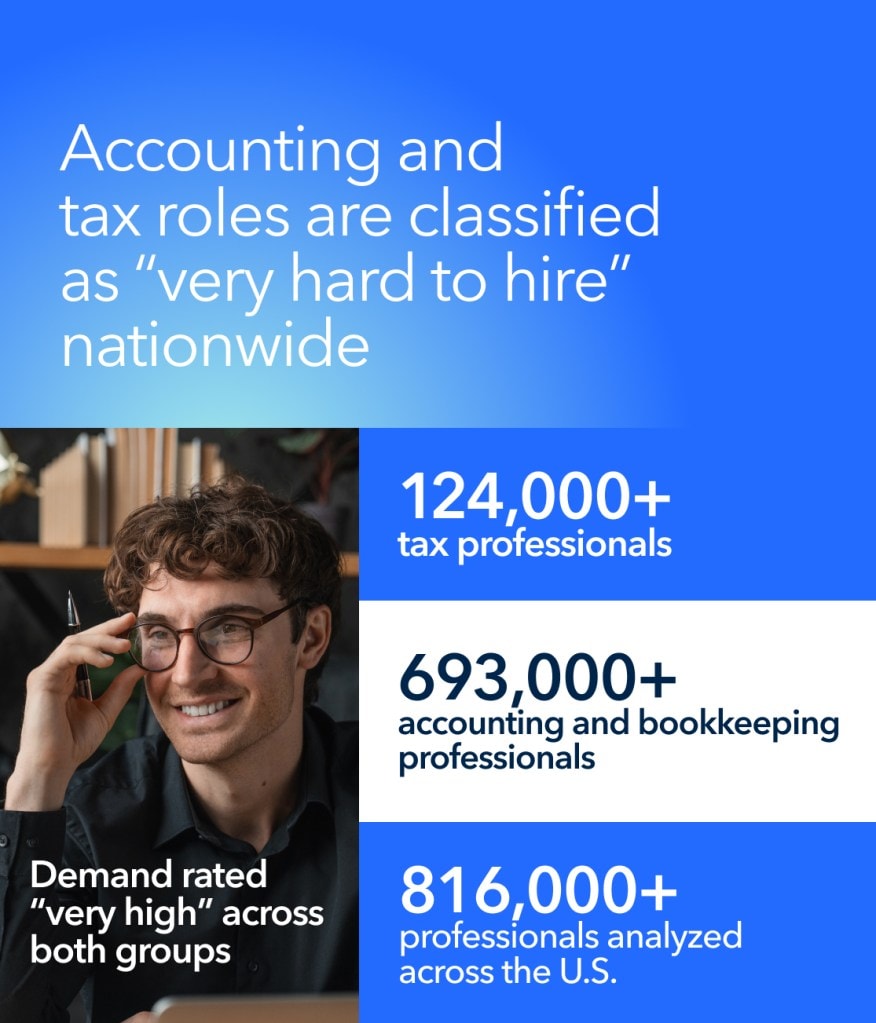
Together, these roles represent more than 816,000 professionals on LinkedIn, including nearly 124,000 tax professionals and 693,000 bookkeeping and accounting professionals.
Both talent pools rate as having “very high” hiring demand, meaning talent is difficult to hire. But our accounting statistics show they behave quite differently depending on nuances like location or industry, translating to uneven pressure and opportunity across the country.
The Biggest Takeaways From the 2026 Accounting Job Market
- Based on LinkedIn Talent Insights data, accountants are in demand across both tax and accounting roles, with both workforces classified as “very hard to hire” nationally.
- Tax opportunities are most intense in midsized metros such as Buffalo-Niagara Falls (NY), Richmond (VA), and Hartford (CT), where smaller professional bases tend to meet recurring compliance-driven demand.
- Bookkeeping and accounting roles face the greatest competition in larger metros, including Atlanta (GA), Dallas-Fort Worth (TX), and Pittsburgh (PA), where year-round operational needs drive steady hiring.
- Just 3 metros—Atlanta, Hartford, and Nashville—rank among the tightest markets for both tax and accounting career paths.
- Industry demand is shifting, with growth in tax hiring coming from sectors like venture capital, insurance, and professional services. Accounting demand is spread across health care, energy, government, and education.
- Skills are becoming a clearer differentiator. Growth in US Generally Accepted Accounting Principles (GAAP) reporting, payroll, reconciliation, and accounting software points to rising value for specialized, portable expertise.
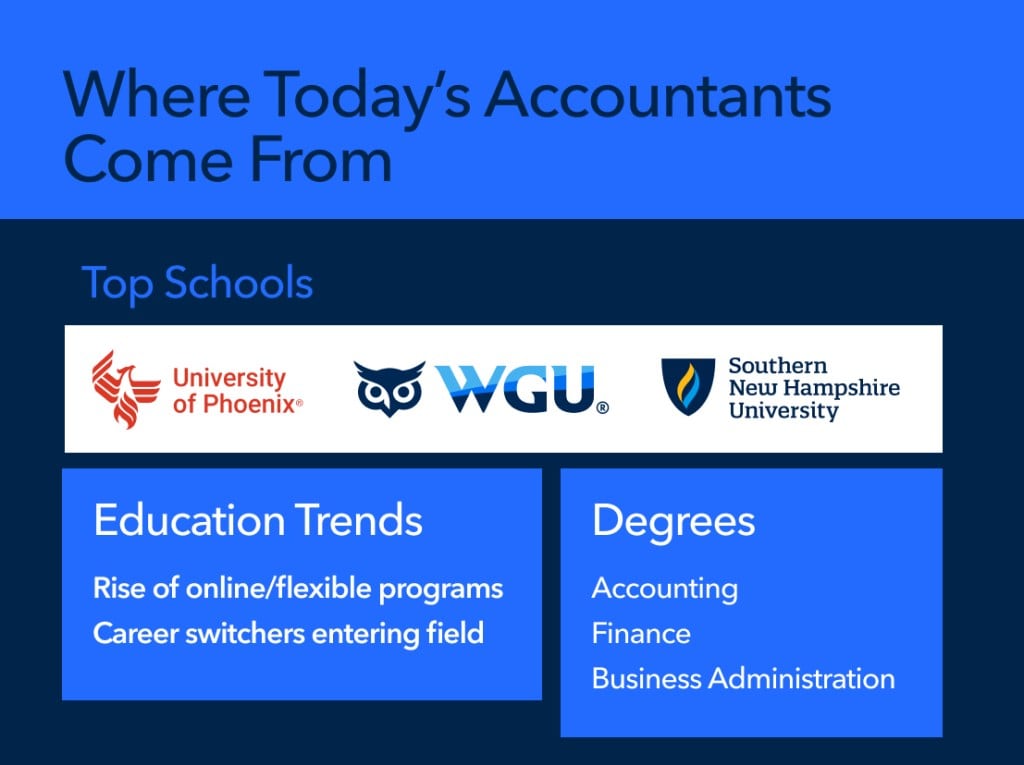
- Education pathways are increasingly flexible, with online-centered schools like University of Phoenix, Western Governors University, and Southern New Hampshire University supplying talent across both pipelines.
For professionals evaluating their options, these patterns point to a growing range of career paths, including flexible, project-based, local, and remote roles that extend beyond traditional firms.
How We Analyzed the Accounting Job Market
Our analysis is based on LinkedIn Talent Insights data, captured as a point-in-time snapshot on December 1, 2025. The goal? To pulse out the accounting career outlook by gauging how hiring demand and available talent match up across US markets.
We analyzed 2 groups separately—tax roles and bookkeeping and accounting roles—to reflect differences in career paths and hiring dynamics. We evaluated them at the metro level across the country. For the sake of consistency in our findings, we kept it to metro areas with at least 300 professionals in a given job grouping.
Intuit’s analysis draws on multiple indicators from LinkedIn Talent Insights to examine how demand and supply correlate across US metros. One of these is a Talent Gap Score, which compares the number of active job postings to the number of available professionals in a market.
Rather than treating the score as a measure of “good” or “bad,” this report uses it comparatively:
- Higher scores signal markets where professionals may have greater leverage and more opportunity.
- Lower scores point to steadier, more balanced hiring conditions between employers and the workforce.
Where Accounting Hiring Competition is the Most Intense
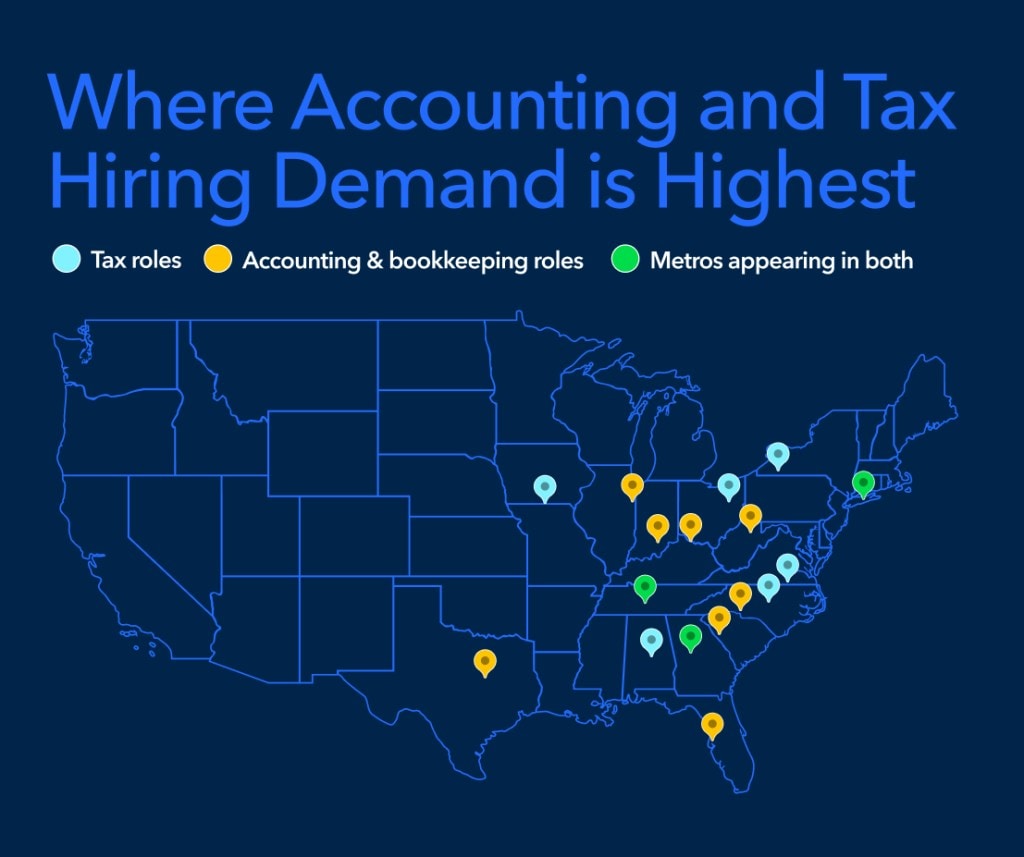
The job outlook for accounting and tax roles varies widely across the US. Some markets face clear talent deficits, giving candidates an upper hand. Others maintain a stable equilibrium between demand and the local workforce, often meaning less competition among employers.
At the same time, professionals now have more power to choose how they work. For those in high-demand metros, staying local and taking on in-person roles offers massive negotiating leverage. Conversely, remote and hybrid roles have expanded access, allowing professionals in slower markets to tap into national demand without having to relocate.
In this analysis, a tight market refers to metros where job openings significantly outnumber available professionals. A more balanced market is one where demand and supply more closely match up.
Mapping this intensity reveals just how uneven today’s labor market can be. Let’s take a closer look at how geography dictates the accountant job outlook.
Midsized Cities Are Feeling the Greatest Competition for Tax Talent
Midsized metros see some of the tightest competition for tax professionals, with Buffalo, New York, and Richmond, Virginia, leading the way. In these areas, smaller local talent pools are likely stretched thin trying to meet recurring, compliance-driven demand.
According to LinkedIn Talent Insights, the metros with the highest Talent Gap Scores for tax roles include:
| US Metros with the Highest Tax Talent Hiring Pressure |
| Metro area | Hiring demand | Talent Gap Score (per 1,000)* |
| Buffalo-Niagara Falls (NY) | Moderate | 231.2 |
| Greater Richmond (VA) | High | 226.9 |
| Greenville-Spartanburg-Anderson (SC) | Moderate | 225.9 |
| Greater Hartford (CT) | High | 191.2 |
| Greater Birmingham (AL) | Low | 181.8 |
| Raleigh-Durham-Chapel Hill (NC) | Moderate | 181.5 |
| Nashville (TN) | Very high | 180.1 |
| Atlanta (GA) | Very high | 179.6 |
| Greater Cleveland (OH) | Very high | 176.9 |
| Des Moines (IA) | Low | 175.4 |
Source: LinkedIn Talent Insights
* Formula: Gap Score per 1,000 = (job posts ÷ professionals) × 1,000
Because the bench often isn’t deep in these markets, even a modest increase in hiring activity can put pressure on available talent. The pressure of peak tax periods only exacerbates those challenges.
It’s also worth noting that tax roles are tied to filing deadlines and regulatory shifts, which means hiring timelines are naturally fast-paced. And that leaves firms and employers competing for the same pool of experienced professionals, meaning there’s little room for delay when roles open. As a result, hiring pressure can build quickly, even without large-scale job growth.
Big Cities Are Driving Demand for Bookkeepers and Accountants
Shifting the lens to bookkeeping and accounting roles, the most intense hiring competition shows up in larger metro areas.
Scale and continuity (rather than seasonality) likely contribute to the pressure in sprawling metroplexes like Atlanta, Georgia, and Dallas-Fort Worth, Texas, 2 of the 3 tightest markets in this group.
Here’s how the full top 10 shakes out:
| US Metros with the Highest Accounting Hiring Pressure |
| Metro area | Hiring demand | Talent Gap Score (per 1,000)* |
| Atlanta (GA.) | Very high | 44.7 |
| Dayton (OH) | Moderate | 40.7 |
| Dallas-Fort Worth (TX) | Very high | 36.7 |
| Greater Pittsburgh (PA) | Moderate | 33.3 |
| Nashville (TN) | Very high | 33.3 |
| Charlotte (NC) | Very high | 32.6 |
| Greater Chicago (IL) | Very high | 31.5 |
| Greater Hartford (CT) | Very high | 31.5 |
| Greater Indianapolis (IN) | High | 30.1 |
| Greater Tampa Bay (FL) | High | 30.0 |
Source: LinkedIn Talent Insights
* Formula: Gap Score per 1,000 = (job posts ÷ professionals) × 1,000
In these metros, demand is often linked to ongoing business activity across sectors, such as small and midsize businesses (SMBs), health care systems, construction, and government entities. And unlike tax roles, bookkeeping and accounting positions are less tied to a single season and more connected to day-to-day financial operations.
That consistency creates year-round hiring pressure. Even in markets with deeper benches of talent, the competition for specialized experience may never truly cool off.
Note: Talent Gap Scores tend to be higher for tax roles because those markets are smaller and more seasonal, meaning even modest increases in hiring demand can produce sharp increases in measured pressure.
Tax and Accounting Jobs Aren’t the Same Market
From the outside, tax roles and bookkeeping or accounting roles often look like 2 sides of the same coin. In practice, though, they operate in entirely different worlds. And that’s what shapes where the accountant occupational outlook is strongest.
Here’s what the LinkedIn Talent Insights data tells us about 3 defining dynamics—demand, pay, and demographics.
Demand
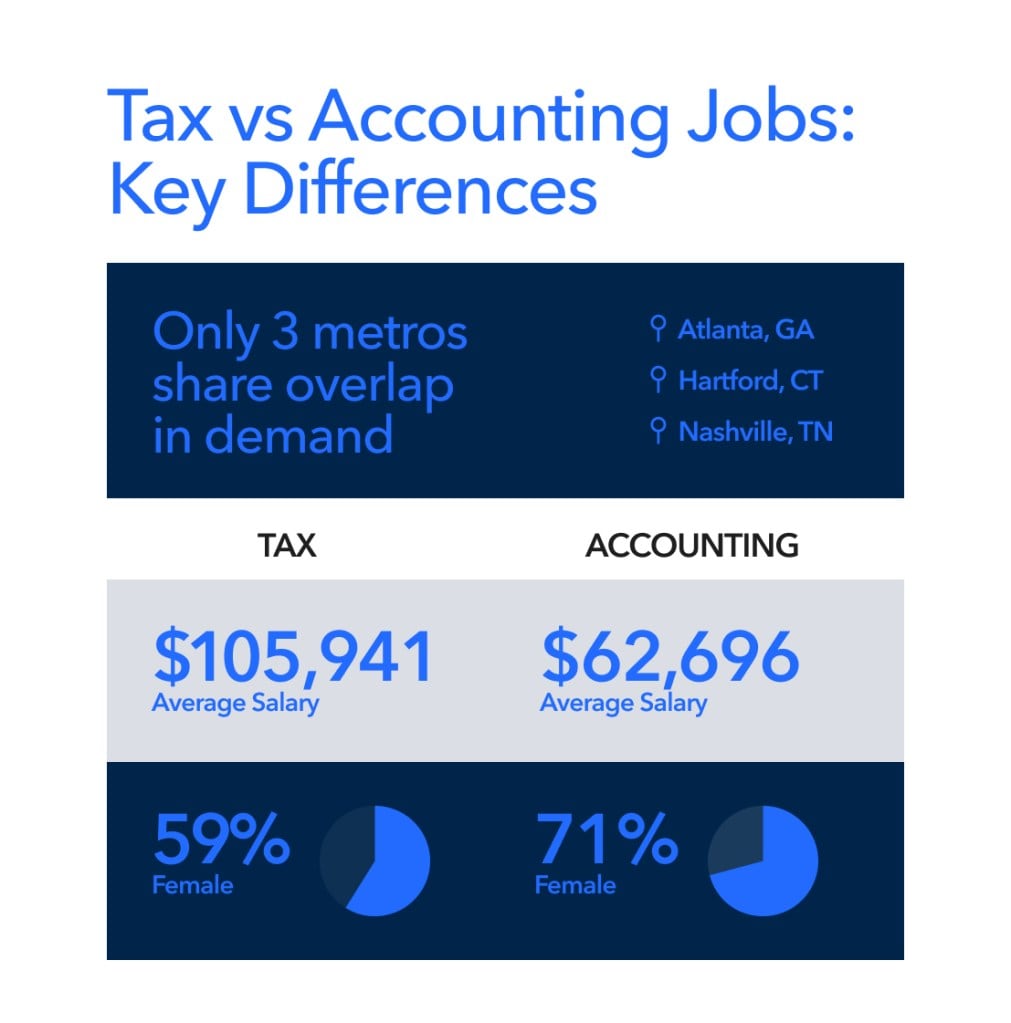
Let’s start with geography. Among the top 10 metros with the most intense hiring competition, only 3 appear on both lists: Atlanta, Hartford, Connecticut, and Nashville, Tennessee.
Everywhere else, the markets diverge. This split reflects the differences inherent in the roles. Tax work tends to cluster around regulatory complexity and filing cycles, whereas accounting and bookkeeping track with the daily pulse of business activity.
Pay and Specialization
Compensation tells a similar story. The LinkedIn Talent Insights data shows tax roles command an annual average salary of $105,941, a premium shaped by specialization and time-bound demand.
By comparison, bookkeeping and accounting roles average $62,696, reflecting a broader talent pool and steady, year-round need across industries.
Workforce Dynamics
Even the people filling these roles are different demographically. While both fields are predominantly female, the gender gap widens in accounting and bookkeeping. Tax roles are 59% female and 41% male, compared to 71% in bookkeeping and accounting. These differences appear to reflect how the roles have historically been structured and staffed across the labor market.
The Industries Fueling Today’s Accounting Hiring Boom
Accounting demand is a direct byproduct of business complexity. You could say the job outlook for accountants follows the money (and the regulations), revealing exactly where industries are expanding and where their operations are getting more complicated.
Charting these industry-level hiring patterns helps clarify why talent is migrating beyond traditional firms and into unexpected corners of the economy.
A couple of themes stand out in the data. First, certain industries are driving greater demand for tax expertise, with themes emerging tied more to regulatory complexity than sheer transaction volume. Second, accounting and bookkeeping roles are being pulled steadily across the broader economy as organizations of all types scale their reach.
Unexpected Industries and Driving Demand for Tax Expertise
While geography tells us where talent is squeezed, a national lens helps to understand who is applying the pressure. Looking at nationwide 1-year hiring growth shows us that some of the most aggressive growth in tax hiring comes from specialized corners of the economy.
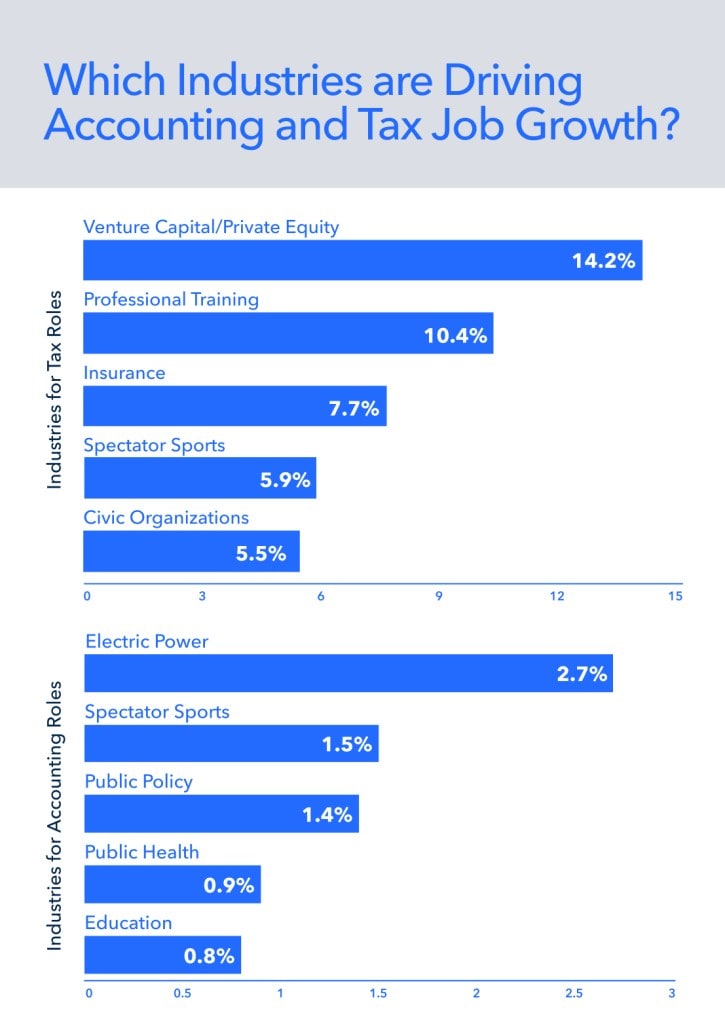
Venture capital (VC) and private equity (PE) lead the list, according to our LinkedIn Talent Insights data, with tax hiring up 14.2%, followed by professional training and coaching at 10.4%, and insurance agencies and brokerages at 7.7%.
| Tax Roles: Top Hiring Industries by Postings |
| Industry | 1-year growth |
| Venture capital and private equity | 14.2% |
| Professional training and coaching | 10.4% |
| Insurance agencies and brokerages | 7.7% |
| Spectator sports | 5.9% |
| Civic and social organizations | 5.5% |
Source: LinkedIn Talent Insights
The common thread here is complexity. Hiring in these industries reflects a need for professionals who can manage regulatory nuance and never-idle compliance requirements.
Take VC and PE firms, for example, where hiring is likely to be driven by the need to manage multi-year horizons and intricate entity structures rather than routine compliance.
Accounting Demand is Being Pulled Across the Broader Economy
If tax demand is driven by complexity, demand for bookkeeping and accounting is driven by infrastructure. Hiring in this category is rising across foundational industries like electric power generation (2.7% 1-year growth), public policy (1.4%), public health (0.9%), and education (0.8%).
| Bookkeeping and Accounting Roles: Top Hiring Industries by Postings |
| Industry | 1-year growth |
| Electric power generation | 2.7% |
| Spectator sports | 1.5% |
| Public policy offices | 1.4% |
| Public health | 0.9% |
| Education | 0.8% |
Source: LinkedIn Talent Insights
These gains point to steady, structural demand driving a strong accountant job outlook. Unlike the often-volatile growth of VC or PE, sectors like public power fuel a consistent need for operational oversight. The result is a consistent, year-round call for accounting talent across sectors that shape everyday economic and civic life.
How Accounting Jobs Are Changing
What are some of the biggest current trends in accounting? Well, across both tax and accounting roles, employers are looking beyond general financial principles toward candidates with specialized skills and deep software fluency.
AI is pushing that shift into overdrive. As software absorbs the routine, rules-based parts of the job, the human role is moving more toward checking outputs and resolving exceptions. In other words, the human mind is bringing real judgment to the gray areas that algorithms can’t navigate.
Deloitte’s Finance Trends 2026 research puts a number on it. Nearly two-thirds of finance teams (63%) have already fully deployed AI and are actively using it.
So, what does that adoption actually look like on the ground? Our analysis of LinkedIn Talent Insights data points to 2 trends:
- Specialization: Rapid growth in technical and compliance-oriented skills
- Tech fluency: A rising baseline expectation that accountants are fluent in the software platforms that power modern finance teams, including AI tools

Which Accounting Skills Are Growing the Fastest?
According to our analysis, specialization has become a primary avenue for career advancement. Skills tied to financial reporting and compliance are growing quickly across both role groups.
US Generally Accepted Accounting Principles (GAAP) reporting stands out, with demand up 128% year-over-year (YoY) among bookkeeping and accounting roles and 75% among tax roles.
That growth makes sense when you consider how GAAP knowledge grows across a career. Early on, it’s mostly about clean execution, like getting entries right and closing the books accurately. That builds the foundation for higher-stakes work at more senior levels. That’s when the harder judgment calls come, like complex reporting judgments and leadership-level decision support.
Employers are hiring for more than skills. They want what those skills unlock.
That pattern holds across the broader data, too. Core operational skills such as payroll and account reconciliation have seen 30% or more growth, reinforcing their relevance across industries and seniority levels.
Platform-based credentials are also gaining ground. QuickBooks ProAdvisor skills have grown 32%, reflecting how closely accounting work is now tied to specific tools.
| Fastest-Growing Skills Among Tax and Accounting and Bookkeeping Professionals |
| Tax roles | Accounting and bookkeeping roles |
| Skill | 1-year growth | Skill | 1-year growth |
| Reconciling reports | 144% | US GAAP reporting | 128% |
| US GAAP reporting | 75% | Reconciling reports | 101% |
| Public law | 50% | Monthly accounts | 69% |
| Oracle General Ledger | 40% | Prepayment processing | 66% |
| UK GAAP | 38% | Payroll software | 53% |
| Tax reporting | 33% | Year-end accounting | 46% |
| Tax software | 32% | Full-charge bookkeeping | 32% |
| Taxation | 32% | Data reconciliation | 32% |
| Payroll management | 29% | ProAdvisor | 32% |
| Federal tax | 27% | Payroll management | 30% |
Source: LinkedIn Talent Insights
Taken together, these are the skills that are both specialized and portable. They allow professionals to move more easily between sectors without starting from scratch.
Why Software Fluency is No Longer Optional for Accountants
Modern accounting work starts with software. Today, nearly 20% of professionals list QuickBooks as a skill, according to LinkedIn Talent Insights data.
Tax software skills are also rising, with 32% YoY growth, illustrating how digital platforms now sit at the center of compliance and reporting work.
For employers, software fluency shortens onboarding and reduces risk. For professionals, it expands where (and how) they can work. Accounting jobs may still rely on fundamentals, but digital platforms have become the central nervous system of compliance and reporting work.
And, as more finance teams integrate AI into core workflows, software is doing more of the first pass. That raises the bar for professionals, who now increasingly review outputs and apply human judgment.
Who’s Entering the Accounting Profession and Where They’re Coming From
The education data challenges the image of the “traditional” accounting student. Rather than a straight line from a physical campus to a firm, today’s accountant job outlook is defined by flexibility. It’s one that accommodates career switchers and working adults as much as it does fresh graduates.
Even with this flexibility, bachelor’s degrees dominate the pipeline across both tax and accounting. While advanced degrees and certifications tend to separate the experts from the generalists over time, the journey often begins at the undergraduate level.
Let’s zoom in on that journey with a closer look at where and what today’s tax and accounting pros studied.
Where They Study
Per LinkedIn Talent Insights data, 3 institutions stand out across both pipelines: University of Phoenix, Western Governors University, and Southern New Hampshire University. These schools are known for serving working adults, online learners, and career switchers.
According to LinkedIn Talent Insights, the top 5 schools producing tax professionals are:
- University of Phoenix
- Baruch College
- Golden Gate University
- Texas A&M University
- California State University, Northridge
And the top 5 schools producing accounting and bookkeeping professionals are:
- University of Phoenix
- Western Governors University
- Southern New Hampshire University
- Baruch College
- California State University, Fullerton
The popularity of flexible education models reflects a broader shift toward accessibility. It’s a theme that also shows up in policy conversations.
Take recent developments with certified public accountant (CPA) licensure, for example. Historically, getting your CPA license required 150 credit hours, effectively requiring a fifth year of education or a master’s degree on top of the standard 120-hour bachelor’s degree. However, faced with a widening talent gap, many states are exploring—and, increasingly, enacting—alternative pathways.
The growing role of nontraditional education paths and shifting licensure standards are signs of a profession adapting to a market that values competency and skill over traditional pedigree.
What They Study
Regardless of where tax and accounting professionals study, their academic roots are consistent. The most common majors—accounting, finance, and business administration—are identical across both tax and accounting and bookkeeping pipelines.
That overlap reinforces how closely tax and accounting careers are intertwined early on. Professionals build their knowledge from the same practical platform, only diverging later through certifications or specialization.
Regardless of the precise paths they take, one thing is clear: Fresh graduates and midcareer switchers alike are building their careers through flexible learning models and familiar business disciplines.
Alternative Pathways
For professionals who want to build more portable skills without going back for another degree, short-form credentials and structured training are worth a serious look. That’s particularly true in software and AI-driven workflows as the job shifts increasingly toward reviewing outputs and explaining results to stakeholders.
Intuit Academy is one practical starting point for building in-demand skills, particularly for professionals who want to expand or pivot their careers without committing to another full degree.
What These Trends Mean for the Future of Accounting Careers
The LinkedIn Talent Insights data reveals an accountant job outlook that’s highly active, yet distinctly uneven. While demand is strong across the board, specialization and geography play a significant role in shaping the nature of opportunities.
In tighter metro markets, where demand outpaces the available workforce, professionals often find themselves more in control. That might mean faster-moving hiring timelines and direct competition among employers. These locales are where conversations around compensation and flexibility are less theoretical and more of a must to secure talent.
Conversely, stability is the name of the game in balanced markets. That might mean steadier hiring conditions powered by deeper talent pools and more predictable career paths. These are the types of markets that might appeal to those who value continuity or long-term growth within a specific region or sector.
Across both environments, a few themes are shaping the future of accounting careers. Specialized skills, particularly in tax, compliance, and reporting, are becoming more valuable. Software fluency is now more of a baseline expectation than a differentiator. And pathways into the profession are broadening, with flexible education models and shifting credential requirements opening doors for a more diverse range of professionals.
The result? A profession in motion. No longer do firm sizes or traditional “busy season” cycles define accounting careers. It’s now more of a strategic mix of market conditions and skill portability. For those making the leap into tax or accounting, the ability to read these market signals is now just as critical as mastering the fundamentals.
How Intuit is Supporting the Future of Accounting Work
If the trends in this report tell us anything, it’s that accounting and tax expertise are in demand, especially for professionals evaluating their next career move. And professionals have more choice in how they apply their skills than perhaps ever before.
Intuit is built around that reality. Through Intuit Expert Careers, accounting and tax professionals can put their experience to work supporting the people and small businesses who rely on products like TurboTax and QuickBooks.
Wherever you’re based, there’s a good chance Intuit is hiring near you. Our expert roles span cities coast to coast.
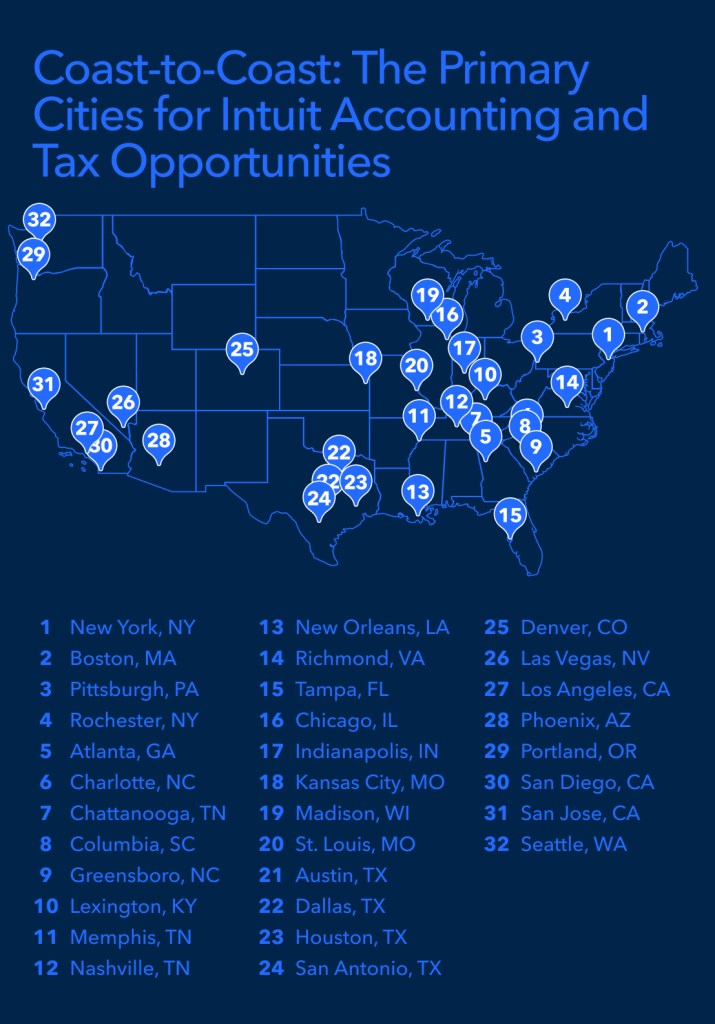
Note: Intuit hires in many locations beyond the cities shown above. Visit Intuit’s job search page for the full list of available opportunities.
These roles are designed to break the traditional mold, offering professionals the flexibility to choose their ideal environment. Whether you want to connect directly with your community through a local, in-person role, or you prefer to work entirely remotely from your home office, Intuit provides the chance to do meaningful, high-level advisory work without the grueling hours of a traditional busy season.
Methodology: How We Conducted This Analysis
This analysis is based on data from LinkedIn Talent Insights, using a December 1, 2025, snapshot of the US accounting job market. The report examines 2 distinct role groups—tax roles and bookkeeping/accounting roles—across US metro areas.
The analysis incorporates multiple LinkedIn data signals, including job postings, professional counts, hiring demand indicators, compensation benchmarks, skills growth, industry hiring patterns, and education backgrounds. These data points reflect LinkedIn’s available metro-level reporting.
To compare hiring competition across locations, the report uses a Talent Gap Score, calculated as the number of job postings relative to the number of available professionals: Gap Score per 1,000 = (job posts ÷ professionals) × 1,000.
To ensure statistical stability, Talent Gap Scores are only calculated for metros with at least 300 professionals in the relevant role group.
LinkedIn Talent Insights data is derived by aggregating profile data voluntarily submitted by LinkedIn members. As such, LinkedIn cannot guarantee the accuracy of LinkedIn Talent Insights data.