Table of contents
Table of contents
Accounting for multiple entities becomes more complex with each new subsidiary, as each one introduces intercompany balances, elimination entries, and close dependencies with the group result. The Intuit Enterprise Technology Benchmark Report found that 80% of multi-entity businesses describe managing intercompany transactions and billing as a significant bottleneck.
Other factors that make this harder include a lack of common rules across entities, leading to inconsistent posting conventions, account structures, and tight timelines. Combined with manual entry and complex spreadsheet consolidation, final results are delayed and require a full reconciliation pass before the numbers are accurate enough for reporting.
An effective, modern enterprise accounting solution for scaling multi-entity businesses requires a unified workflow that enforces consistency at the point of entry.

3 steps to set up a unified workflow to eliminate reconciliation delays
The core change in accounting for multiple entities is adopting a unified workflow. This provides a single source of truth by matching "side A" and "side B" of an intercompany transaction at the point of entry, not at the end of the month.
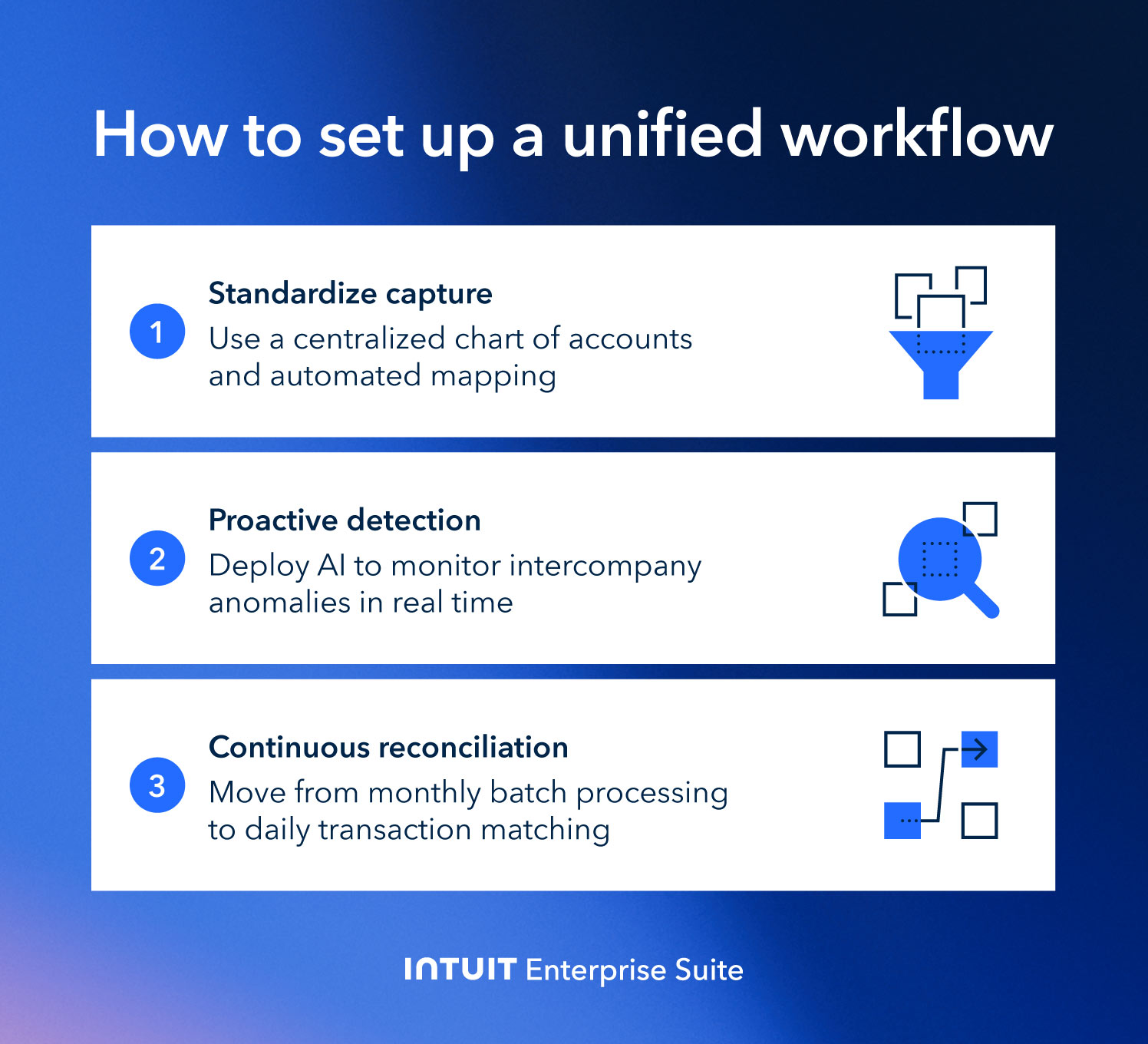
1. Standardize entity-level transaction capture
A centralized chart of accounts prevents reconciliation of debt by ensuring that every “due-to” in Entity A has a corresponding “due-from” in another. Modern accounting software for multiple businesses automates this mapping at the time of the transaction. Yet, APQC benchmarks show that 25% of companies manually process intercompany transactions, leaving mismatches undetected until the close.
Matched due-to and due-from entries show you an intercompany balance set you can approve before the group close, so you go into the close knowing the intercompany balances already match.
2. Set up proactive variance detection with AI
Intuit Intelligence monitors financial performance across the group, identifying anomalies and deviations from goals and budgets in real time. Across a multi-entity operation, that monitoring includes intercompany activity, so the controller has visibility into discrepancies weeks before the close begins.
This is why 92% of senior leaders are redesigning processes or workflows around AI, according to the Intuit Enterprise Technology Benchmark Report. With finance catching and remedying variances during the accounting period, they are routine corrections. This in-period discipline means you deliver the group close on time and on numbers the board can act on.

AI variance reviews deliver the best results when the accounting structure underneath is consistent. Before you rely on them, make sure every entity follows the same entity codes, account mappings, intercompany rules, and posting dates.
3. Shift from batch to continuous reconciliation
Moving away from "batch processing" reduces the administrative burden on regional accounting managers and improves global cash visibility. It also reduces the cost of reconciling intercompany activity across entities. An Intuit Enterprise Suite study by Forrester projected benefits in present value of up to $127,334 across three years from intercompany transaction efficiencies.
With continuous matching, you review entity performance and liquidity throughout the month, and address regional issues before they delay the consolidated result. You also see the group's current cash position across all entities, updated daily, which supports your working capital decisions.
How does automated elimination logic reduce multi-entity close friction?
The automated logic in accounting software for multiple entities removes the risk of double-counting revenue and expenses across the group by identifying and neutralizing intercompany transactions during consolidation.
System-enforced elimination rules
Defining elimination logic at the suite level ensures that intercompany sales, cost of goods, and interest are wiped out automatically during the consolidation run. The Enterprise Technology Benchmark found that 64% of businesses say month-end close takes too much time. By removing manual intercompany processing, you remove repetitive close work and the errors that come with it.
Mapped eliminations mean your consolidated revenue, costs, and margins reflect genuine external performance, updated every time an intercompany transaction is recorded.
Case study: Fire and Ice operates a multi-entity Employee Stock Ownership Plan (ESOP). Their three-person finance team used to take an hour to prepare consolidated quarterly statements. After moving to Intuit Enterprise Suite, automated elimination and intercompany entries reduced that to around five minutes, freeing the team to review the statements before sending them to the bank.
Run your elimination rules against the last three closes. Where the automated result matches what your team built manually, the rules are working. Where it doesn't, you know exactly which mappings to fix before you go live.
The line-of-sight audit trail
Modern financial architecture links every elimination entry back to the original source transaction, providing the proof required to meet rigorous 2026 standards. Scrutiny is already intensifying. A FERF survey found that 57% of respondents worked harder in each successive cycle to meet requirements, so audit-ready documentation must now be a permanent part of the finance workflow.
Intercompany allocations carry logs and attachments in Intuit Enterprise Suite, so when the audit asks for the trail behind an elimination, you already have the proof attached to the entry. You answer every question from the system without reconstructing evidence from emails and spreadsheets, and the review moves faster because of it
Case study: Western Companies managed four entities across heavy equipment sales, finance, and service. A manual consolidation error caused an incorrect trial balance that led to $12,000 of extra auditor time. After moving to Intuit Enterprise Suite, the audited financial review time dropped by 90%. The team stopped rebuilding evidence from spreadsheets because it was already attached to every entry.
Shared service center allocations
Automating the distribution of corporate overhead, such as HR or IT costs, across multiple entities removes one of the quieter bottlenecks that delay the close. APQC benchmarks show that 8.3% of general accounting headcount goes to processing allocations. As an organization scales, that burden multiplies with every new member.
Set up multi-entity accounting software to distribute those costs by rule, so it calculates each subsidiary's share and posts both sides of the intercompany balance as part of the transaction. With shared costs allocated automatically, you compare entity margins without guessing which subsidiary is carrying corporate overhead.
Example: A CFO is evaluating whether to invest further in a subsidiary that appears to deliver 18% margin. But the subsidiary's share of corporate overhead was set two years ago when it had half the headcount. Once finance recalculates the allocation, the margin drops to 11%. The case for further investment is no longer as strong, so the board pauses until finance can confirm the margin at current cost across all entities.

How does close orchestration scale as an organization adds more legal entities?
Managing the close across a handful of entities is a coordination task, but past a certain count, it becomes a control problem. You need real-time visibility into every subsidiary's progress so you can act on bottlenecks before they delay the group result.
1. Transition to system-enforced governance
Growing from 5 to 50 entities means trust-based manual controls are no longer fit for purpose. You need system-enforced workflows that prevent unauthorized postings once a period is closed.
Intuit’s Enterprise Technology Benchmark found that 76% of multi-entity businesses say their existing technology struggled to keep up when they added new entities. This pressure extends to every part of the finance workflow, including governance.

The best accounting software for multiple entities lets governance scale with the group. Each new entity requires configuration to match the group standard, but once that's done, the same permissions, close controls, and posting rules apply.
Case study: Four Points RV Resorts operates 8 parks, with up to 3 LLCs per property. The business previously needed a fractional CFO for reporting, paying $600 a month with a multi-day wait for data. After moving to Intuit Enterprise Suite, the team replaced that with self-serve consolidated reporting, giving leadership direct access to entity-level data without waiting for manual report preparation.
2. Use real-time cross-entity variance analysis
A unified suite allows finance to perform side-by-side performance comparisons, identifying underperforming business units in seconds rather than days. The Enterprise Technology Benchmark found that 89% of multi-entity leaders need a unified financial view across entities. Of those, 69% say they cannot effectively guide growth because they lack real-time visibility across entities, projects, and departments.
Side-by-side entity performance updates in real time, so you spot underperformance as it develops and redirect resources to prevent a weak quarter from becoming a prolonged drain on group margin.
Case study: Cornerstone Development Company has five entities that trade in construction, consulting, utility engineering, and environmental compliance. The team used Intuit Enterprise Suite to gain faster, more accurate insights into project margins. They reduced the month-end close time by 50% so the company could compare results across entities while there was still time to intervene in weak projects before the quarter closed.
Cross-entity comparison only tells you something useful if every entity is measured the same way. Standardize revenue recognition, close completion tracking, and intercompany balance reporting first. Add project or divisional dimensions once you’re happy the three base metrics match across entities without manual correction.
3. Find your data ceiling
A firm reaches its operational limit when correcting field data takes more finance capacity than advising the board on capital allocation. That tipping point is common. The Intuit Enterprise Technology Benchmark found that 73% of multi-entity business leaders expect to outgrow their current technology within 12 months if they hit growth goals.
One practical test is an intercompany policy that sets a strict 24-hour window for matching intercompany entries. When the system enforces this, the month-end "reconciliation nightmare" effectively disappears. Fix the data ceiling, and every capital allocation recommendation you take to the board is built on numbers verified through the month.
Case study: HFMM Legacy Group operates eight entities with more than 100 employees and around $10 million in revenue, aiming to reach $50 million in five years. After moving to Intuit Enterprise Suite, the team integrated a recent acquisition in about two hours. Each new addition raises the data ceiling and the group scales without rebuilding the data foundation every time.

When you schedule a demo, you agree to permit Intuit to use the information provided to contact you about Intuit Enterprise Suite and other related Intuit products and services. Your information will be processed as described in our Global Privacy Statement.
Boost productivity and enhance profitability
Accounting for multiple entities without a connected workflow forces finance to rebuild intercompany data, chase elimination errors, and delay qualification of close results. The right operating structure means intercompany balances match at entry, eliminations run by rule, and the close confirms your consolidated position. You get back to advising on capital allocation, pricing, and growth.
Explore Intuit Enterprise Suite, the AI-native ERP built for multi-entity accounting. Book a call with one of our consultants.
Check out upcoming events and learn more about Intuit Enterprise Suite.
Customer stories

Case Study
How FEFA Financial is growing with Intuit Enterprise Suite—without migrating to an ERP

Case Study
How this mission-driven, employee-owned company created efficiencies with Intuit Enterprise Suite
October 25, 2024

Case Study
Why this camping business chose Intuit Enterprise Suite over NetSuite
October 25, 2024

Case Study
Migrating to Intuit Enterprise Suite took 2 hours (with zero disruption) for this aspiring $50M revenue business
April 25, 2025

Case Study
Humble House Foods case study: How they improved visibility & simplicity using Intuit Enterprise Suite
September 24, 2025