Table of contents
Table of contents

Project-based accounting is the methodology of tracking costs, revenue, and margins at the individual project level. For construction firms, this approach provides the visibility needed to monitor profitability and ensure every job stays within its established budget.
For growing firms, fragmented data is typically the result of disconnected point solutions—where time-tracking, procurement, and payroll live in silos outside the general ledger. This fragmentation creates blind spots in reports, obstructing margin protection. Without a unified system, projects often exceed their break-even point weeks before the CFO is alerted, making cost-correction impossible.
Consolidating these operational streams into a single financial core is the only way to eliminate data latency. According to a 2025 Forrester study, enterprises using a unified system are projected to recover 65% of revenue previously lost to data gaps and achieve 74% savings over three years through automated intercompany operations.
In this guide, we'll cover how to leverage project-based accounting to move from data gathering to strategic advising.

How does project accounting work?
Project accounting ensures audit-ready governance by monitoring the specific financial performance of every contract. This approach is essential for industries with high operational complexity, such as construction, professional services, and engineering.
And the financial stakes for accurate tracking are high. According to Deloitte’s 2026 Engineering and Construction Industry Outlook, the industry is facing a 40-year high in effective tariff rates on construction goods, ranging from 25% to 30%, highlighting the need to track every dollar.
While traditional financial accounting focuses on your company’s overall financial health, project-based accounting narrows the scope to the financial performance of individual projects. By treating projects like mini-businesses, you can track their costs, revenue, and resources. Simply put, financial accounting manages the entity, while project accounting manages the margin.

When should you use project-based accounting?
You should transition to project-based accounting when your firm manages high-stakes, multi-phase contracts in which minor variances in labor or materials directly affect working capital. For multi-entity firms, this framework is a requirement for maintaining audit readiness and protecting margins across the project lifecycle.
By deconstructing every project stage into a dedicated sub-ledger, your finance team can monitor resource allocation in real time. This visibility allows you to identify cost overruns and labor drift before they erode profitability.

Let’s say your construction company just landed a contract to build a new office complex, and it includes multiple phases like:
- Site preparation
- Foundation work
- Building construction
- Interior finishing
By isolating the costs of materials, labor, and equipment for each phase, you gain the granular data necessary to audit project performance in real time. For a CFO, this transparency is the basis for effective project governance; it allows you to pinpoint exactly where a project is deviating from its original margin profile.
If a specific phase exceeds its budget, you can immediately identify the root cause—whether labor inefficiency or material cost spikes—and make informed decisions about resource reallocation.
If your organization involves long-term projects with multiple phases, project-based accounting can provide detailed financial insights needed to keep everything on track.
What does a project accountant do?
A project accountant is responsible for managing the financial aspects of individual projects within your company. These accountants track project costs, forecast future expenses, and help ensure each project stays on budget. Their goal is to provide data-driven insights that allow you to make strategic decisions.
What is the difference between a project accountant and a management accountant? Both accountants focus on financial management, but their roles differ. Project accountants concentrate on the financial details of specific projects, while management accountants track the budgets, forecasting, and strategic planning for your entire company.
Components of project-based accounting
Effective project accounting for complex firms requires a connected platform that eliminates disconnected data silos.
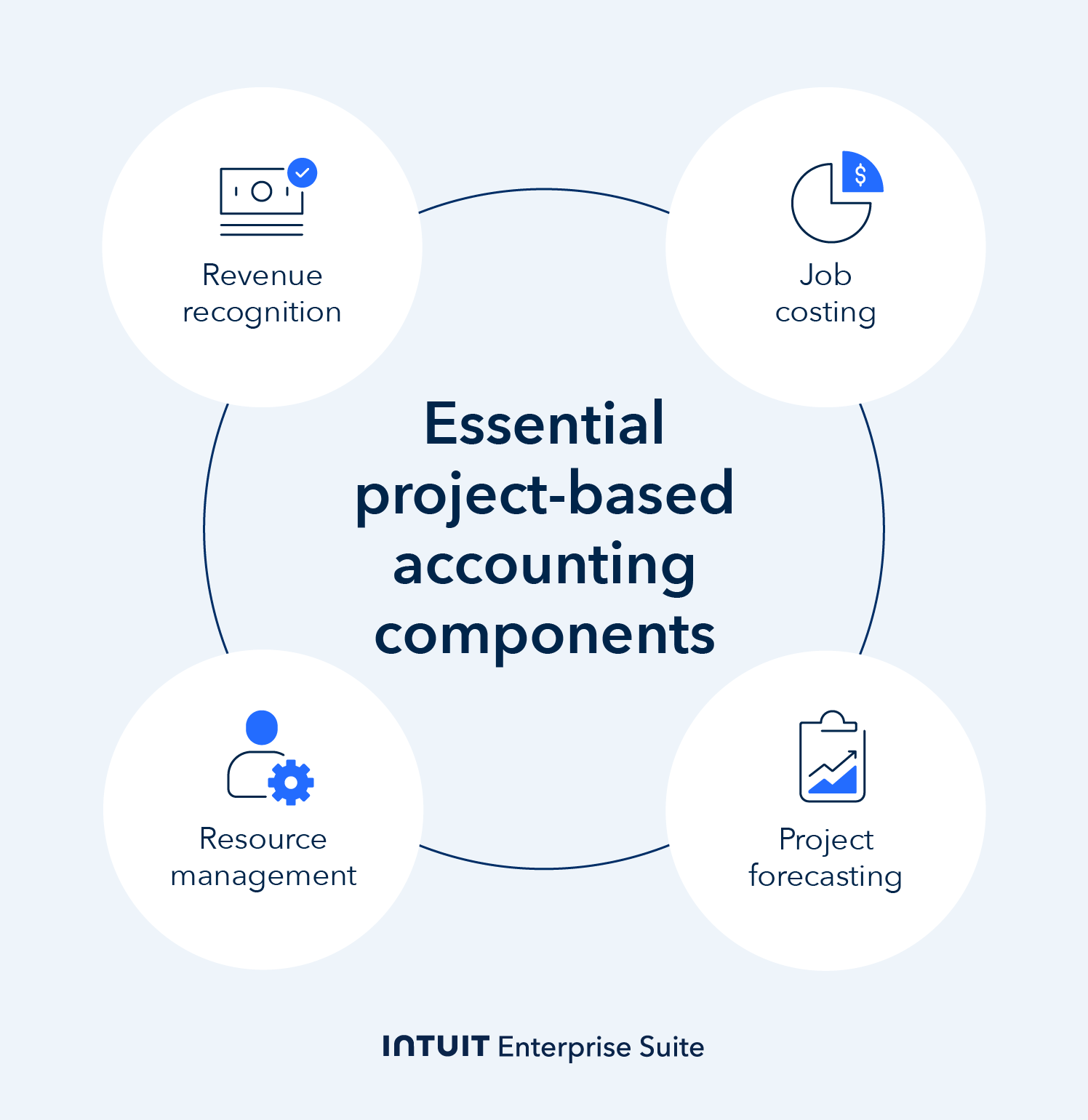
Job costing
Job costing provides real-time visibility into project margin control. While your project accountants track the daily delta between estimated material quantities and actual labor hours, you use this data to audit performance across your entire portfolio. This up-to-date reporting allows you to identify variances and mandate resource reallocations.
To protect your bottom line, you must ensure your teams account for both direct and indirect costs in every estimate:
- Direct costs: Labor, materials, and equipment dedicated to a specific job site.
Indirect costs: Shared overhead and administrative expenses that impact your firm's total cost of service.
Intuit Enterprise Suite customers are saying
"[Intuit Enterprise Suite has been] a solution for the thing that we needed right away, which is a consolidation of information, the ability to look across our organization, and get that data in a format so we could move quickly."
- Ed Sutton, Owner & CFO, MDR Realty LLC
Project forecasting
Based on your current data, project forecasting helps you predict future costs, forecast revenue, and estimate timelines. Project forecasting helps project managers prepare for potential challenges and determine how best to keep things on track. Like project costing, this is an ongoing process, and you should update it regularly when data becomes available.
Example: Project forecasting was especially important during the pandemic, when supply chain bottlenecks caused delays in material deliveries. In addition, the materials themselves became more expensive. With project forecasting, construction companies were better prepared to adjust their budgets accordingly.
Intuit Enterprise Suite customers are saying
"Because we can switch between companies and run consolidated reports, it allows us to standardize and make things uniform. As opposed to managing several environments, we're just managing one environment."
- Jason Corby, CFO and Owner, HFMM
Resource management
Resource management can help you save time and money on your project. By using labor, materials, and equipment efficiently, you can better ensure that resources are allocated effectively, reduce waste, and minimize delays.
In addition, Agentic AI within the suite can monitor routine workflows—ingesting labor hours from the field, equipment usage logs, and material costs—to provide a current view of your project’s burn rate.
Example: On a construction site, resource management may involve scheduling workers in shifts to help ensure the project progresses steadily without downtime or bottlenecks. You may also have time blocks to consider. For example, if you’re repaving a busy road, you might be limited to late nights and weekends and must plan accordingly.
What is a project accounting summary? Project accounting provides a detailed financial overview of individual projects, helping businesses track expenses, manage resources, and recognize revenue.
Revenue recognition
Accurate revenue recognition ensures financial statements reflect GAAP-compliant governance. For long-term projects, revenue is typically recognized at specific milestones—such as foundation completion—to ensure cash flow aligns with operational progress.
You may recognize revenue for each completed milestone on a project, such as finishing the foundation or installing the roof. When done well, revenue recognition ensures that your company’s financial statements accurately reflect the project’s progress.

5 project-based accounting methods
There’s no one right way to recognize revenue and track financial performance. For $10M+ firms, the best method for the job will depend on your firm’s accounting policies, contract complexity, and audit-ready governance standards.
Here are a few of the most common project-based accounting methods to consider:
Completed contract
The completed contract method (CCM) defers all revenue and expense recognition until a project is finalized. This is used for short-term jobs where final costs are volatile, ensuring that profit is recognized only when the performance obligation is fully met.
Example: A heavy equipment manufacturer building a specialized $3M industrial turbine might recognize the total revenue and expenses only after the unit passes final site testing and is officially accepted by the client.
Cost recovery
This conservative method recognizes revenue only after total cash collected covers the total cost of materials and labor. It is a strategic tool for high-risk ventures where collectability or final expenses are difficult to forecast.
Example: A construction firm managing a $10M environmental remediation project recognizes no profit until all material and specialized labor costs are fully recouped through client payments, mitigating the risk of unforeseen site conditions.
Percentage completion
The percentage completion method recognizes revenue and costs proportionally as the project progresses. Under ASC 606, this is the standard for construction and engineering firms seeking up-to-date visibility into multi-year contract performance.
Example: If your company is building a whole neighborhood of similar homes, you might recognize revenue and costs based on the individual completion of each home or after reaching a certain milestone across all homes.
Sales basis
The sales basis method recognizes revenue at the moment of delivery or final transaction. This creates a literal, verifiable audit trail tied to a specific transfer of control, ideal for speculative developments or service-line standardization.
Example: A developer building speculative luxury homes recognizes revenue for each property only when the title is officially transferred to the buyer at closing.
Installment
The installment method recognizes profit only as cash is collected, making it a necessity for projects with high credit risk or long payment terms. This keeps financial statements grounded in actual liquidity rather than projected performance.
Example: A manufacturer selling high-value industrial machinery on a five-year financing plan recognizes profit in proportion to each quarterly cash installment received, ensuring the books reflect actual cash flow rather than theoretical gains.
Project accounting vs cost accounting: What’s the difference? Project accounting tracks a project’s costs to determine its profitability. Cost accounting software tracks how much you spend on materials and labor for a project and calculates the revenue it generates.
Why is project-based accounting important?
When you have multiple projects going on simultaneously, you need an accurate account of each one. Each project can significantly impact your company’s overall financial well-being.

Here are the benefits of project cost accounting:
- Real-time margin visibility: Identify cost overruns and billable leakage as they occur. By tracking budget-to-actuals in real time, you can intervene before project-level variances erode the firm’s net profitability.
- Precise revenue recognition: Automate compliance by linking project milestones and percent-complete data directly to the general ledger. This ensures accurate WIP (Work in Progress) reporting and prevents revenue overstatement.
- Working capital optimization: Align billing cycles with actual project costs to reduce DSO (Days Sales Outstanding). Granular tracking enables you to manage the cash gap on long-term contracts, stabilizing liquidity across all entities.
- Labor burden: Quantify the true cost of labor by tracking hours against specific project phases. This visibility allows you to optimize realization rates and ensure that high-value talent is allocated to the most profitable workstreams.
- Enhanced forecast accuracy: Use historical project data and current burn rates to refine bidding strategies. This data-driven approach allows you to set realistic budgets for multi-phase contracts and anticipate financial hurdles 60 days in advance.
- Continuous audit readiness: Maintain a transparent, GAAP-compliant audit trail for every material cost and labor hour. By centralizing documentation within your ERP, you transform the audit process into a routine verification rather than a manual search for supporting data.
Having detailed financial data for each project will make it much easier to hold project managers and team members accountable. Use it to clearly understand the project scope, including factors like the timeline, milestones, and budget.
How to operationalize project-based accounting in 5 steps
For a multi-entity enterprise, implementing project-based accounting isn't about building a system from scratch—it’s about systemizing your operational data to drive financial oversight. Transitioning from fragmented spreadsheets to a unified system like the Intuit Enterprise Suite enables you to enforce consistency and margin control across all subsidiaries.
Here is how finance leaders operationalize project-based accounting within an AI-native ERP:
- Standardize project categories across all entities: Create a uniform list of cost codes and phases to ensure financial data is comparable across your entire portfolio. This allows for accurate consolidated reporting across different business units.
- Set budget-to-actual alerts: Link project budgets directly to your general ledger to identify cost overruns as they happen. Immediate visibility into variances lets you adjust resources before they affect quarterly profits.
- Automate field-to-ledger data tracking: Connect labor hours and material costs from the job site directly to your accounting system. Eliminating manual data entry reduces latency and ensures your project's financials reflect current field activity.
- Use AI to enforce expense policies: Set the suite to automatically flag spending that violates project limits or corporate policy. This serves as a real-time compliance layer, protecting your margins without requiring manual spot checks.
- Centralize project-level reporting: Use a single source of truth to track WIP (Work in Progress) and profit margins across all active contracts. Having this data in a single system provides the objective evidence needed for board-level decisions and capital allocation.

When you schedule a demo, you agree to permit Intuit to use the information provided to contact you about Intuit Enterprise Suite and other related Intuit products and services. Your information will be processed as described in our Global Privacy Statement.
Boost productivity and enhance profitability
Managing a multi-entity portfolio requires you to maintain profitability across simultaneous, high-stakes engagements. Project-based accounting provides the structural framework you need to govern these complexities, delivering the granular data required to audit performance at every level.
Intuit Enterprise Suite is the AI-native ERP that unifies entities, automates workflows, and delivers the real-time visibility your team needs to stay agile. By selecting a solution designed for rapid time-to-value, you can unify your financial data and enhance your firm's long-term financial resilience.
Check out upcoming events and learn more about Intuit Enterprise Suite.
Customer stories

Case study
How FEFA Financial scaled up with Intuit Enterprise Suite (No ERP migration needed)

Case study
Case study: Fire & Ice transforms multi-entity challenges with Intuit Enterprise
October 25, 2024

Case study
Four Points RV Resorts review: Why they chose Intuit Enterprise Suite over NetSuite
October 25, 2024

Construction
Migrating to Intuit Enterprise Suite took 2 hours (with zero disruption) for this aspiring $50M revenue business

Case study
Humble House Foods case study: How they improved visibility & simplicity using Intuit Enterprise Suite
September 24, 2025