Table of contents
Table of contents
Key takeaways
- Intuit Enterprise Suite has the capabilities nonprofits need to streamline resource allocation and reporting, helping them clear their next audit with ease.
- Organizations can build an audit-ready architecture by centralizing, implementing system-enforced controls, tracking digital assets, enabling AI anomaly detection, and standardizing processes.
- Financial precision and transparency directly translate into positive audit reports that fuel donor trust.
For too many multi-entity NPOs, audits are a cause for alarm. In 2024, 91% of companies cited manual data wrangling as an impediment to productivity. Even with digital systems, 45% still cited inadequate reporting capabilities. In the face of a nonprofit audit, this level of friction and lack of transparency can lead to negative reports that erode donor trust.
The solution is to harness AI-powered ERP software that standardizes, automates, and unifies your financial workflows across entities.
This article will cover how to prepare for a nonprofit audit and the five steps to build a unified, automated financial workflow. Inuit Enterprise Suite can implement these steps for you and help secure positive reports during your next audit.

Step 1: Centralize governance across all affiliated entities
A successful nonprofit financial audit involves providing uniform, organized information. The more an auditor has to hunt for data, the worse off you’ll be.
Individualized, trust-based systems across entities lead to inconsistent reporting and unnecessarily complicate data retrieval. When accounts across regional chapters are mismatched, auditors must manually reconcile transactions and untangle the data themselves. This disorganization and internal inconsistency lead to longer auditing times, a higher bill at the end, and a damaging report.
The solution is unifying multi-entity nonprofit accounting through an AI-powered ERP. Whether you opt for on-premises, cloud, or hybrid, ERPs provide centralized governance. With them, nonprofit headquarters can ensure every transaction follows the same rules regardless of the subsidiary.
Standardizing charts of accounts (COAs) in this manner eliminates the need for time-consuming, expensive data mapping. With data scientists spending as much as 80% of their time on data collection and cleaning, this represents a significant time savings.
Step 2: Transition from manual oversight to system-enforced internal controls
Manual, policy-based controls inevitably create workflow and reporting variances across entities, leaving audit trails fragmented and difficult to reconstruct. True audit readiness requires shifting from informal policy to system-enforced governance, where internal controls are hard-coded into the financial architecture itself.
This structural enforcement eliminates human error and ensures that every transaction complies with organizational bylaws and regulatory mandates before it is posted to the ledger.
Intuit Enterprise Suite embeds this level of control directly into daily operations by establishing automated, parallel workflows for up to five concurrent approvers and strictly segregating duties at the point of entry.
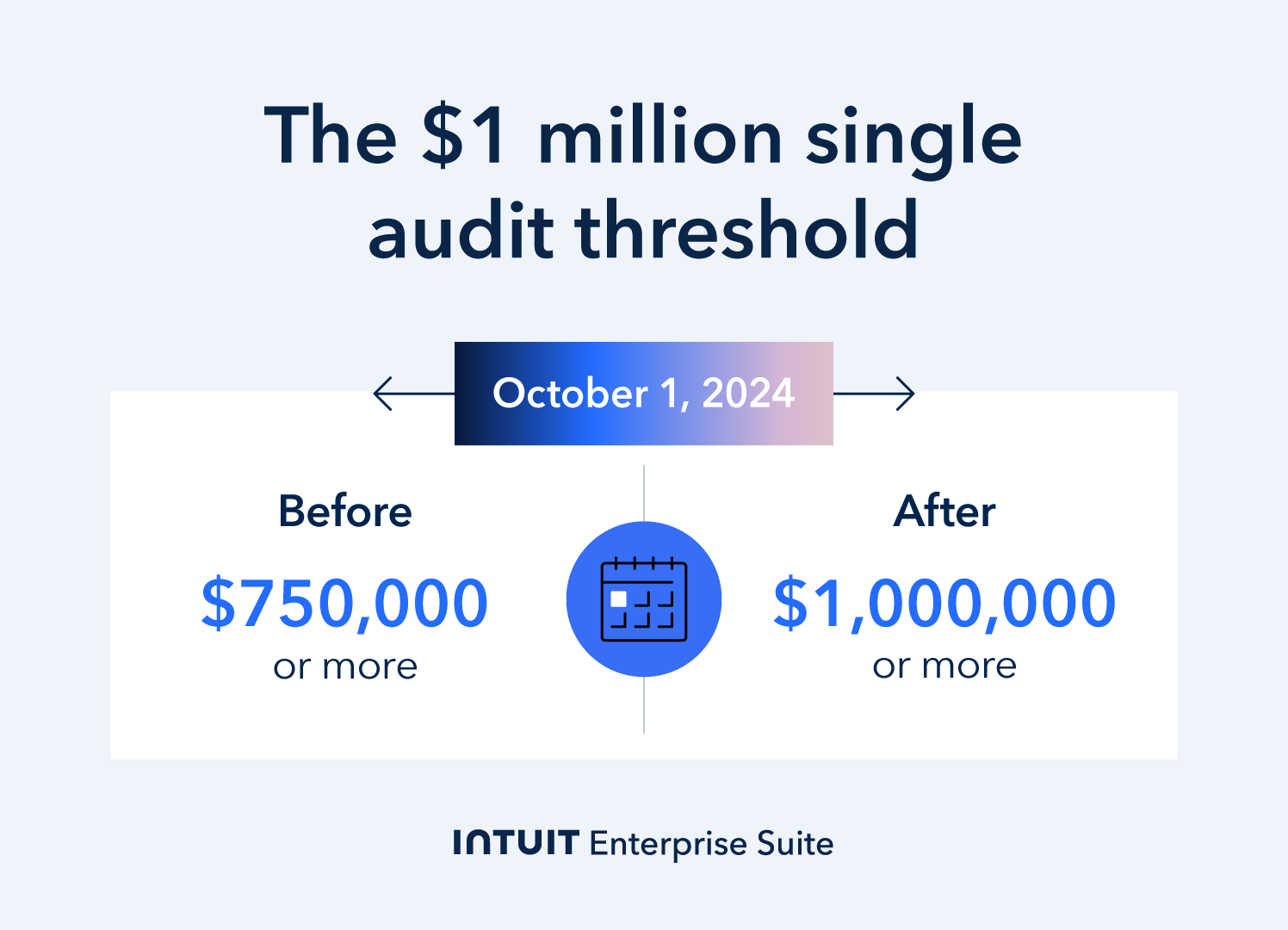
Digital audit trails also create a self-healing record: Every journal entry links directly to its supporting documentation. With the new $1 million single audit threshold mandating federal review, digital, system-enforced tracking surfaces audit trails and historic approval for instant auditor verification.
Step 3: Implement real-time restricted asset tracking
Rigorous grant tracking is imperative to ensuring that assets are used only as specified. Relying on manual spreadsheets for this process invites human error, leading to reduced asset leakage. This misallocation is often a primary source of findings during audits of nonprofit organizations.
AI-powered ERPs allow finance teams to categorize expenses by both nature and function and will automatically suggest tags to optimize compliance, transparency, and accuracy. This multidimensional reporting allows you to fulfill GAAP requirements without manual exports.
With category tags in place, the system-enforced architecture prevents funds from being released unless the specific parameters of those tags are met. These predefined protocols create a seamless path from donor intent to actual spend, with an audit trail to support it.

Major donors account for 77.7% of nonprofits' total fundraising revenue. Having a fail-proof asset-tracking system ensures their intent is met, increasing the likelihood of their continued support.
Step 4: Deploy AI-native anomaly detection
Waiting until year-end for a financial review is often too late to course-correct misallocated resources or inaccurate entries. Tools like Intuit Intelligence pair AI capabilities with expert human teams to monitor your financial records in real time and flag anomalies and restricted-fund violations as they occur.
Continuous AI-powered review of large datasets surfaces risks that manual sampling might miss. When applied across all entities, AI monitoring provides company-wide performance summaries built on granular insight.
The “decision-grade” data this architecture provides is what CFOs need to move their nonprofit forward with confidence and inspire donor trust. AI-forward tools like Intuit Enterprise Suite empower you to shift your role from data hunter to true strategic advisor.
Step 5: Orchestrate a standardized close
Traditional financial teams spend up to 80% of their time manually compiling, organizing, and reconciling data. AI-powered automation stands to save nonprofits 25 hours per week. Automating all eliminations and transfers and consolidating ledgers into a single dashboard allows you to monitor all subsidiaries in real time.
Such centralized command and oversight standardize month-end close processes and significantly reduce manual intervention. This, in turn, reduces bottlenecks before they delay global reports and surfaces discrepancies before they become a problem.
Rather than spending weeks reconstructing transaction histories, CFOs can provide auditors with clean, system-verified, read-only digital ledgers from the onset of fieldwork.
This upfront transparency significantly reduces billable auditor hours, mitigates the risk of unexpected management letter comments, and ensures that the organization can demonstrate rigorous compliance to donors, board members, and regulatory bodies alike.

What triggers indicate a nonprofit has outgrown its processes?
Operational inefficiencies aren’t always easy to notice, especially when they occur over time and have become normalized into the status quo.

Here are the top three indicators that your nonprofit has outgrown its existing system:
1. Long month-end close: If you’re taking longer than 10 days to complete close cycles, your reports will be outdated by the time you read them. In fact, 73% of businesses take a week or less, and an elite 18% manage month-end processes in one to three days. Rapid month-end closes are possible, but not with legacy manual systems.
2. Reliance on manual spreadsheets: Manual data entry is prone to human error. Nonprofits that rely on manual spreadsheets for reconciliation and eliminating inter-charter transfers quickly hit their operational ceiling. At some point, finance teams will reach capacity, and moving faster would only increase the risk of mistakes.
3. Impact reporting insufficiencies: Large donors and government grants want—and require—that you use their assets as intended. Disparate systems prevent CFOs from consolidating an accurate impact report to share with donors and their board. This damages trust and increases the risk of donor attrition.
As your nonprofit decentralizes, manual reporting processes become a liability that auditors will flag as a material weakness. The solution is an enterprise-grade upgrade.
For example, a national NPO could reduce its audit preparation time simply by centralizing its data with AI-powered multi-entity accounting software. This allows them to redirect up to 30 hours a week toward mission-critical programs.
Leading ERP systems automate processes, improve reporting accuracy, and comply with NPO audit requirements.
How does financial precision translate into increased board confidence and donor trust?
CFOs build trust by showing exactly how they are allocating their assets. In 2026, donors are more likely to increase funding for organizations that provide transparent, real-time reporting. Donors and grantmakers want to see that you are using their money effectively.
The continuous, digital tracking provided by ERP systems provides instant proof of resource allocation and impact, even across chapters.
CFOs can leverage AI, analytics, and integration to improve resource allocation, impact reporting, and donor trust.
In addition to improving resource tracking and reporting, ERP systems allow you to reclaim time and focus on long-term capital preservation and mission expansion. Automating your administrative floor with enterprise accounting software reduces manual burden and lets CFOs shift from bookkeeping to proactive stewardship.

When you schedule a demo, you agree to permit Intuit to use the information provided to contact you about Intuit Enterprise Suite and other related Intuit products and services. Your information will be processed as described in our Global Privacy Statement.
Strengthening mission impact through financial precision
Nonprofit audits can make or break your organization’s reputation. Modernizing your accounting system through these five steps increases the likelihood of a positive report.
AI-powered accounting software consolidates financial data across nonprofit entities and automates reporting, making every subsidiary audit-ready. Use Intuit Enterprise Suite to optimize your financial workflows, increase donor trust, and strengthen your mission impact.
Check out upcoming events and learn more about Intuit Enterprise Suite.

Customer stories

Case study
Case study: Fire & Ice transforms multi-entity challenges with Intuit Enterprise
October 25, 2024

Case study
How FEFA Financial scaled up with Intuit Enterprise Suite (No ERP migration needed)

Case study
Four Points RV Resorts review: Why they chose Intuit Enterprise Suite over NetSuite
October 25, 2024

Construction
Migrating to Intuit Enterprise Suite took 2 hours (with zero disruption) for this aspiring $50M revenue business
April 25, 2025

Case study
Humble House Foods case study: How they improved visibility & simplicity using Intuit Enterprise Suite
September 24, 2025