Table of contents
Table of contents
Multi-entity accounting is the systemized consolidation of financial activity across multiple legal subsidiaries into a single, authoritative group ledger. It serves as the framework for managing complex intercompany eliminations, ensuring reporting consistency and continuous audit readiness across the entire enterprise.
Intercompany transactions, allocations, and eliminations can consume weeks of a finance team’s time at month-end. For CFOs at multi-entity firms, these manual processes do more than delay reporting—they compromise audit readiness and forecast accuracy.
Consolidating these operations into a single source of truth is the only way to eliminate this data latency. Research confirms the impact of that architectural shift: A Forrester TEI study found that enterprise firms utilizing a unified, AI-native platform can achieve a 299% ROI over three years.
In this post, we'll cover how a connected multi-entity accounting approach shifts your team from manual data gathering to driving strategic outcomes.
How does multi-entity accounting work?
Multi-entity accounting unifies an organization’s financial data into a single, connected system, eliminating disconnected data and fragmented reporting. While each entity within the organization can handle its own bookkeeping and account management, the system enables seamless reporting across all entities.
With this setup, your accounting teams can track finances separately for each entity, efficiently manage intercompany transactions, and generate consolidated financial statements with minimal manual intervention.
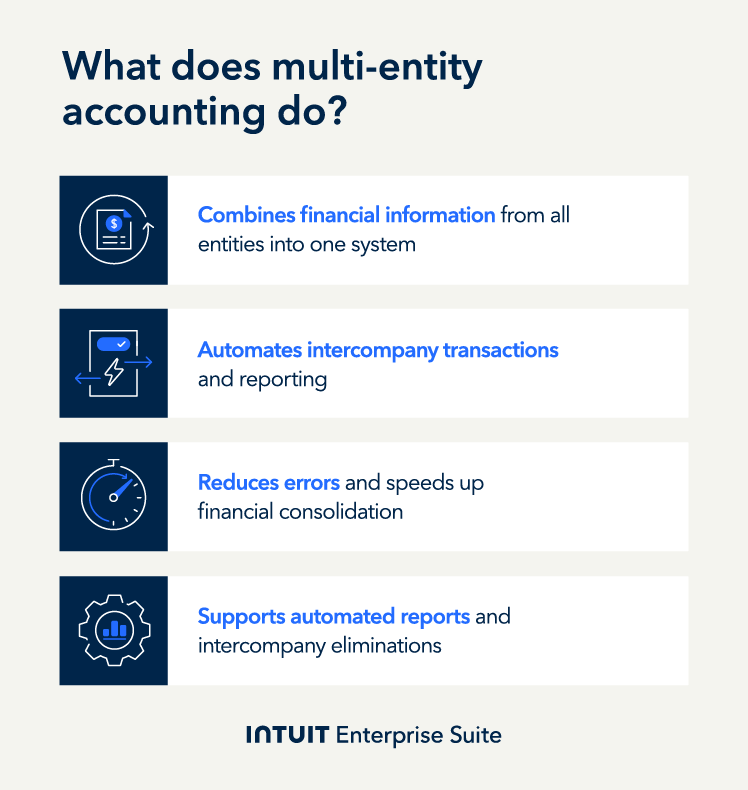
It works by centralizing financial data from various entities, automating the consolidation process, and ensuring consistent project-based accounting practices across the organization. This reduces errors, speeds up financial reporting, and provides a comprehensive view of your organization’s financial health.
Here is a brief summary of the differences between traditional and multi-entity systems:
Ultimately, this system-level integration allows the finance function to transition from manual data gathering to high-level strategic advising. By enforcing group-level standards at the transaction level, you eliminate the data latency that typically prevents CFOs from making precise, confident capital allocation decisions.
The building blocks of multi-entity accounting
To maintain financial rigor across a complex organization, finance leaders must establish a standardized framework for data collection and reporting. Understanding these core components is essential for ensuring audit readiness and operational control.
What is an entity in accounting?
In an enterprise context, an entity is a distinct business unit—such as a subsidiary, division, or legal branch—that maintains its own financial records while operating under a parent organization. Each entity requires independent financial statements, including a balance sheet and income statement, to ensure transparency and compliance.
Intuit Enterprise Suite provides a single environment to manage these entities, allowing for standardized accounting policies across the entire organization without sacrificing the operational agility of individual units.
What is project-based accounting?
Project-based accounting is a specialized financial practice that tracks revenue, expenses, and profitability at the individual project level rather than as general overhead. Rather than treating projects as general overhead within an entity, this practice tracks at the task level across your entire portfolio.
By standardizing project tracking across subsidiaries, Intuit Enterprise Suite ensures that project-level variances—like labor overruns or unbilled expenses—are visible in your consolidated financial reports in real time. This integration enables precise revenue recognition (ASC 606) and WIP (Work in Progress) reporting that reflects the group's actual financial health, not just that of an individual branch.
What is multi-unit accounting?
Finally, multi-unit accounting involves managing the financial records for multiple units or branches within a single organization. This is different from multi-entity accounting, as all those units may be part of the same entity.
This approach enables a business to track each unit's income, expenses, and overall performance. At the same time, it allows your finance teams to consolidate all this data into a single, comprehensive financial report. You and other shareholders then get a more holistic view of the entire organization.
Intuit Enterprise Suite unifies both structures into a connected platform. It automates intercompany eliminations, transforming weeks of manual consolidation into minutes of automated processing. This gives stakeholders a real-time, consolidated view of the organization’s total financial health while maintaining granular control at the unit level.

When you schedule a demo, you agree to permit Intuit to use the information provided to contact you about Intuit Enterprise Suite and other related Intuit products and services. Your information will be processed as described in our Global Privacy Statement.
Enterprise use cases for multi-entity accounting
For firms scaling beyond $10M in revenue, multi-entity structures are a strategic necessity to manage risk, regulatory requirements, and operational complexity. These structures allow organizations to maintain distinct financial records for various subsidiaries, branches, or divisions while ensuring standardized governance across the enterprise.
Industry-specific requirements often drive the need for a connected platform capable of handling complex entity relationships.
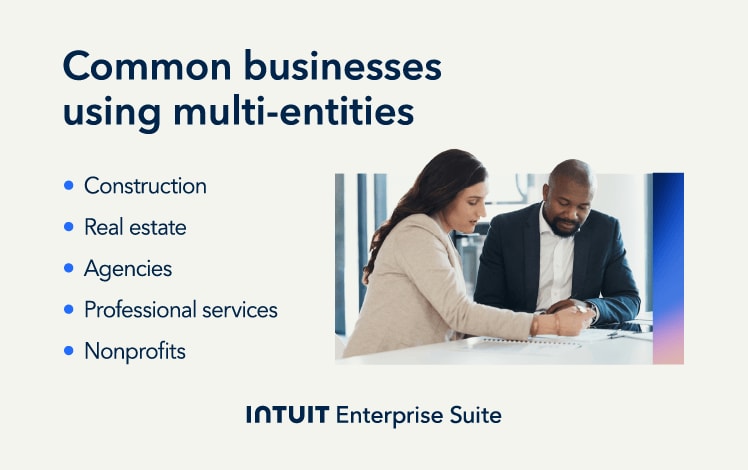
This is common in industries such as:
- Construction: Construction companies often have multiple entities for different projects, ensuring project-specific liability and financial management.
- Real estate: Real estate developers may have separate entities for different properties or developments to manage risks and tax implications.
- Professional services: Law firms, accounting firms, and consulting companies may use multiple entities for different practice areas or client engagements.
- Agencies: Advertising, marketing, and public relations agencies can maintain separate entities for different clients or services.
- Nonprofits: Nonprofits often operate under multiple entities to manage different programs or fundraising initiatives.
- Holding companies: Parent organizations use multi-entity accounting to unify disparate data from hundreds of entities into one platform, facilitating automated eliminations and instant consolidated reporting.

What drives enterprises to choose a multi-entity accounting structure?
Operating with multiple legal entities provides senior finance leaders with the control and visibility needed to manage multimillion-dollar decisions with clarity. This structure is essential for balancing strategic growth with operational precision.
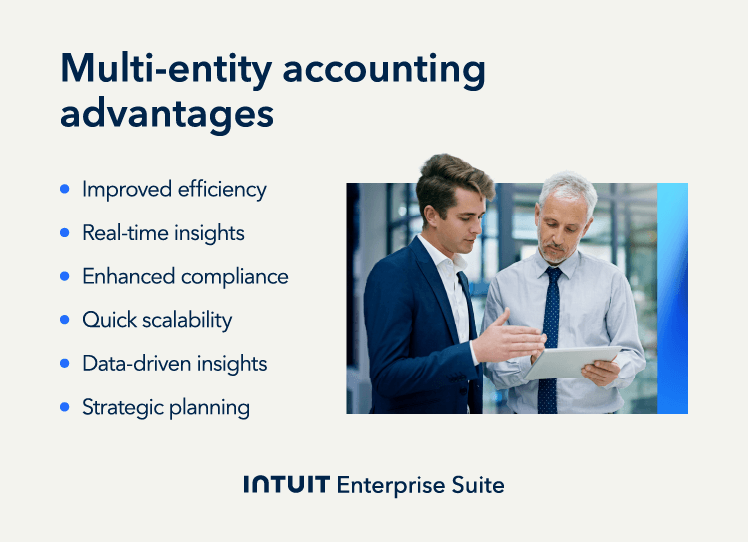
Enterprises choose a multi-entity framework for a variety of reasons:
- Risk management: Separate entities can limit liability, protecting one entity's assets from the debts or liabilities of another.
- Tax optimization: Different entities may be subject to different tax rates or have access to specific tax incentives, allowing for more efficient tax planning. You can try a pass-through entity, too.
- Regulatory compliance: Certain industries or regions may require businesses to operate under specific legal structures, such as subsidiaries or branches.
- Organizational structure: Multiple business entities can be used to create distinct divisions or business units, improving efficiency and accountability.
- Investment and acquisitions: Acquiring or investing in existing entities can be a strategic way to expand into new markets or industries.
By centralizing these functions within Intuit Enterprise Suite, finance teams can automate intercompany operations and reconciliations, resulting in up to 74% savings over three years from improved efficiency. This transition allows the finance department to shift from repetitive data gathering to driving strategic business impact.
Accounting challenges multi-entity businesses face
Manual accounting tasks and fragmented data entry directly impact a multi-entity organization's ability to scale while maintaining financial rigor. Managing the complexities of a complex structure introduces several high-stakes challenges that require a connected, AI-native platform to solve.
Some of these challenges include:
Inefficient intercompany operations
Managing transactions between subsidiaries often consumes weeks of a finance team’s time during the month-end close. Without a standardized system, reconciling these transactions results in data discrepancies and delayed reporting, compromising audit readiness.
A BlackLine survey found that 99% of finance stakeholders struggle with intercompany financial processes, with 80% identifying automation as the critical factor for improving data reliability.
Delayed reporting
Generating a unified view of performance across hundreds of entities is often slowed by diverse currencies and varying accounting standards. Relying on manual spreadsheet exports to "stitch together" these numbers creates blind spots that limit the CFO's ability to drive forward-looking strategy.
According to a 2025 CFO Agenda report, 50% of finance professionals prioritize moving away from spreadsheets because they are error-prone and lack the real-time access required for modern consolidated reporting.
Compromised data consistency
Maintaining a single source of truth is difficult when entities use disparate accounting methods or different reporting timelines. These inconsistencies result in inaccurate analytics that can lead to poor capital allocation decisions.
Research from 2025 indicates that 72% of finance teams have now adopted AI tools to automate routine tasks—a jump from 34% in 2024—primarily to eliminate the manual reformatting and data manipulation that causes reporting errors.
Regulatory and compliance risk
Operating across multiple jurisdictions requires strict adherence to evolving local laws and tax obligations. Managing permissions and access across large, distributed teams without GAAP-compliant governance leaves the enterprise exposed to significant audit findings and penalties.
This is crucial as regulatory pressure intensifies, with the SEC initiating 200 enforcement actions in the first quarter of 2025 alone—a pace unmatched since 2000.
6 Strategic advantages of multi-entity accounting
For C-suite executives, managing multiple entities often results in inefficiencies, inaccuracies, and wasted time. Multi-entity accounting addresses these pain points by providing a centralized, automated solution that simplifies financial management and enhances decision-making.

Here’s how you can benefit from it:
1. Accelerated operational efficiency
Automating routine financial tasks—including intercompany transactions, allocations, and eliminations—reduces manual overhead and the risk of entry errors. Firms that use these automated workflows can achieve significant time and overhead savings, primarily through efficiencies in intercompany management.
Example: A regional construction group might automate 250 monthly intercompany expense allocations. This eliminates the bottleneck of chasing intra-firm data, allowing the team to reduce the total close cycle from 10 business days to 4.
2. Real-time unified visibility
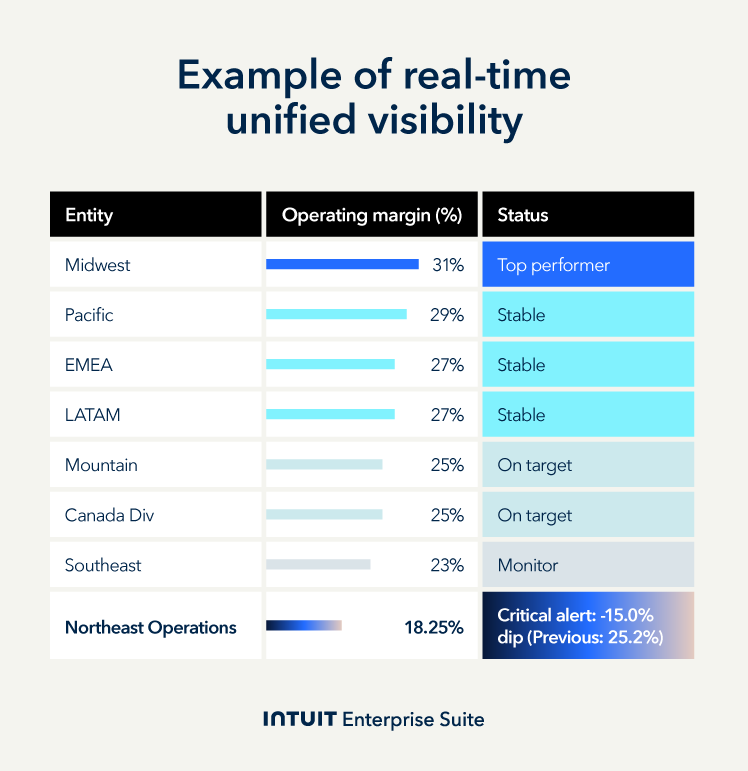
A connected platform delivers a single source of truth across hundreds of entities, providing instant insight into cash flow, profitability, and performance. This real-time visibility allows leaders to move beyond hindsight reporting to forward-looking strategy.
Example: Instead of waiting for individual subsidiary reports to be exported and merged, a manufacturing CFO could access a live, consolidated dashboard. If they identified a 15% margin dip in one unit and a surplus in another, they can move capital within the same day to maximize the firm's overall ROI.
3. Audit-ready governance
Standardized accounting policies and GAAP-compliant governance ensure that every transaction, approval, and journal entry is transparently tracked. This provides finance teams with the control they need to maintain compliance without the bottlenecks of manual red tape.
Example: An accounting director faces a surprise year-end audit. With a consolidated multi-entity accounting system, they don't have to request information from sources at each location. Instead, they can be prepared in a single afternoon.
4. Frictionless scalability
Modern financial systems are designed to evolve with acquisitions and organizational growth with minimal reliance on external IT consultants. Businesses can scale their operations without the high cost and prolonged implementation cycles typical of legacy ERP migrations.
Example: Following a major acquisition, a professional services firm can integrate two new regional entities into its central reporting environment in under 48 hours.
5. AI-driven financial intelligence
AI agents embedded directly into the workflow surface key trends, risks, and opportunities that might otherwise remain hidden in fragmented data. These tools retrieve and analyze data to deliver clear, actionable intelligence, helping finance teams amplify their impact across the organization.
Example: Consider a scenario in which a controller receives an automated AI anomaly alert about a sudden rise in Days Sales Outstanding (DSO) within a specific division; this early detection enables the finance leader to identify and resolve a billing bottleneck before it impacts the firm's overall cash flow.
6. Strategic forecast accuracy
By shifting the focus from manual data manipulation to analysis, finance teams can provide more accurate forecasts and strategic financial planning for stakeholders. This transformation enables leaders to model different scenarios and share insights with the confidence that comes from unified, real-time data.
Example: A finance team uses real-time multi-entity data to build a three-year growth model that helps secure a multimillion-dollar credit line for international expansion.

Boost productivity and enhance profitability
Ultimately, a robust multi-entity accounting system should provide you with the actionable financial insights you need to drive growth. And leveraging powerful ERP software to this end means you can automate consolidation, streamline intercompany transactions, and ensure data consistency across all your business units.
If you’re ready to take control of your complex financial landscape, explore a solution designed for your unique needs. Learn more about how the right multi-entity accounting solution can help you make smarter, faster decisions for the future of your organization.
Check out upcoming events and learn more about Intuit Enterprise Suite.
Customer stories

Case study
How FEFA Financial scaled up with Intuit Enterprise Suite (No ERP migration needed)

Case study
Case study: Fire & Ice transforms multi-entity challenges with Intuit Enterprise
October 25, 2024

Case study
Four Points RV Resorts review: Why they chose Intuit Enterprise Suite over NetSuite
October 25, 2024

Construction
Migrating to Intuit Enterprise Suite took 2 hours (with zero disruption) for this aspiring $50M revenue business

Case study
Humble House Foods case study: How they improved visibility & simplicity using Intuit Enterprise Suite
September 24, 2025