Table of contents
Table of contents
ERP vs. accounting software: ERP software integrates core business processes into one product solution, whereas accounting software is only for financial management. Accounting software is often part of a more extensive ERP software interface.
As a business executive, you might face scaling challenges. Or maybe you’re focused on regulatory compliance, ensuring that your business remains compliant with ever-changing regulations. Instituting a business solution to help with these challenges will be helpful for you and your employees.
While accounting software only focuses on financial management, a complete ERP solution can help manage many facets of your business in one place, from accounting to supply chain management and more.
When considering ERP or accounting software, which is best for you and your business? Explore the similarities and differences between these offerings below to determine which will help keep operations running smoothly.
What are ERP systems?
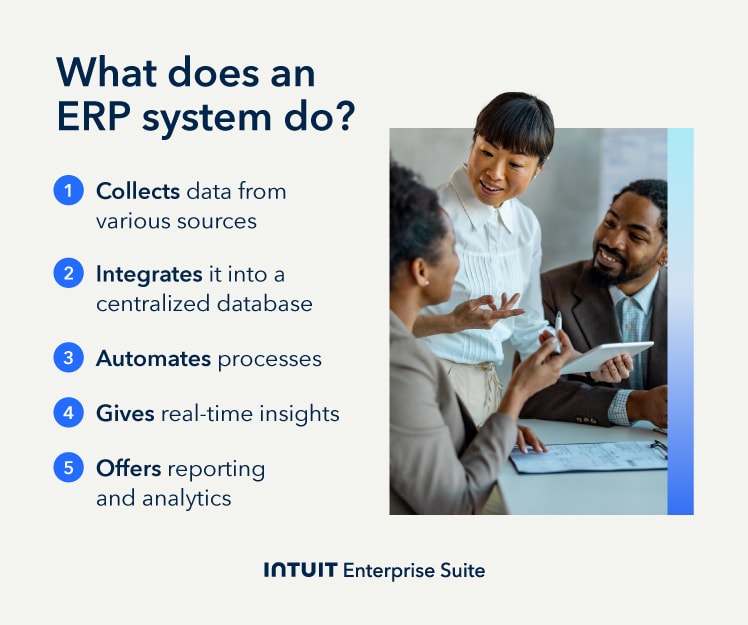
Enterprise Resource Planning systems, or ERP systems for short, are software business solutions that integrate several critical business functions into one system. They organize and manage essential business tasks, providing a comprehensive view of business operations in one location versus many different software systems.
When the term “ERP” was coined, key features included a centralized database and integrated modules for finance, HR, and manufacturing tasks. Today, ERPs can be cloud-based, on-premise, or mobile. As new technologies such as AI emerge and businesses need different things to be integrated for seamless workflow, ERPs will continue to evolve.

What is accounting software?
Accounting software can be part of an ERP accounting system or can be used as an individual solution for a business to automate financial tasks and manage accounting records. Core functions of accounting software can include:
- General ledger
- Accounts receivable and payable
- Bank reconciliation
- Payroll
- Inventory management
- Financial reporting
- Tax preparation
Types of accounting software
There are different types of accounting software for various kinds of businesses.
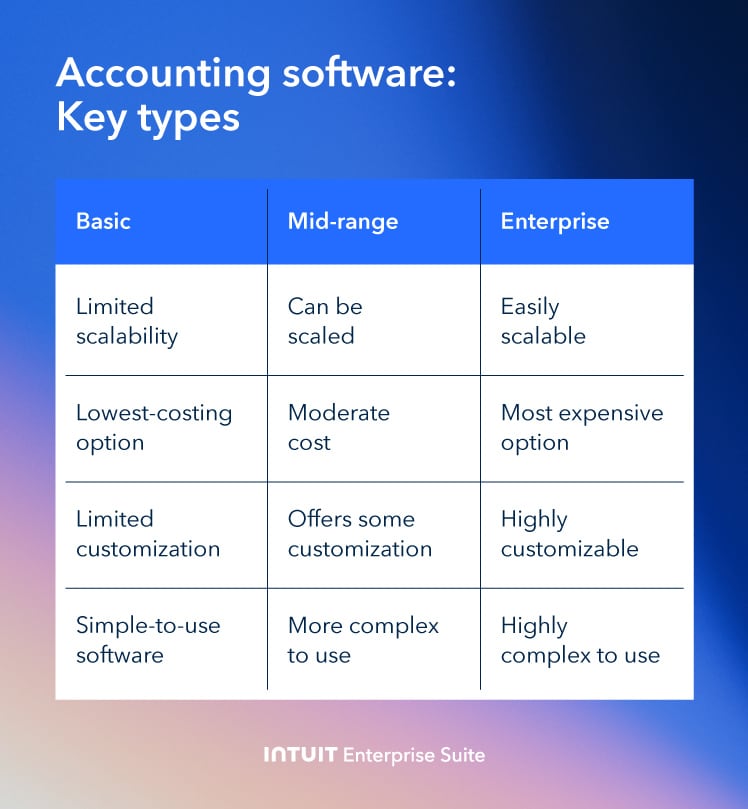
Basic accounting software is best positioned for small companies since it offers simple accounting features like invoicing and expense tracking.
Mid-range accounting solutions offer more advanced key features like inventory management and payroll processing and are ideal for small to mid-sized businesses.
Enterprise accounting software, which is best for large enterprises, offers the most comprehensive accounting package, including advanced reporting and robust security. This high-end option can help simplify complex financial processes, reducing human error along the way.
ERP vs. accounting software: Key differences
While both ERP solutions and accounting software can help businesses achieve their business goals, there are some key differences.
Scope and integration
The scope and integration of ERP and accounting software varies greatly:
- Scope: While accounting software primarily focuses on financial management, ERP accounting software offers a broader scope of business solutions for various functions, including finance.
- Integration: Accounting software can be integrated with other financial tools but is limited to other business solutions. On the other hand, ERP solutions can seamlessly integrate different functions to give a holistic view of the business.
 If you have existing accounting software, you can transition to a full-service ERP if needed.
Scalability and customization
Scalability and the ability to customize a software solution to a particular business are essential to maintain efficiency.
- Scalability: ERP software is designed to grow with businesses. Different modules can be added or removed anytime to accommodate changing business needs. In contrast, accounting software is limited in scalability, requiring a company to switch to a new offering if it experiences growth.
- Customization: While stand-alone accounting software can sometimes be customized (most often, only mid-range and enterprise opinions), ERP software is made to be highly customizable to fit all types of business needs.
Industry-specific solutions
Depending on your industry, you might need custom-tailored ERP solutions for your business.
- Accounting software: Some accounting software can be tailored to specific industries, but it’s most often generic across businesses and industries.
- ERP software: Tailor your ERP software to your industry with modules for manufacturing, point of sale, client management, and more that can be added depending on the industry.
Compliance and reporting
ERP in accounting can help businesses with the crucial reporting and compliance they must keep.
- Accounting software focuses on financial compliance and generates standard financial reports like income statements and balance sheets. This solution does not offer complex compliance requirements for industry-specific businesses.
- ERP software: Due to their comprehensive nature, a significant benefit of ERP solutions is the fact that they cover comprehensive compliance requirements, including industry-specific ones. They also offer advanced reporting metrics to help businesses remain compliant.
Intuit Enterprise Suite customers are saying
"We’ve now been moved over to the Intuit Enterprise Suite. It has immediately solved the issues we’ve had as it relates to multi-entity. We were looking at something like Netsuite when all we need is consolidated financials and intercompany transfers via journal entries. Those needs are getting addressed now which is exciting for us."
- Matt Van Der Molen, CMO, Four Points RV Resorts
Real-time data and analytics
Real-time data and analytics are crucial for business owners to make adequately informed decisions.
- Accounting software only offers limited real-time data on financial transactions but not data on other crucial business functions. Additionally, insights and analytics may require manual data entry, making the process less than seamless.
- ERP solutions can provide cross-departmental real-time insights to help inform decision-making quickly and efficiently. These solutions also offer complex and sophisticated analytic tools like predictive analytics and machine learning. And ERP systems with cloud-based features allow businesses to access this real-time data from anywhere when needed.
Customer relationship management (CRM)
Customer relationship management capabilities are crucial for any business, so finding the right solution for you is important.
- Accounting software may have limited CRM features like basic sales tracking, but it lacks significant scope and only focuses on financial data instead.
- ERP software offers complex and robust CRM modules, focusing on aspects like sales force automation and customer service support. When comparing ERP vs. CRM, it's important to note that while ERP includes CRM functionality, standalone CRM systems often provide more advanced tools for customer engagement and relationship management.
Total cost of ownership (TCO)
Even though both business solutions can help to optimize business operations, their TCO varies greatly.
- Accounting software generally has lower upfront and implementation costs. Ongoing costs include maintenance, support, and user training, which typically follow the same costs as ERP accounting software.
- ERP software typically has higher upfront costs due to its all-encompassing nature and customization. Implementation costs are also generally higher than accounting software, primarily due to professional services and customization.

When you schedule a demo, you agree to permit Intuit to use the information provided to contact you about Intuit Enterprise Suite and other related Intuit products and services. Your information will be processed as described in our Global Privacy Statement.
Choosing between ERP and accounting software
Choosing between a comprehensive ERP accounting suite and accounting software doesn’t need to be challenging—you just need to know what factors to evaluate.
Before choosing a business solution, consider the following:
- Your business size and complexity.
- Your future growth and how you see your product solution growing with you.
- The need for program integration with other business functions.
- Your allotted budget for a software solution, including upfront and ongoing fees.
- If you need any industry-specific requirements or solutions.
- The level of training that your employees will need to operate the solution.
Choosing the right business solution can streamline processes and improve your overall business efficiency.

Hybrid approach: When to use both ERP and accounting software
If you want the best of both worlds, why not choose both an ERP solution and accounting software to propel your business?
This hybrid solution is best when:
- Your business needs highly specialized financial reporting like complex tax calculations or for companies that have unique accounting standards.
- You want to mitigate data migration challenges, which can happen when migrating large amounts of historical data from legacy systems to a new ERP system.
- You have budget constraints that make it less expensive to have a separate accounting software from your ERP solution.
Taking the best of both worlds regarding ERP accounting modules and accounting software can help integrate business functions without solely relying on a solution that could put you over budget.

When to choose ERP over accounting software
When your business has outgrown standalone accounting software, or you could benefit from all the benefits that an ERP can bring your company, there are some definitive signs that you should choose an ERP over accounting software. Those include:
- Having a projection of tremendous business growth or expanding business operations.
- The desire to foster company-wide communication and data sharing quickly and effectively.
- A need to make data-driven decisions quickly by using real-time information.
- Your business needs include complex supply chain and inventory management needs.
- Your business is manufacturing, retail, healthcare, construction, automotive, logistics and transportation, or pharmaceutical—the top industries that benefit most from an ERP solution.
Many businesses start with accounting software and simply outgrow it, causing the need for a transition.
N&N Moving Supplies, for example, found that they had Inefficient manual processes for payroll and accounting and implemented an ERP solution that reduced payroll processing time by 84%.
Boost productivity and enhance profitability
As an executive, you know your business needs the best to choose between ERP vs. accounting software. Choose enterprise accounting software to help your company make more informed financial decisions and efficiently support your business growth.
If you have more complex business needs beyond financial management, consider Intuit Enterprise Suite, which helps you manage multiple entities and project-based accounting—all with tailored support.

ERP vs. accounting software FAQ
Check out upcoming events and learn more about Intuit Enterprise Suite.

Customer stories

Case Study
How FEFA Financial is growing with Intuit Enterprise Suite—without migrating to an ERP

Case Study
How this mission-driven, employee-owned company created efficiencies with Intuit Enterprise Suite
October 25, 2024

Case Study
Why this camping business chose Intuit Enterprise Suite over NetSuite
October 25, 2024

Case Study
Migrating to Intuit Enterprise Suite took 2 hours (with zero disruption) for this aspiring $50M revenue business
April 25, 2025

Case Study
Humble House Foods case study: How they improved visibility & simplicity using Intuit Enterprise Suite
September 24, 2025
More on ERPs

Guide
Data analytics: How AI-driven ERP data analytics reveal blind spots & align resources for growth

ERP
ERP implementation: From spreadsheets to an integrated & scalable ERP system
May 27, 2025

ERP
7 advantages of an ERP system every exec & business owner should know
November 22, 2024

ERP
AI in ERP: Unifying data using intelligent automation
October 14, 2025