Table of contents
Table of contents
As your organization scales, you’ll need deeper, real-time visibility into financial performance to effectively allocate resources and ensure compliance across entities. But according to our 2024 Business Solutions Survey, 45% of businesses reported inadequate reporting and analysis capabilities from their current digital accounting solutions.
Multidimensional accounting resolves this challenge by providing a unified, centralized framework for financial data. This capability is built into the data model of modern ERP-level financial systems, not layered on through reporting tools or workarounds in your chart of accounts.
Instead of relying on rigid chart-of-accounts structures that limit financial visibility, you and your teams can analyze financial information across an unlimited number of dimensions simultaneously.
This granular insight makes it easier for your teams to measure and and for you to manage profitability across departments, product lines, or even geographic regions.
Such a powerful, 360-degree view empowers you to move beyond basic multi-entity reporting and prioritize what actually drives performance and profitability throughout the entire organization.
Read on to learn how multidimensional accounting works, how to set it up, and whether your current system is holding your organization back.

How multidimensional accounting works
Multidimensional accounting provides an adaptive framework for segmenting and analyzing financial data across multiple business dimensions—such as project, cost center, product line, or geographic region.
Unlike rigid legacy ERPs that are limited to a single dimension (like a chart of accounts), this approach captures the full context of every financial transaction. This deeper level of financial visibility ensures you’re not relying on aggregated totals alone, but instead evaluating performance across the operational drivers behind those results.

For CFOs, this isn't just about better reporting; it's about transforming financial data into a strategic asset for confident decision-making and robust performance management.

Understanding dimensions in accounting
In accounting, dimensions are categories used to organize and analyze financial data. Instead of simply recording a transaction, you can tag it with various dimensions to yield a more granular view of the organization’s value drivers.
Common dimensions in a multidimensional accounting system:
- Departments: Track financial performance by specific departments
- Products or services: Analyze profitability or costs associated with different product lines or services
- Regions: Understand revenue and expenses based on areas
- Projects: Track profitability on a per-project basis
While many businesses attempt to build these capabilities using manual tags or codes within their current software, scaling this approach often leads to disconnected data.
For example, some organizations attempt to approximate multidimensional reporting by expanding account numbering structures or layering manual tags within their existing accounting systems.
Account numbering system
An account numbering system is a structured way to assign unique identifiers to each account in the general ledger (GL). This system usually combines numbers and letters to categorize accounts, such as assets, liabilities, revenue, and expenses. For example, a revenue account might include a department tag, product tag, and region tag.
While an organized numbering system lays the groundwork for more advanced accounting needs, it breaks down at scale.
As organizations add entities, product lines, and operating segments, these numbering structures often expand into hundreds or thousands of account combinations, making reporting increasingly error-prone and difficult to govern. That’s where the right solution can make a big difference.

Dimensions of a general ledger
From there, you can add multiple dimensions to the general ledger. The dimensions of a general ledger typically include:
- Account code: Primary identifier for the type of a transaction
- Cost center: Department or unit within the company responsible for the transaction
- Product/service line: Product or service related to the transaction
- Location: The geographical area where the transaction occurred
- Project code: Identifies the project associated with the transaction

When you schedule a demo, you agree to permit Intuit to use the information provided to contact you about Intuit Enterprise Suite and other related Intuit products and services. Your information will be processed as described in our Global Privacy Statement.
Setting up a multidimensional chart of accounts
In traditional accounting systems, finance teams approximate multidimensional reporting by embedding dimensions directly into the chart of accounts (COA) structure. Here's how that's typically done:

1. Identify dimensions and segments: Determine the dimensions that are most relevant to your business. These could include departments, products, regions, or projects.
2. Design the account number structure: Use a system that incorporates these dimensions and allows team members to uniquely identify each account.
3. Create the account numbers: Each account number should uniquely identify a combination of dimensions.
4. Assign account descriptions: These descriptions should reflect the dimensions associated with the account, making it easy to understand the nature of the transactions recorded under it. For instance, “Revenue-Sales-North.”
5. Implement in your accounting software: Put your multidimensional COA in place.
This approach can work, but it creates rigid, bloated account structures that become harder to maintain as your organization grows. Adding a new region, department, or product line means rebuilding parts of the COA, and reporting flexibility remains limited by the accounts' original design.
Modern ERP-level systems like Intuit Enterprise Suite (IES) handle this differently. Instead of embedding dimensions into account numbers, dimensions are built directly into the data model, so you can slice and analyze financial data across any combination of dimensions without restructuring your chart of accounts.
 Tracking details like location or product line through a chart of accounts can be cumbersome. Instead, multidimensional accounting software, like IES, captures these operational details at the transaction level, using tags, classes, or other categorizing elements.
Do you need a multidimensional accounting solution?
Multidimensional accounting provides clearer visibility into organizational performance than standard accounting systems can, especially for complex companies.
A multidimensional accounting solution becomes increasingly important if your growing business has:
- Complex operations like managing multiple departments, products, or locations.
- Inaccurate reporting due to inconsistencies or outdated financial data.
- Limited insights when trying to understand the performance of different business segments.
- Slow decision-making because of a lack of timely, actionable financial information.
- Regulatory compliance requires adherence to complex regulations.
Accounting capabilities that enable multidimensional reporting also unlock the agility needed to protect the bottom line.
For example, finance teams can quickly identify which departments, products, or regions are driving revenue growth or contributing to rising costs. This information allows you to reallocate resources before a trend impacts the quarterly forecast.
 A multidimensional accounting solution is especially useful if you’re scaling across multiple locations or entities. It provides the granular visibility needed to drill down into costs and revenue drivers that traditional accounting systems overlook.
Advantages of upgrading to multidimensional accounting
Multidimensional accounting is a strategic necessity for scaling multi-entity enterprises. Instead of trying to modernize your current ERP solution, replacing it with a system built for this complexity delivers measurably more value.
The value of embracing a new multidimensional accounting system can include:
Simplified chart of accounts
A traditional chart of accounts can easily become bloated, with thousands of account codes as new entities or projects are added. With a multidimensional approach, you can reduce this complexity.
Example: A global SaaS company with products in the US and Europe might have a separate revenue account for each product in each region (like "4001 - US Product A Sales"). With multidimensional accounting, they can have just one account, "4000 - Product Sales," and use dimensions for Region and Product to track everything.
Allocated payments to the correct department or entity
Manual allocation of payments and expenses is a common source of errors and delays. Multidimensional systems automate this process using predefined allocation rules and cost distribution logic, ensuring transactions are consistently assigned to the correct departments or projects.
A recent survey of finance leaders found that 82% of organizations still rely on manual processes for their financial close and record-to-report activities, which leads to prolonged, error-prone cycles. Automating these tasks with a multidimensional system directly addresses this inefficiency.
Accurate and consolidated reporting
Consolidating financial data across multiple entities without manual adjustments is a major challenge for many companies. Multidimensional systems provide a single source of truth, ensuring consistent and transparent financial reporting across operating entities.
Example: A manufacturing company might have a single cloud services bill for its entire organization. Instead of manually splitting the bill for each department based on usage, a multidimensional system can automatically allocate costs to the R&D, Production, and Operations cost centers based on pre-set rules, ensuring each department's budget is accurately charged.
Easier intercompany transactions
Intercompany transactions are especially challenging for global, multi-entity businesses. Multidimensional systems automate this process through workflows such as matching intercompany entries, applying system-driven eliminations, and reconciling balances during the close, reducing the need for manual coordination across entities.
According to a 2023 study by BlackLine, 99% of large multinational companies report facing specific challenges with intercompany financial processes. The study also revealed that these issues are not just operational hurdles; they are directly impacting business outcomes and putting unsustainable pressure on finance teams.
Automating these workflows eliminates that bottleneck, freeing finance capacity and reducing the risk of errors.
Visibility into trends in your business
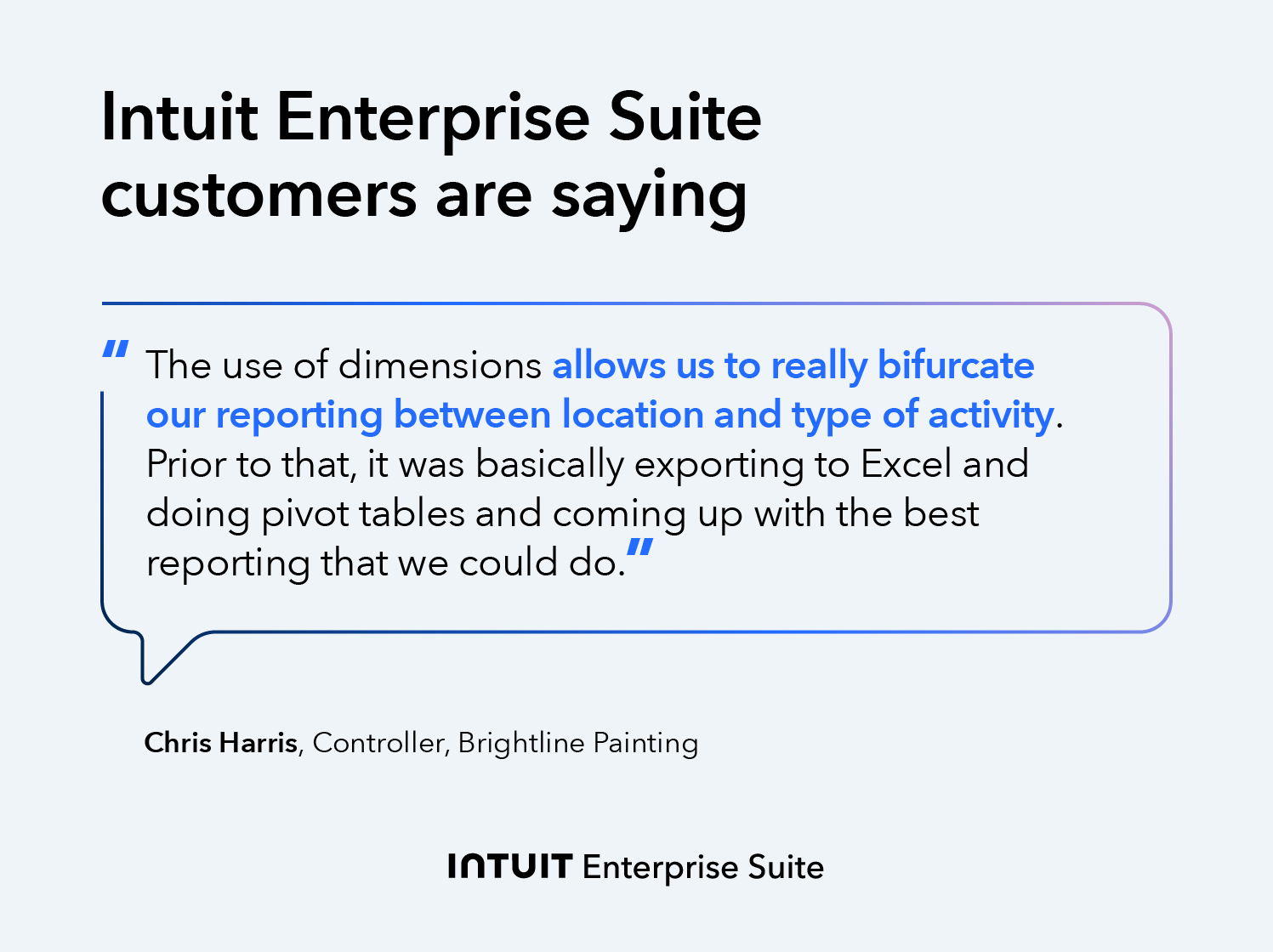
The ability to slice and dice data across multiple dimensions allows you to spot trends and make informed decisions faster. You can then pinpoint the root cause and make immediate, data-driven decisions to fix the problem, such as re-evaluating the pricing model or improving the onboarding experience.
Example: With dimensions, a SaaS company could instantly analyze its churn rate. With multidimensional reporting, a CFO could see if churn is higher among customers who use a specific product feature or if it’s isolated to a particular region or marketing campaign.
Why use multidimensional reporting?
Multidimensional reporting transforms basic financial data into a comprehensive view of your company’s performance. Instead of just seeing a total number for revenue or expenses, you can analyze your finances across multiple dimensions at once.
For example, suppose a SaaS company wants to evaluate the profitability of its new pro subscription plan launched six months ago. In that case, the CFO might be able to find this information in a single report using multidimensional reporting software.
This report would instantly show the plan's overall profitability by breaking it down across key dimensions:
- Region: The report could show that the Pro plan is highly profitable in North America but is underperforming in Europe due to higher marketing costs.
- Customer segment: It could reveal that the plan is generating significant profit from enterprise clients but is barely breaking even with small business customers because of high support costs.
- Marketing channel: The report might also highlight that customers acquired through Google Ads have a lower customer lifetime value (CLV) compared to those from content marketing efforts, allowing the marketing team to reallocate their budget.
By instantly correlating revenue, costs, and customer data across these multiple dimensions, the SaaS company's leadership can make data-driven decisions—like re-focusing their sales efforts on enterprise clients—all from one centralized report.

How AI enhances multidimensional financial management
The biggest bottleneck of multidimensional accounting has always been the manual effort required to categorize transactions, which reduces productivity, reporting accuracy, and overall efficiency. As an AI-native ERP, Intuit Enterprise Suite eliminates that friction by automating the categorization process at scale.
AI-driven capabilities advance the organization by:
- Maintaining consistent financial data: Automatically assigning dimensions during transaction classification ensures entries are coded correctly as they flow into the system, improving reporting accuracy across entities.
- Detecting financial anomalies earlier: Flagging inconsistencies during reconciliation and review helps finance teams catch issues, such as incorrectly coded expenses, before they impact reporting.
- Accelerating financial close: Reducing manual data entry and classification throughout the month streamlines the close process and shortens the record-to-report cycle.
The result is a finance team that spends less time on data policing and more time using multidimensional insights to drive strategy.
Navigate midsize and complex business challenges and opportunities
As your organization expands, so do the complexities of managing financial data. Multidimensional accounting offers a powerful way to navigate these challenges, providing the clarity and insights you need to make informed decisions.
Discover the benefits of ERP and how enterprise financial management software like Intuit Enterprise Suite can integrate with multidimensional accounting to enhance your financial management.
Check out upcoming events and learn more about Intuit Enterprise Suite.

Customer stories

Case Study
How FEFA Financial is growing with Intuit Enterprise Suite—without migrating to an ERP

Case Study
How this mission-driven, employee-owned company created efficiencies with Intuit Enterprise Suite
October 25, 2024

Case Study
Why this camping business chose Intuit Enterprise Suite over NetSuite
October 25, 2024

Case Study
Migrating to Intuit Enterprise Suite took 2 hours (with zero disruption) for this aspiring $50M revenue business
April 25, 2025

Case Study
Humble House Foods case study: How they improved visibility & simplicity using Intuit Enterprise Suite
September 24, 2025